Finite Math Online Course for Academic Credit
Finite Mathematics - DMAT 145 - is a common freshman course for business-oriented students to learn more mathematics for application to their business and economic degrees.
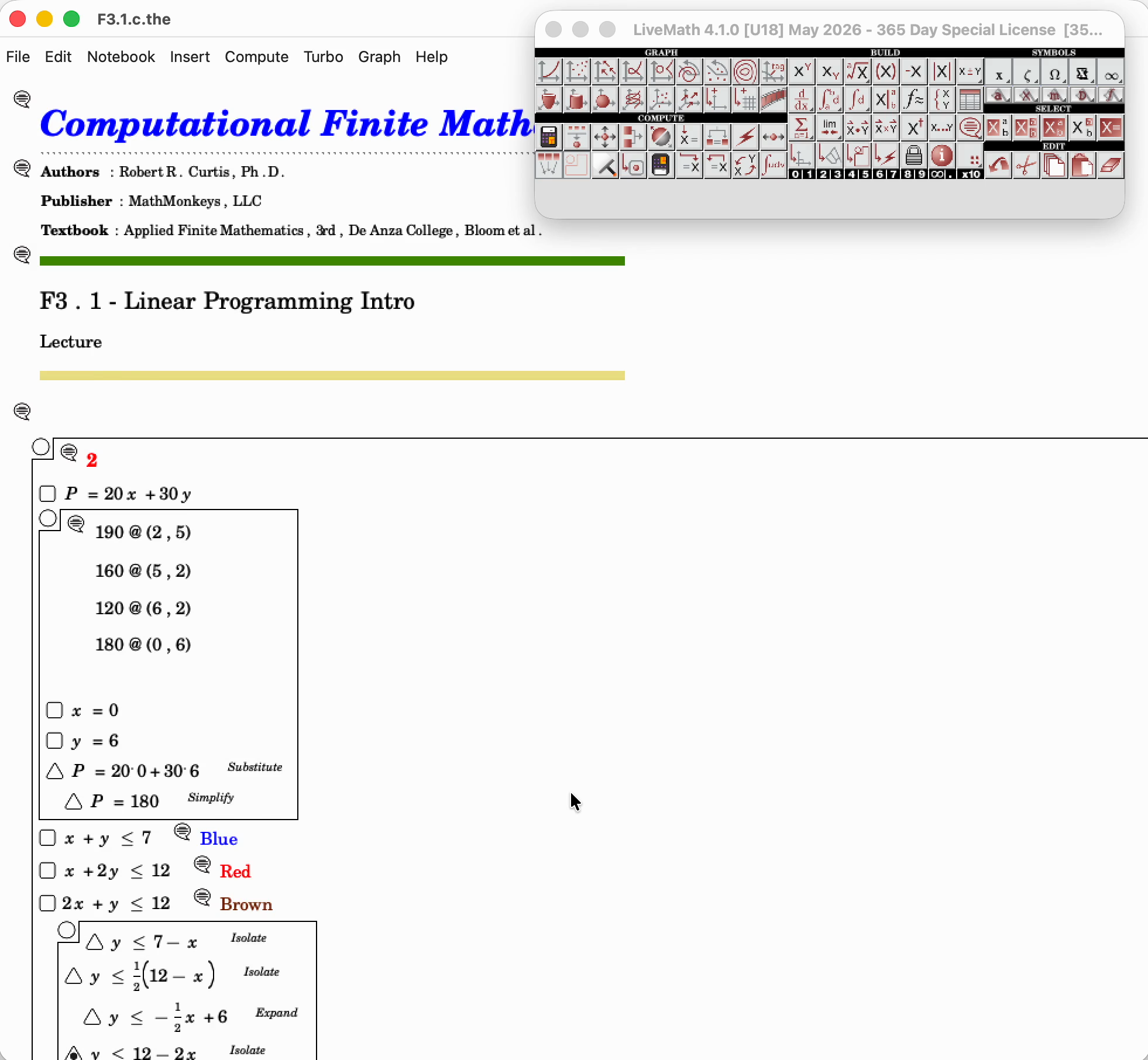
Topics range from solving linear systems via matrix row operations and inverse methods, to formulating and solving linear programs using both geometric and simplex techniques. The course continues into the mathematics of finance, sets and counting, probability, Markov chains, and game theory - each topic explored interactively in the LiveMath software alongside the printed text.
Completion of DMAT 145 - Computational Finite Mathematics - earns 3 academic credit semester hours with an official academic transcript from Roger Williams University, in Providence, Rhode Island, USA, which is regionally accredited by the New England Commission of Higher Education (NECHE), facilitating transfer of credits nationwide to other colleges and universities.
DMAT 145 - Learning Outcomes
- To identify, manipulate, and understand the core concept of functions
- To understand and compute the key components of linear equations
- To understand and compute matrix algebra and systems of linear equations
- To understand and compute the concept of linear programming, and various methods of analysis
- To study topics in Mathematics of Finance
- To understand and compute set notation, analysis, and counting
- To understand and compute the core topics of Probability and Sampling
- To understand and compute with the Conditional Probaiblity formula
- To understand and compute Markov Chains
- To understand and compute the basics of Game Theory
DMAT 145 - Syllabus of Topics
Sample Lecture Videos for Finite Mathematics
The DMAT 145 - Computational Finite Mathematics course uses the LiveMath software to bring linear systems, matrices, linear programming, and the mathematics of finance to life via interactive, computational lectures that accompany the text. Students will learn to read the printed text alongside live, on-screen computations in LiveMath.
There are 30+ videos for the course, spanning many hours of video content for the course lectures.
Distance Calculus Referenced Colleges & Universities (29 Years - 393+ Institutions)
Distance Calculus students have transferred course credits to these colleges and universities:
Distance Calculus - Student Reviews
The only problem with the course is the lack of pen and paper work. This shouldn't come as a crazy surprise with an online course, but there is not much emphasis on symbolic computation. Mathematica or other software does most of the heavy computation for you. The lectures usually show how to solve the problems through paper, but those skills are rarely put into practice. Literacy Sheets act as a way to do some of that (especially with the Calculus II & III course).
All in all, this isn't a huge issue. I just memorize and practice things like double integration, Laplace, ODE solving, matrix diagonalized form, row operations, etc. With a little outside work, this resolves itself. Without Roger WIlliams, I probably would not have been able to take any of these math courses in highschool.
So overall, a great choice for highschool advanced math, especially with transferrable credits.
Probability Theory is required for me to apply to Master's programs in Statistics, so I was glad when I found Distance Calculus. While the course was slightly less difficult than I originally expected, there were parts that definitely slowed me down and made me think. (Also, although calculus is not everywhere in the course, it is everywhere in normal and exponential variables and beyond, so make sure to review derivatives and integrals (single and double)!) I used Mathematica for my software, and it helped speed along calculations and proved to be the perfect stage and tool for this material. I think visual learners will absolutely revel in how the material is presented in this course. (I know I did!) As there is plenty of writing and calculation to do, you have many opportunities to develop and strengthen your voice as a mathematician. The modern format of 80% electronic notebook work and 20% handwritten work is an excellent mixture for studying probability theory and grasping its core ideas. Dr. Curtis is clear in his answers to any questions and concerns you may have and is highly responsive to email and chat, and to responses you leave in your notebooks. He truly wants to help you and to see you succeed, and he is always on your side.
I highly recommend Probability Theory with Distance Calculus!
Dist Calc saved a ton of hassle and time having to take calc at a local community college, which realistically would have delayed my entrance to BU LEAP by at least a year.
Would strongly recommend it.
First, this course uses software called LiveMath. This software can be a little bit challenging to get the hang of, but once you do get the hang of it, it's super easy. Remember that for all new things, it takes a bit to get used to it. Overall, I was highly satisfied with this course. I thought that the instructions were extremely detailed, including a video and a textbook explaining every different concept. In addition, this course offered exposure to a lot of different aspects of finite math. I think that many would agree with me on the following, that, you know, when a teacher is passionate about what they are teaching, it is so much more enjoyable, and you can definitely see that in this course. This course can be challenging at times. Maybe it'll be easy for you, maybe it'll be hard, but I think it's important to remember that the things that challenge us are, you know, the things that make us learn and the things that make us better. There's also a math chat option for if you need help or if you have any questions. Overall, I would recommend this course. I actually initially went into this course looking for an easy course to just help me get the credit requirements, but it ended up being an amazing learning experience and completely shifted my perspective on math overall. And another thing that I thought was great in this course is throughout so many different lectures, the professor would explain how each different thing can be applicable in life. And I think that, you know, that is a lot of what people think about when they are learning something. They're like, will I ever use this? Do I need to learn this? And a lot of this actually is really applicable. And I think that even if, you know, you may not be doing these math equations in your future, I think that, you know, the psychology behind these and the rules can be applied to so many different fuacets of life.







More Details
- How Our Courses Work
- About the Mastery Learning Format
- Asynchronous & Self-Paced
- Computer & Software Requirements
- Maximum Course Time (1 Year)
- Completion Time Estimates
- Academics
- Course Prerequisites
- Course Syllabi
- Grading Policy
- University Accreditation (NECHE)
- Course Articulation/Transfer
- How Exams Work
- Explore
- Honors Course Track
- Student Reviews
- Introductory Videos
- Who Can Enroll?
Frequent Questions
- Enrollment
- When Can I Enroll?
- When Can I Start My Course?
- Term Dates: Enroll Anytime!
- Costs & Tuition
- Credits & Transcripts
- Will My Credits Transfer?
- Letters of Recommendation
- Is My College On Your Transfer List?
- Other Questions
- Frequently Asked Questions
- Is This the Same as AP Calculus?
- Are These Computer-Based Courses?
- Are These Online Courses?
- Financial Aid?