Applied Calculus Online Course for Academic Credit
"Applied Calculus" - DMAT 203 - Applied Calculus - is best described as a "single college-level course in differential and integral calculus". This type of single-semester course has many equivalent names:
- Applied Calculus
- Business Calculus
- Survey of Calculus
- Liberal Arts Calculus
- Calculus for Management or Social Science or ...
- Calculus for Biology
Completion of DMAT 201 - Calculus for Business earns 3 academic credit semester hours with an official academic transcript from Roger Williams University, in Providence, Rhode Island, USA, which is regionally accredited by the New England Commission of Higher Education (NECHE), facilitating transfer of credits nationwide to other colleges and universities.
DMAT 201 - Calculus for Business is offered in the Fall, Winter, Spring, and Summer semesters with "revolving enrollment", which means you may enroll at any time, and start your course whenever you wish, independent of the traditional academic calendar.
Applied Calculus Course Information Videos
Different Names for Applied Calculus
- Applied Calculus
- Business Calculus
- Survey of Calculus
- Liberal Arts Calculus
- Calculus for Management or Social Science or ...
- Calculus for Biology
- Calculus for Life Sciences
- Brief Calculus
Lower Applied Calculus vs. Higher Engineering STEM Calculus I
Both Applied Calculus and (Engineering) Calculus I provide an introduction to differential and integral calculus.
Applied Calculus provides a lighter, more general introduction to the introductory topics of Calculus, while the higher Calculus I course expects students to have strong fundamentals the limit definition, definition of continuity, derivatives of functions, integrals, and applications of calculus to more difficult and challenging problem sets, in preparation for continuation to the higher Calculus II course in the first year Calculus sequence. Applied Calculus is "a notch or two easier" than the Engineering Calculus I course
Applied Calculus does not include nor require trigonometry. High School Algebra II is sufficient prerequisite for Applied Calculus, while the higher Calculus I course requires College Algebra, Trigonometry, and/or Precalculus.
The main topical differences between the lower Applied Calculus and the higher (Engineering) Calculus I course are described in the table below.
The Applied Calculus course does include more applications to business, finance, economics, etc. than does the Engineering Calculus course.
DMAT 203 - Learning Outcomes
- To identify, manipulate, and understand the algebraic, numerical, and graphical fundamentals of linear, polynomial, exponential, logarithmic, and rational polynomial functions
- To understand and compute numerical, and graphical limits at finite and infinite values
- To understand and compute the fundamental concept of the derivative
- To understand and compute various measurements of growth of a function
- To algebraically compute derivatives of common functions using summation, product, quotient, and chain rules for derivatives
- To understand and compute optimization of functions using derivatives, finding critical values
- To understand and compute the second derivative
- To understand and calculate numerically and graphically the core concepts of the integral for applications to signed area measurements
- To compute numerically, algebraically, and graphically integrals of a variety of functions
- To algebraically compute integrals of basic polynomial and exponential functions, with an introduction to the algebraic substitution technique
- To use the tools of differential and integral calculus in various applications in business and finance
- To understand and compute the Fundamental Theorem of Calculus
- To understand and compute partial derivatives of multivariable functions, to begin study of optimization in higher dimensions
- To utilize computer algebra and graphing software to amplify traditional manual computation techniques
DMAT 203 - Syllabus of Topics
Nearly all collegiate students have completed "high school algebra". There is no mathematics placement exam. The Applied Calculus course starts with a very thorough "warm up" module on the important topics of high school algebra, with the added usage of the LiveMath software, which makes for an excellent "refresher" for student who have maybe be away from academic mathematics for some time.
Will Applied Calculus Suffice For Your Program?
The keywords to look for in your academic program's description is
Academic programs that usually will accept the lower Applied Calculus course include:
- MBA & Business Schools
Many MBA & EMBA programs accept Applied Calculus to satisfy their calculus course requirement. - Pharmacy, Nursing, or Pre-Med Schools
- Architecture
- Baccelaureate General Education Requirements
- Other Graduate School Programs
- Primary/Secondary Education Teacher Certification
Academic programs that usually require the higher (Engineering) Calculus I course include:
- Science Majors
Physics, Mathematics, Engineering, Computer Science, Chemistry - Economics Majors/Degrees
Programs in Economics tend to be more mathematically oriented, and usually require Calculus I and beyond - Special Military Training
Advanced military training programs, such as Test Pilot School, usually the higher Calculus I course
Transferring Credits vs. Satisfying Program Prerequisites
Many of our Applied Calculus students are seeking to satisfy the prerequisites for a graduate program of study, which is distinctly different than planning to transfer academic credits to a home institution. Some of the differences include:
- Prerequisite Satisfaction: Minimal Grade
Students using the Applied Calculus course to satisfy a prerequisite in another academic program will be required to achieve a minimal grade. For some programs the minimal required grade is a "B", and for others a "C" grade will suffice. - Prerequisite Satisfaction: Course Approval
For Prerequisite Satisfaction, often only the graduate program (usually an admissions officer) must give approval for usage of the Distance Calculus course. For transferring of academic credits, often others, such as the Registrar, must also give approval to transferring credits. - Transferring Credits: Grades May or May Not Transfer
When Transferring Credits, many institutions will accept the academic credits in transfer, but not the letter grade earned. In these cases, earning an "A" in the course is no different than earning a "B" or a "C". Often this type of situation gives the student guidance on which Grade Path to choose for Distance Calculus.
In either case, it is important to check with your graduate program to make sure the Applied Calculus course will satisfy their prerequisite requirements, and to make sure the Distance Calculus course is acceptable to them.
Applied Calculus Course Content & Syllabus
The Applied Calculus course provides a general (and lighter) introduction to beginning calculus.
- Intensive Algebra Refresher
Applied Calculus starts with an intensive 20 assignment refresher of high school Algebra I/II, starting from scratch with solving basic equations, ranging then to functions, linear equations, polynomials, and then exponential and logarithmic functions. This refresher aids students who have been away from academics for a while, as well as students with weaker mathematical backgrounds. For students with stronger math backgrounds, this refresher can be completed very quickly, and provides an excellent platform on which to learn the computer algebra software. - Introduction to Differential Calculus
Applied Calculus begins with investigating the phenomena of growth of the various types of functions, culminating with the derivative as a measurement of growth. Algebraic rules for computing derivatives of functions are explored and utilized. Applications of the derivative to "max/min" problems are the final set of topics in the study of differential calculus. - Introduction to Integral Calculus
Applied Calculus studies the connection between integrals as measurement of signed area of regions defined by function curves, concentrating on the graphical and numerical aspects of integrals. Algebraic methods for computing basic integrals, followed by the introduction of the Fundamental Theorem of Calculus, conclude the course. - Application of Calculus
Applied Calculus is less about "rigourous calculus development" and more about learning various topics to study with the tools of Calculus - mathematical models involving calculus: applications of calculus in finance, applications of calculus in computing area and volume, applications of calculus in physics, applications of calculus in epidemiology. This Applied Calculus course is not "applied" in the sense of only being about these applications, but there are many problem sets about such applications so students learn working knowledge of how calculus is applied in many disciplines.
Applied Calculus - Academic Caveats
Some issues to consider when determining if Applied Calculus is for you.
- Terminal Course
Applied Calculus does not lead to the higher Calculus sequence, and is not equivalent to the higher Calculus I course. Applied Calculus is usually the last math course a student takes as an undergraduate. - No Trigonometry
Applied Calculus does not include nor require Trigonometry. If your academic program requires a calculus course that includes trigonometry, you need to take the Calculus I course instead. - No Multivariable Calculus
Applied Calculus does not branch into the multivariable calculus topics - required by some majors/programs, especially Economics. If you need Multivariable/3D Calculus topics, you'll need to go through the higher Calculus I/II + Multivariable Calculus sequence.
Applied Calculus Student Academic Goals
One way to determine if Applied Calculus is the right course for you is to align yourself with examples of student profiles we usually encounter.
- Prepare for MBA or Other Graduate Program
Many graduate programs, such as MBA's, have prerequisites that include "a single college-level Calculus course". The majority of our Applied Calculus students are seeking to satisfy such prerequisite requirements prior to starting their graduate school program. Our MBA-bound students tend to be highly-focused, goal-oriented students who complete their course work under very tight deadlines. - Pharmacy, Nursing, Pre-Med
Often these academic and training programs require "a single college-level Calculus course" as a prerequisite. Many students in these programs have strong mathematical skills, which aid them in completing the Applied Calculus course quickly. Some students in this category do have weaker mathematical backgrounds, requiring more time to achieve mastery and success in the Applied Calculus course. - General Education Requirement
Many students have "one more class" to finish to earn their baccelaureate degree, and Applied Calculus fits the bill for them.
Warning: Many colleges/universities have a senior residency requirement where the last set of credits (usually 20-30 credits) must be completed at the college/university granting the degree, and cannot be "transferred in" from another school. Make sure you check with your college/university about such rules. - Teacher Re-Certification
Primary and secondary educators often are required to take courses for their certification and/or re-certification programs.
Warning: Distance Calculus courses do not carry graduate-level credits. Some recertification programs require their teachers to complete graduate level credits. Calculus courses are inherently undergraduate-level courses.
Calculus for Business Learning Outcomes
- To identify, manipulate, and understand the algebraic, numerical, and graphical fundamentals of linear, polynomial, exponential, logarithmic, and rational polynomial functions
- To understand and compute numerical, and graphical limits at finite and infinite values
- To understand and compute the fundamental concept of the derivative
- To understand and compute various measurements of growth of a function
- To algebraically compute derivatives of common functions using summation, product, quotient, and chain rules for derivatives
- To understand and compute optimization of functions using derivatives, finding critical values
- To understand and compute the second derivative
- To understand and calculate numerically and graphically the core concepts of the integral for applications to signed area measurements;
- To compute numerically, algebraically, and graphically integrals of a variety of functions;
- To algebraically compute integrals of basic polynomial and exponential functions, with an introduction to the algebraic substitution technique;
- To use the tools of differential and integral calculus in various applications in business and finance
- To understand and compute the Fundamental Theorem of Calculus
- To understand and compute partial derivatives of multivariable functions, to begin study of optimization in higher dimensions.
- To utilize computer algebra and graphing software to amplify traditional manual computation techniques.
Applied Calculus Example Student Profiles
Case 1: MBA-Bound Student Needs Applied Calculus
Sally just got her acceptance letter from her MBA graduate school, but with notification that she needs to finish "a single collegiate-level differential and integral calculus course" by the start of MBA courses.How fast can Sally finish the DMAT 201 - Applied Calculus course?
MBA students tend to be highly-motivated and deadline-centered students, ready to "do what it takes" to get finished by the required date. Here are some scenarios for Sally:
Time commitments are important for success in an online Applied Calculus course for college credit from Distance Calculus. There are no fixed due dates in the Distance Calculus online courses, so it is important that students instead set their schedules for a dedicated amount of time towards the coursework.
It is also very important to consider that going faster through a course is DIRECTLY DEPENDENT upon your math skill level, and your successful engagement of the course. We require that you complete the course in a Mastery Learning format. If you are struggling with the course content, or trying to go too fast where the quality of your submitted work is suffering, then the instructors will force a slow-down of your progress through the course, even if you have fixed deadlines.
Case 2: Pharmacy Student Needs Applied Calculus
Marc is planning to go to Pharmacy School in a few months, and needs to finish the Applied Calculus course prior to the start of school. Marc has been away from academic mathematics for many years, and does not have a strong mathematics background, but makes up for such weaknesses with drive, energy, and dedication to achieving his goals.How fast can Marc finish the DMAT 201 - Applied Calculus course?
Marc will need to plan for extra time, especially at the beginning of the course, to get back into the swing of academic mathematics. The high school algebra review portion of the course (20 assignments) will be time well spent for Marc, as he revisits topics from high school that previously he did not have much success with. Marc is able to dedicate himself to the task, and is able to move more quickly through the Calculus curriculum (50 assignments). Here are some scenarios for Marc:
Case 3: Working Parent Planning for Graduate Studies Needs Applied Calculus
Amelia is a parent of three children who also works full-time. Amelia has ambitious plans to return to graduate school in the next year to advance her career. Amelia cannot take a traditional classroom math course due to her schedule constraints.How fast can Amelia finish the DMAT 201 - Applied Calculus course?
We have many students like Amelia who are quite successful in Distance Calculus!
Amelia will probably do her math homework after her kids are asleep for the night, in the 10pm-midnight timeframe. The Mastery Learning format for Distance Calculus serves Amelia well, where she is able to spend extra time on those topics that are more challenging for her, without penalty or "falling behind" as she would in a traditional course.
When the children get sick and stay home from school, or life and work commands extra time, Amelia is able to take a break from Distance Calculus - usually for a few weeks, but perhaps for a few months, if needed - and return to her studies when her schedule permits. While such breaks do cause slower completion times, and "getting back in the swing of things" does require extra time and effort for Amelia, the flexibility of the asynchronous course format allows Amelia to finish the course when she can.
Case 4: 18-22 Year Old Student With Full Course Load Needs To Finish Applied Calculus
James is an undergraduate student at a university, carrying 15 semester credits - a full course load. James wants to add the Applied Calculus course to his course schedule, in order to complete a general education requirement.What are the challenges that James will face with this plan?
In our experience, when a student is faced with "too many courses" at the same time, it is the asynchronous distance course that almost always is the course to suffer a lack of attention. With other synchronous course deadlines and examinations, it is natural that an asynchronous course such as Distance Calculus becomes the "pressure valve".
Students in these situations nearly always finish their Distance Calculus course during the winter break (December, January), spring vacation (April), and/or the summer vacation months (May-August). Even with the best of intensions, it is very difficult to complete a Distance Calculus course while taking 4 or 5 other courses simultaneously.
Younger students also have more difficulty with the flexible schedule of Distance Calculus. It is very easy to put off your course work "until all day Saturday" or "next week after my Philosophy exam", which snowballs into a huge amount of work leftover to an increasingly short amount of time. Planning for vacation times is the best approach for students in this category.
Distance Calculus Referenced Colleges & Universities (29 Years - 393+ Institutions)
Distance Calculus students have transferred course credits to these colleges and universities:
Applied Calculus: Academics
80% Computer Algebra, 20% Pencil/Paper, 0% Multiple Choice
Through the usage of a computer algebra system like LiveMath™ - you will never miss a minus sign again!
Although the driving of a computer algebra system requires some up-front time to learn and master, once completed (rather quickly for most students), the time saved from having to be a "minus sign accountant" adds to the productivity of your study time. If you have ever spent hours looking for that "little numerical error", you know what we mean.
Command of a computer algebra software system is a modern-day necessity of mathematical academics. It is important, however, to retain a meaningful command of paper/pen/pencil manual computations as well. Our blend of curriculum strives for an 80%/20% split between computer algebra usage and manual computation and written skills. With each module in our curriculum, a concluding Literacy Sheet assignment ensures that each student has written mathematical competency in the subject area.
The proctored final exam is a written exam away from the computer. It is these Literacy Sheet assignments, and the continuing bridge from modern computer algebra software back to classical, manual mathematics that prepares the student for this written final exam.
We do not have any multiple-choice work. We are a real collegiate-level course program - not a "canned" set of multiple-choice question sheets which are common from large publishers and degree-mill schools.
Applied Calculus Example Curriculum
Videotext - A Modern Replacement of the Textbook
What is a videotext? …course materials are a combination of computer algebra notebooks, video presentation, screen video presentations, PDF “literacy sheets” to be completed by hand.
Example Videos are in MP4/H.264 format, which play in most modern browsers without additional software.
Applied Calculus Screencast Video Questions
One extremely powerful aspect of the Distance Calculus course technologies is the usage of screencast video (and audio) recordings made by the students and the instructors, exchanged just as easily as emails back and forth.
If a picture is worth a thousand words, then a screencast movie is worth a million words - and saves boatloads of time and effort.
Instead of trying to type out a math question about a particular topic or homework question, the ease of "turning on the screen recorder" and talking and showing your question - in the span of a few minutes - can save hours of time trying to convert your question into a typed (and coherent) narrative question.
Example Instructor Question/Answer Movies
Applied Calculus Example Student Work and Grading
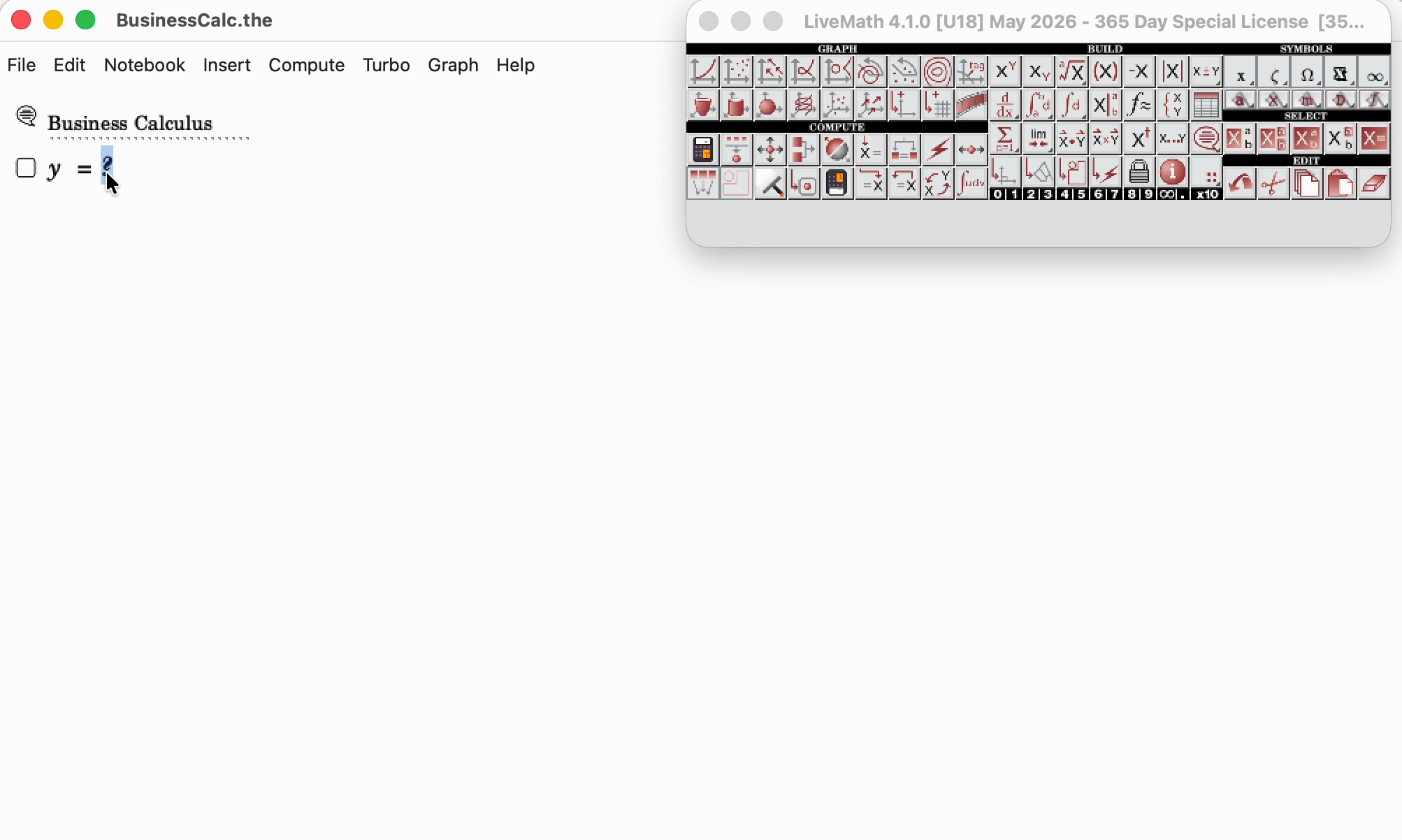
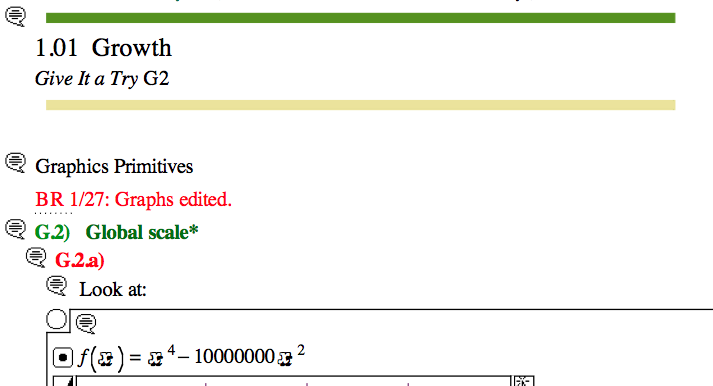
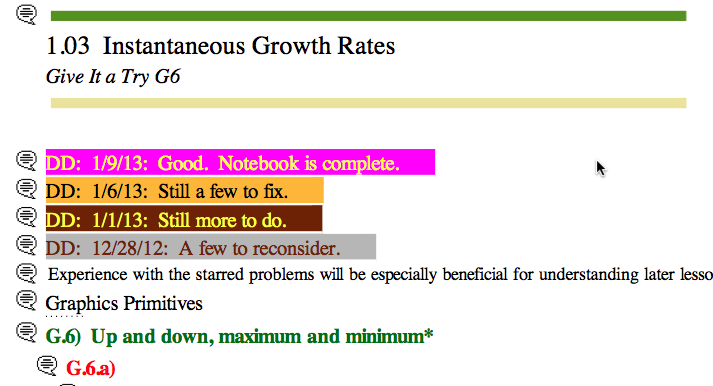
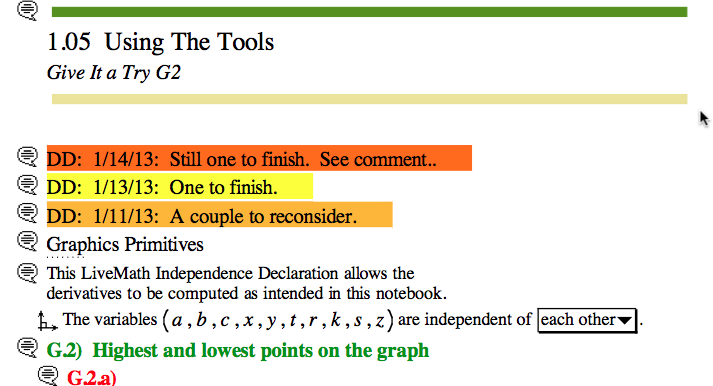
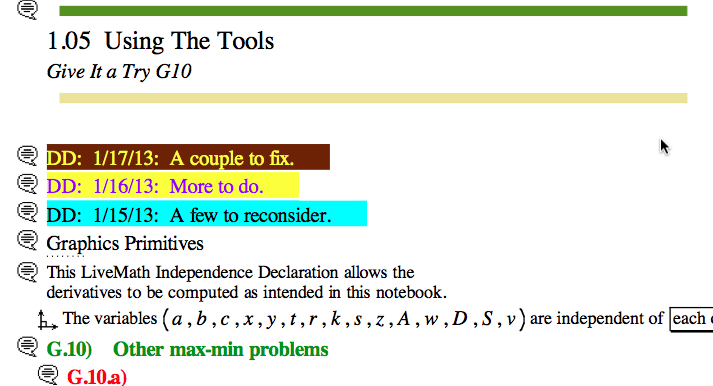
Course work occurs via LiveMath notebooks - interactive documents for mathematical computation. Students submit notebooks, instructors grade and give feedback, and notebooks go back and forth until mastery is achieved (typically 2-5 revisions).
Distance Calculus - Student Reviews
Dist Calc saved a ton of hassle and time having to take calc at a local community college, which realistically would have delayed my entrance to BU LEAP by at least a year.
Would strongly recommend it.
First, this course uses software called LiveMath. This software can be a little bit challenging to get the hang of, but once you do get the hang of it, it's super easy. Remember that for all new things, it takes a bit to get used to it. Overall, I was highly satisfied with this course. I thought that the instructions were extremely detailed, including a video and a textbook explaining every different concept. In addition, this course offered exposure to a lot of different aspects of finite math. I think that many would agree with me on the following, that, you know, when a teacher is passionate about what they are teaching, it is so much more enjoyable, and you can definitely see that in this course. This course can be challenging at times. Maybe it'll be easy for you, maybe it'll be hard, but I think it's important to remember that the things that challenge us are, you know, the things that make us learn and the things that make us better. There's also a math chat option for if you need help or if you have any questions. Overall, I would recommend this course. I actually initially went into this course looking for an easy course to just help me get the credit requirements, but it ended up being an amazing learning experience and completely shifted my perspective on math overall. And another thing that I thought was great in this course is throughout so many different lectures, the professor would explain how each different thing can be applicable in life. And I think that, you know, that is a lot of what people think about when they are learning something. They're like, will I ever use this? Do I need to learn this? And a lot of this actually is really applicable. And I think that even if, you know, you may not be doing these math equations in your future, I think that, you know, the psychology behind these and the rules can be applied to so many different fuacets of life.
The only problem with the course is the lack of pen and paper work. This shouldn't come as a crazy surprise with an online course, but there is not much emphasis on symbolic computation. Mathematica or other software does most of the heavy computation for you. The lectures usually show how to solve the problems through paper, but those skills are rarely put into practice. Literacy Sheets act as a way to do some of that (especially with the Calculus II & III course).
All in all, this isn't a huge issue. I just memorize and practice things like double integration, Laplace, ODE solving, matrix diagonalized form, row operations, etc. With a little outside work, this resolves itself. Without Roger WIlliams, I probably would not have been able to take any of these math courses in highschool.
So overall, a great choice for highschool advanced math, especially with transferrable credits.







More Details
- How Our Courses Work
- About the Mastery Learning Format
- Asynchronous & Self-Paced
- Computer & Software Requirements
- Maximum Course Time (1 Year)
- Completion Time Estimates
- Academics
- Course Prerequisites
- Course Syllabi
- Grading Policy
- University Accreditation (NECHE)
- Course Articulation/Transfer
- How Exams Work
- Explore
- Honors Course Track
- Student Reviews
- Introductory Videos
- Who Can Enroll?
Frequent Questions
- Enrollment
- When Can I Enroll?
- When Can I Start My Course?
- Term Dates: Enroll Anytime!
- Costs & Tuition
- Credits & Transcripts
- Will My Credits Transfer?
- Letters of Recommendation
- Is My College On Your Transfer List?
- Other Questions
- Frequently Asked Questions
- Is This the Same as AP Calculus?
- Are These Computer-Based Courses?
- Are These Online Courses?
- Financial Aid?
Frequently Asked Questions
Is Applied Calculus The Same As Business Calculus
Yes, Applied Calculus, Business Calculus, Survey of Calculus - all are different names for the same level of "lower calculus", in the sense of being lower than the Engineering Calculus I course.
Is Applied Calculus Easier Than Calculus I?
Yes, Applied Calculus is certainly easier than the Engineering Calculus I course, although the topics look similar when you look at a syllabus of both courses.
Is Applied Calculus from Distance Calculus Accredited?
Yes, All Distance Calculus courses are offered through Roger Williams University in Providence, Rhode Island, USA, which is regionally accredited (the highest accreditation) through New England Commission of Higher Education (NECHE).
Do MBA Students Usually Take Applied Calculus?
Yes, the majority of our Applied Calculus students are either enrolled or applying to an MBA program
Can I Take Applied Calculus Without Having Trigonometry?
Yes, the prerequisite for Applied Calculus is Algebra II from high school, which most university students have taken already. Trigonometry is not part of the prerequisite for Applied Calculus