Honors Differential Equations Online Course for Academic Credit
Honors Differential Equations can be best described as "Higher-Level Integration Theory" at the Honors course level. The simplest Differential Equations have solutions that are simple Integrals as you learned in Calculus II. But very quickly the Differential Equations become more complicated, and so, too, are the solutions.
Physicists think of Differential Equations as the equations that get spit out from their analysis of the various physics situations, and thus need to be solved to understand the physics. Unfortunately, most Differential Equations cannot be solved algebraically, but the main focus of classroom/textbook courses is usually to just try to exhaust all of the Differential Equations that can be solved by hand.
Our Honors Differential Equations online course via Distance Calculus @ Roger Williams University takes a different approach: what do these differential equations mean? What do their solutions mean? What do their graphical or numerical solutions mean? Using a power tool like Mathematica, we are not bound by just those differential equations that have hand-calculated solutions, but rather all differential equations are fair game, and we investigate the concepts of Differential Equations from a laboratory-science point of view.
The first course in a study of Differential Equations is often called Ordinary Differential Equations; other names for this course include:
- Introductory Differential Equations
- Ordinary Differential Equations
- A First Course in Differential Equations
- Single-Variable Differential Equations
Nationally, "Honors" courses usually are centered on a mathematically rigorous development of the concepts of calculus, bringing many advanced topics from upper division courses such as Advanced Calculus and Real Analysis into the freshman honors calculus courses. While this may be a worthwhile approach for students who seek to become mathematics majors, it creates, for many students, an inflated level of course difficulty of questionable benefit to related fields of study.
Our approach to Honors courses is built upon a distinctly different educational philosophy:
- Freshman & Sophomore Calculus is NOT the correct math level to increase rigor
We believe that mathematical rigor is learned after exposure to the calculus, in the upper division, after some time and maturing of mathematical thought is allowed to organically develop. No student ever understood the concept of a derivative because the natural numbers were first axiomatically developed. - Honors means DEEPER, not just HARDER
In mathematics, the potential for making any course harder is a rather simple proposition. Work SMARTER, not HARDER mandates that an honors course should not be more difficult just to say it is. A true honors student wants to go deeper into the topics, not flirt with academic demoralization via some mathematical bootcamp experience. - Technical Writing Curriculum
While axiomatic development has its place in upper division math, core improvement of technical writing skills will benefit all students in all disciplines with immediate effect. If calculus is supposed to be mathematical preparation for science, technology, and engineering related fields, then development of technical writing skills should be as important as computational prowess. - Course Term Paper
Each Honors course student will write a 10-20 page term paper on a topic chosen in collaboration with the course instructor, empowering the student to simultaneously improve technical writing skills and deepen knowledge in the student's chosen academic field via a uniquely creative exercise that will transcend the traditional course boundaries.
In summary, our Honors courses go deeper and broader in the curriculum, offer a notch more challenging course work set, and featuring a technical writing curriculum that truly prepares the student for further academics in the sciences.
Completion of DMAT 322 - HONORS Computational Differential Equations earns 4 academic credit semester hours with an official academic transcript from Roger Williams University, in Providence, Rhode Island, USA, which is regionally accredited by the New England Commission of Higher Education (NECHE), facilitating transfer of credits nationwide to other colleges and universities.
Differential Equations Online Course Introductory Videos
Differential Equations Online Course Introduction
Differential Equations can be thought of as "the task of integration, with (more and more) complications".
Simple algebraic integration of a function f(x) can be re-interpreted in terms of this integral being the solution of a differential equation y' = f(x), and our task is to solve for y - as integration is the "inverse" operation of differentiation, we see that y is the algebraic integral of f(x).
The equation y' = f(x) is the most basic differential equation possible. Quickly we are lead to investigate more complicated forms of equations involving differentiation, for example: y' = y + f(x), which asks: find a function y = y(x) which has the property that its derivative y' is equal to itself y added to a function f(x). Not an easy question before starting the Differential Equations course, but upon completion of this course, such questions - and exponentially more difficult and complex such equations - are answered with skill and understanding.
More than just an "algebraic game involving integrals", the topic of Differential Equations studies not only the algebraic solutions of such equations (when possible!), but also the qualitative understanding of the properties and solutions of these equations.
Traditional Differential Equations courses often are dedicated to learning these "expanded integration techniques" to study the solutions of these equations purely from an algebraic point of view. While this approach has its merits, the types of differential equations encountered "in the real world" (i.e physics, chemistry, engineering, etc) require solution and analysis techniques beyond what is possible via algebra alone.
The course curriculum for our Honors Differential Equations online course is based directly on Differential Equations & Mathematica by Carpenter/Davis/Uhl - part of the Calculus & Mathematica courseware series - and uses Mathematica by Wolfram Research as the computer algebra and graphing system. Engaging the algebraic investigations only briefly, the curriculum moves quickly to investigating the much richer concepts accessible via Mathematica's numerical and graphical differential equation solvers, opening up the introductory study of differential equations far beyond the traditional textbook on the subject.
A Laboratory Approach to Differential Equations
Most classroom Differential Equations courses follow a "cookbook recipe" approach: here is how you solve this kind of equation, here is how you solve that kind. Memorize the procedures, run them on exam day. That has merits, but it leaves out something essential about the subject.
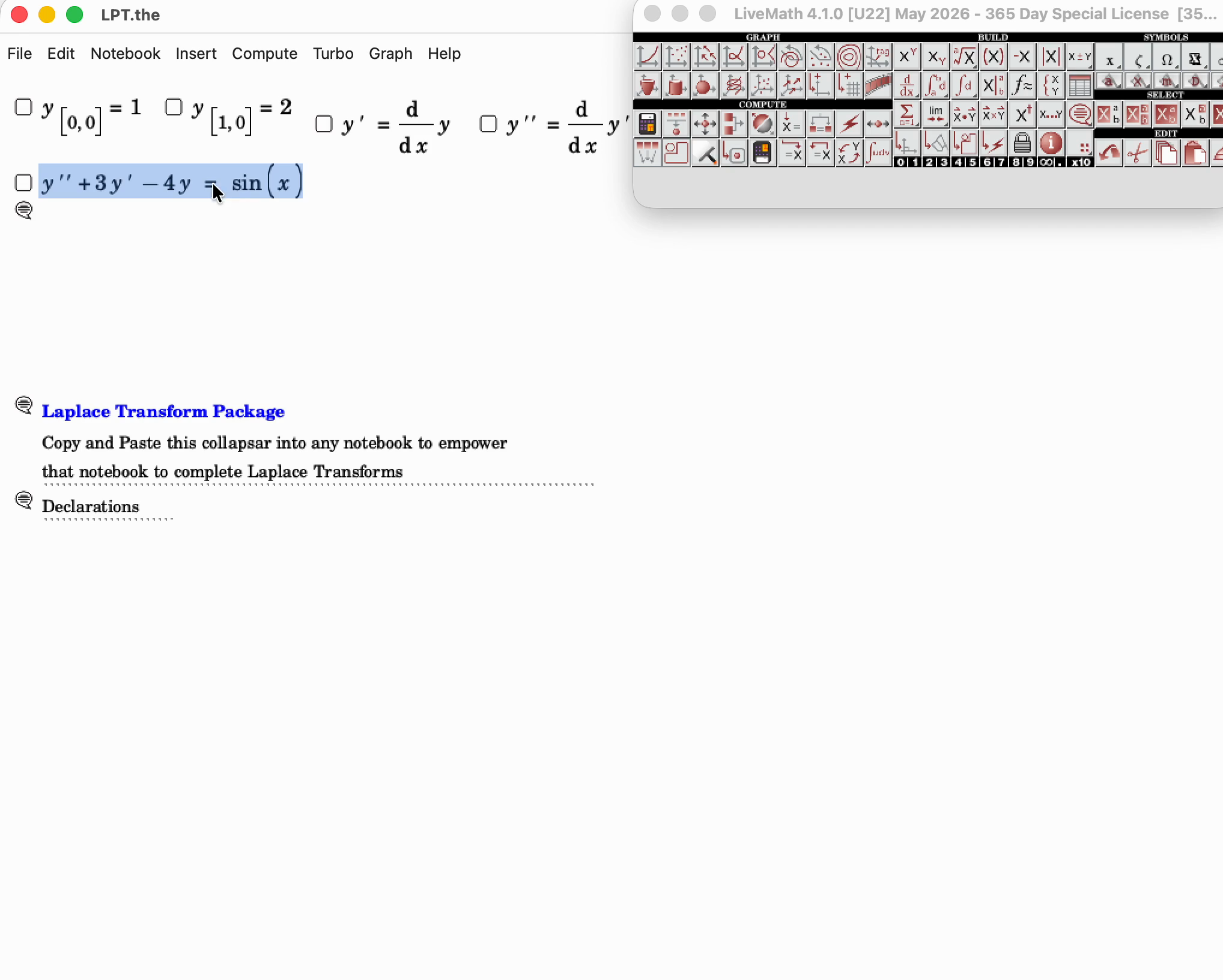
Honors DMAT 322 is built differently. Using Mathematica as our laboratory tool, the course feels like working in a real laboratory - the way a biology student uses a microscope, or a chemistry student uses beakers and reagents. Mathematica is the instrument; differential equations are the specimens. You solve them algebraically when possible, then look at the solutions numerically and graphically to understand the nature of the equation, not just its formula.
Three Perspectives: Algebraic, Numerical, Graphical
Most differential equations textbooks dwell almost entirely on the algebraic side. Our course explores three perspectives in parallel:
- Algebraic - When a closed-form algebraic solution exists, we find it and work with it.
- Numerical - When algebra fails, numerical solvers approximate the solutions to any precision.
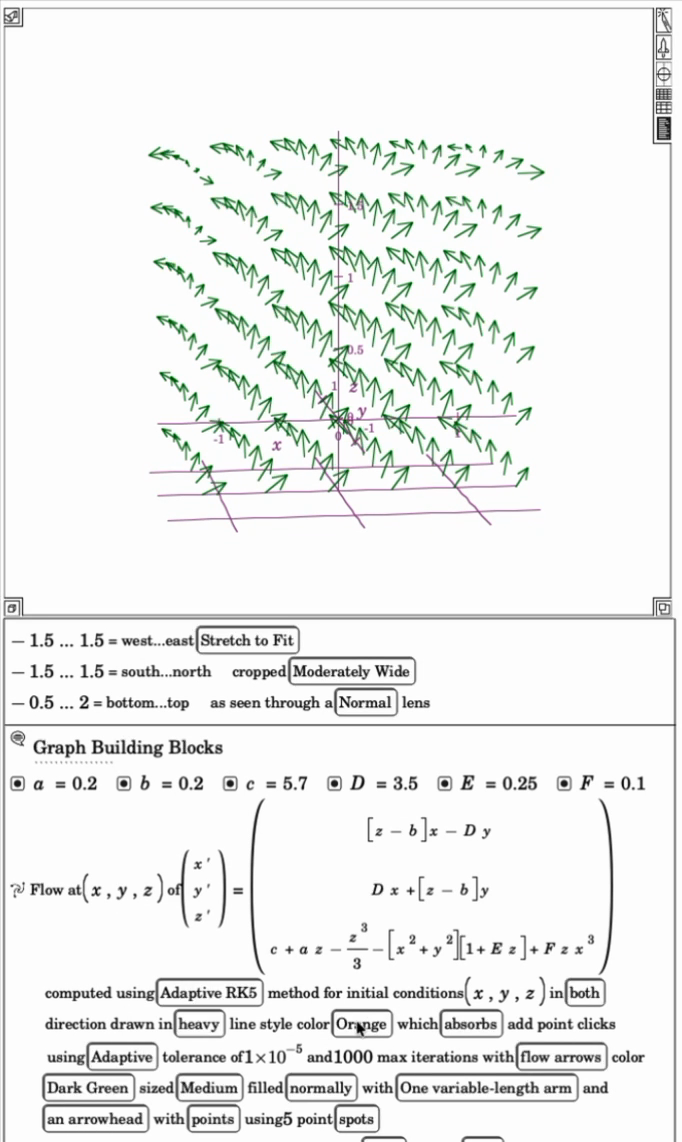
- Graphical - Phase plots, slope fields, flow plots, and 3D visualizations show the behavior of solutions even when no formula is available.
The result: we are not restricted to those differential equations that happen to have hand-solvable forms. The differential equations that engineers, physicists, and scientists encounter in the real world rarely fit those neat algebraic boxes. With numerical and graphical tools at hand, we can study them anyway.
What You'll Cover in DMAT 322
The course progresses through the standard catalog of differential-equation types and techniques, at honors depth:
- First-order linear differential equations
- Second-order linear differential equations
- Higher-order linear differential equations
- Nonlinear differential equations
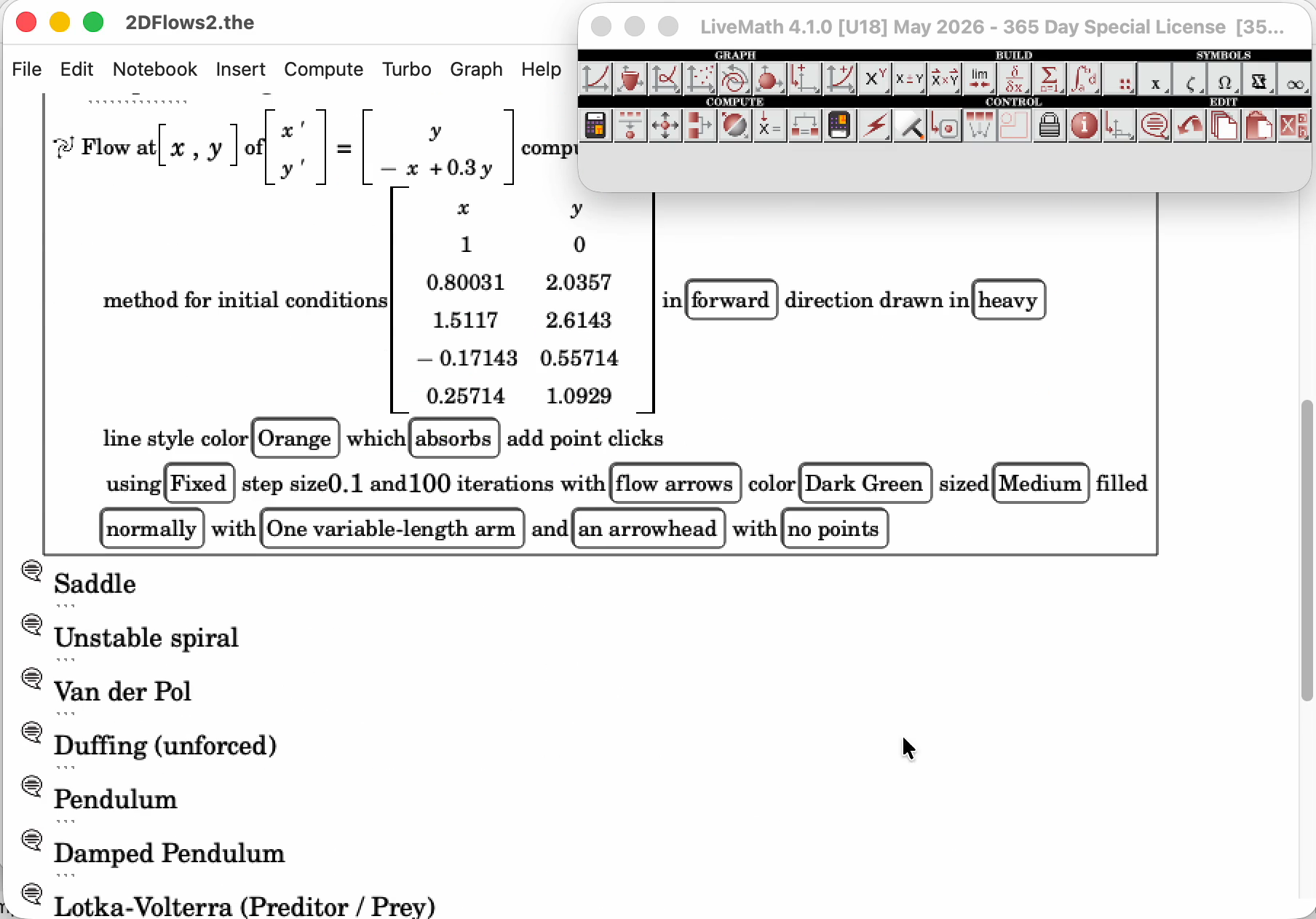
- Systems of differential equations in 2D - phase plane and flow plots
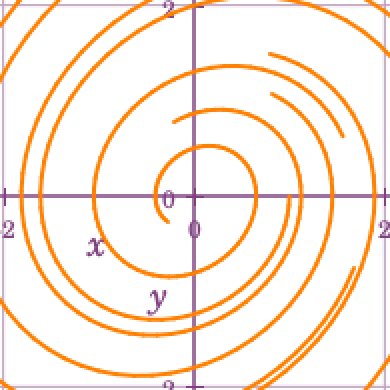
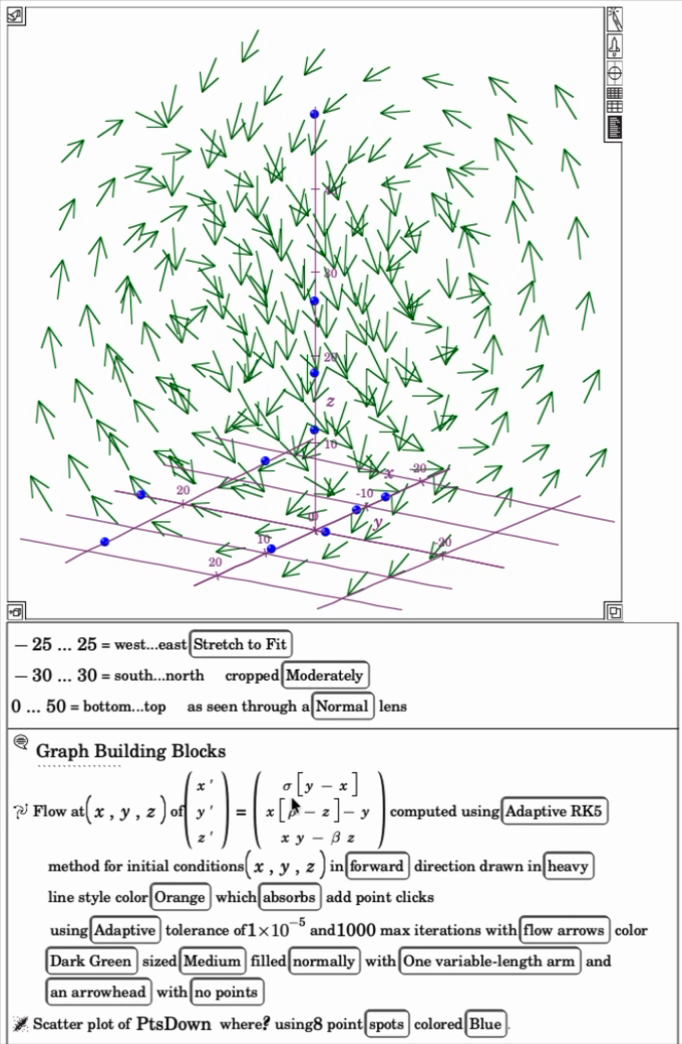
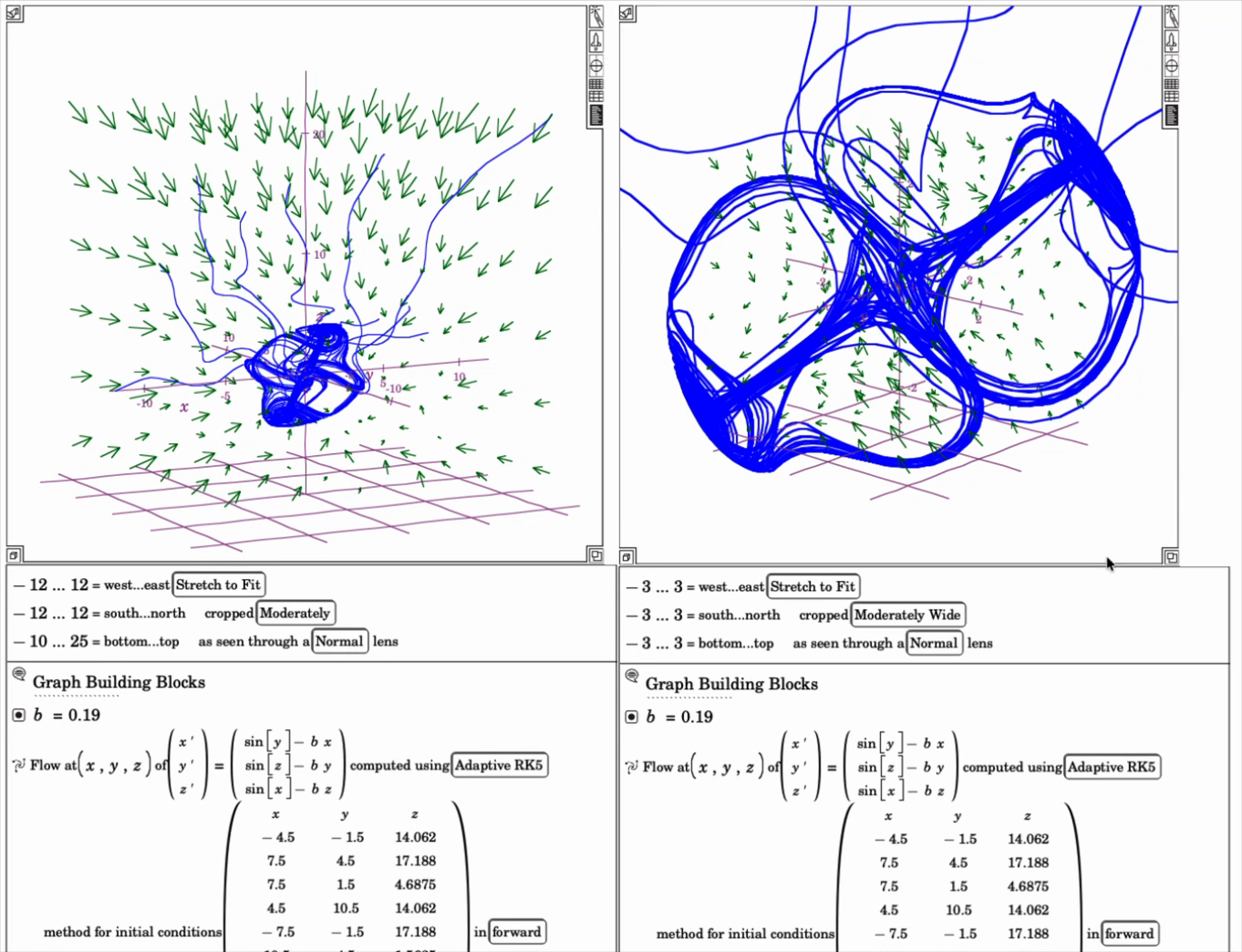
- Systems of differential equations in 3D - the dramatic flow visualizations you see on this page (Lorenz attractor, Thomas attractor, Aizawa attractor, non-autonomous flows)
- Additional honors-level investigations using Mathematica's full algebraic and computational depth
Preparation for Engineering and Physics Applications
Will Honors DMAT 322 prepare you for engineering and physics work that uses differential equations? Absolutely. But the preparation goes well beyond memorizing algebraic techniques.
You leave DMAT 322 with full command of the subject. When a differential equation appears in your other coursework or research, you do not stare at it wondering if there is a formula somewhere. You know how to study it: how to analyze it, how to graph its solutions, how to set up numerical investigation, and which algebraic techniques (if any) apply. That is a much stronger working toolkit than a textbook formula sheet.
DMAT 322 Honors vs DMAT 321 Standard
Honors DMAT 322 is a 4-credit honors course (one credit more than the standard track) and uses both LiveMath and Mathematica so you have a combined dual-software experience - you may like one or the other better, but each is a tool to study mathematics in their own way. The honors track goes further into the algebraic and computational depth of the subject. If you are looking for a faster 3-credit track that covers the same core material with a lighter time commitment, take a look at DMAT 321 - Differential Equations: same laboratory approach, same three-perspective philosophy, lighter footprint.
DMAT 322 - Learning Outcomes
- To understand the core construction of the differential equation, and its classification parts
- To understand the role of the forcing function in differential equations
- To understand, observe, and compute the steady state solutions for a differential equation
- To understand, observe, and compute solutions of differential equations with a variety of forcing functions, including DiracDelta, step, oscillatory, and others
- To understand, observe, and compute solutions of differential equations with a variety of forcing functions, including DiracDelta impulses, step, oscillatory, et al.
- To understand and compute solutions of second order differential equations oscillators and how forcing functions affect their solutions
- To understand and compute manual solutions of first and second order differential equations using classical techiques
- To understand and compute with the Laplace Transform method
- To understand and compute graphical and numerical solution methods of differential equations
- To understand and compute solutions of linear systems of differential equations
- To understand and compute polynomial approximations to solutions of differential equations
- Honors Topics:
- * To understand and compute the linearization and equilibrium point solution methods
- * To understand and compute the classic examples of Van der Pol, Lorenz, Hamiltonian Systems
- * To understand an introduction to partial differential equations
- * To understand and compute solutions to the Heat and Wave Equations.
- * To develop mathematical technical writing skills, culminating in a term paper on an approved topic
DMAT 322 - Syllabus of Topics
High School Students - Differential Equations Course
Many advanced high school students who have completed their AP Calculus AB and BC courses, which are equivalent to Calculus I and Calculus II, respectively, often find themselves in their senior year of high school with no further courses in mathematics to take at their high school.
There are no further AP Calculus courses beyond the AP Calculus BC (Calculus II) course.
An excellent next academic move for these advanced high school mathematics students is to take one or more of the following Distance Calculus courses:
- DMAT 355 - Multivariable Calculus
- DMAT 322 - Differential Equations
- DMAT 335 - Linear Algebra
- DMAT 311 - Probability Theory (Calculus-Based Statistics)
Here is a video discussing some options for these advanced high school students.
Advanced High School Math Plan for Senior Year
After AP Calculus
Honors Differential Equations Online Course Credit: University-Level 4 Semester Credit Hours
What are Ordinary Differential Equations?
"Ordinary" means that the functions we are studying are functions of one variable. Usually: y = f(x)
Historically, this course was called "Ordinary Differential Equations", often abbreviated as ODE, and you will see ODE used interchangeably with DE to abbreviate the term "Differential Equations".
What is a non-Ordinary Differential Equation? Those are called Partial Differential Equations, and they involve looking at equations involving partial derivatives of functions of two or more variables, like this: z = f(x,y).
Partial Differential Equations is usually a junior-level mathematics course that all mathematics majors, and many physics and engineering majors, will take to learn about the next steps in the study of differential equations.
The term "ordinary" in Ordinary Differential Equations helps you identify the course level of the Differential Equations course you might be required to take. This Differential Equations online course - DMAT 322 - is the first course on ordinary differential equations.
Colloquially, you may hear other students refer to this course as "Diff-E-Q" or "DiffyQ".
There is also a higher, junior level course on Differential Equations - usually referred to "Advanced Differential Equations", or "Intermediate Differential Equations", which does continue the study of ordinary differential equations, but at a more advanced level, and quite distinct from the partial differential equations courses. Our DMAT 322 - Differential Equations is not considered to be one of these higher junior-level and above courses.
Differential Equations Examples of the Curriculum
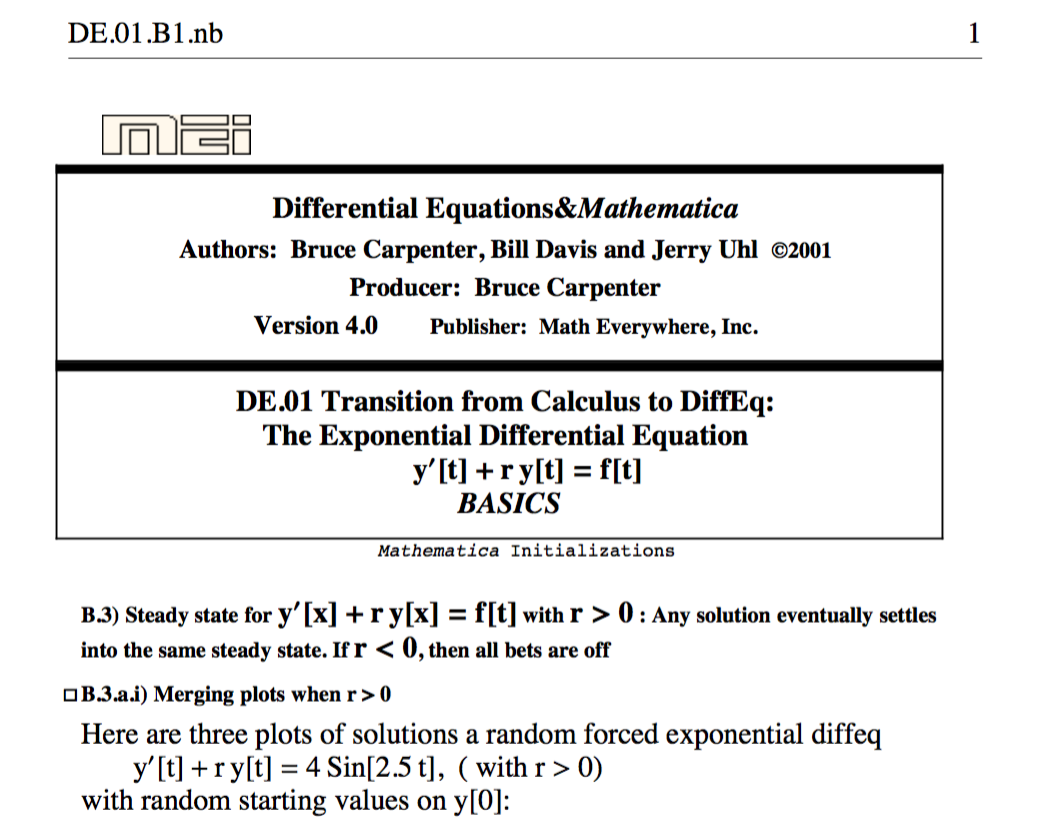
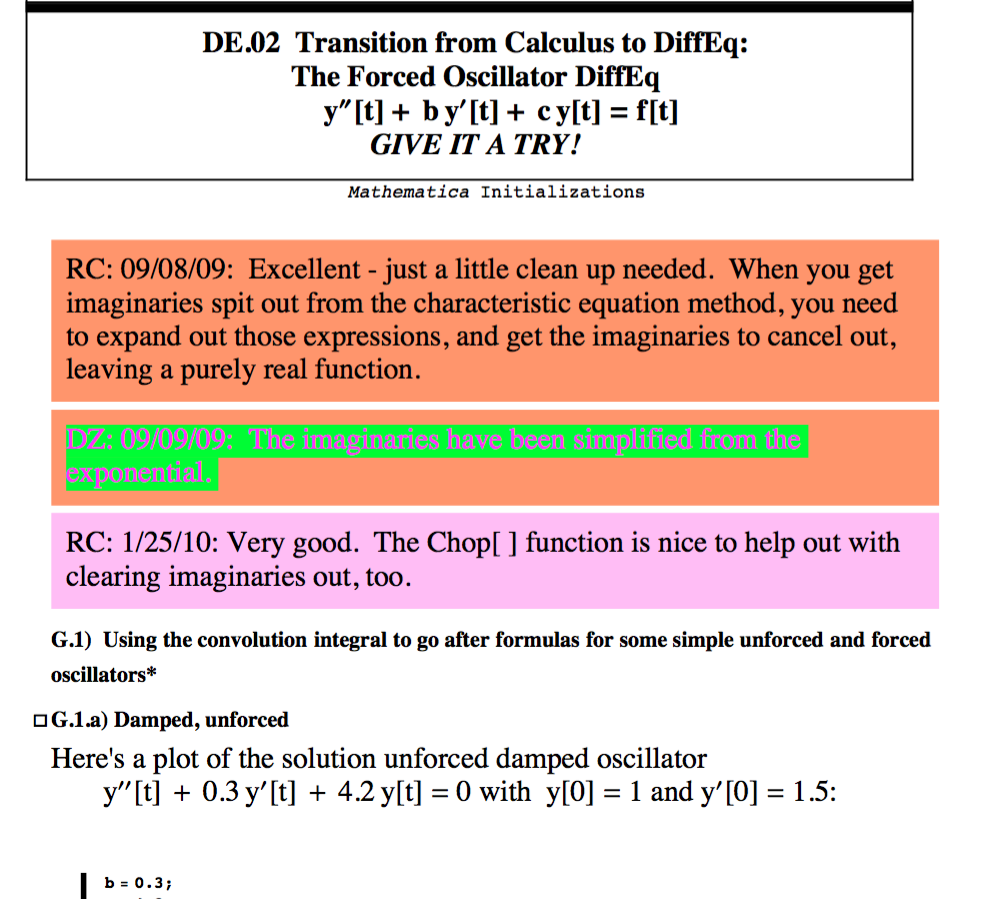
Below are some PDF "print outs" of a few of the Mathematica™ notebooks from Differential Equations&Mathematica by Carpenter/Davis/Uhl. Included as well is an example homework notebook completed by a student in the course, demonstrating how the homework notebooks become the "common blackboards" that the students and instructor both write on in their "conversation" about the notebook.
Sample Curriculum PDFs
Screencast Help Video
That Looks Like Programming Code!
Yes, Mathematica™ is a syntax-based computer algebra system - i.e. the instructions to generate the graphs and computations look like a programming language code (which it is).This course is not a course on programming. We do not teach programming, nor do we expect the students to learning programming, or even to know anything about programming. The mathematics is what is important in this course, not the code.
With that tenet in mind, the authors of the Differential Equations&Mathematica courseware have designed the explanation notebooks (Basics & Tutorials) and the homework notebooks (Give It a Try) in such a way as to make it easy to Copy/Paste from the explanations into the homework notebooks, and make minor changes (obvious ones) to produce the desired similar (but different) output. In this way, we are able to stick strictly to the mathematics at hand, and deal with the programming code as minimally as possible.
Differential Equations Online Course Credit: 3 semester university-level credit hours
Distance Calculus Referenced Colleges & Universities (29 Years - 393+ Institutions)
Distance Calculus students have transferred course credits to these colleges and universities:
Distance Calculus - Student Reviews
I felt like I really learned Calculus and also really enjoyed it!
First, this course uses software called LiveMath. This software can be a little bit challenging to get the hang of, but once you do get the hang of it, it's super easy. Remember that for all new things, it takes a bit to get used to it. Overall, I was highly satisfied with this course. I thought that the instructions were extremely detailed, including a video and a textbook explaining every different concept. In addition, this course offered exposure to a lot of different aspects of finite math. I think that many would agree with me on the following, that, you know, when a teacher is passionate about what they are teaching, it is so much more enjoyable, and you can definitely see that in this course. This course can be challenging at times. Maybe it'll be easy for you, maybe it'll be hard, but I think it's important to remember that the things that challenge us are, you know, the things that make us learn and the things that make us better. There's also a math chat option for if you need help or if you have any questions. Overall, I would recommend this course. I actually initially went into this course looking for an easy course to just help me get the credit requirements, but it ended up being an amazing learning experience and completely shifted my perspective on math overall. And another thing that I thought was great in this course is throughout so many different lectures, the professor would explain how each different thing can be applicable in life. And I think that, you know, that is a lot of what people think about when they are learning something. They're like, will I ever use this? Do I need to learn this? And a lot of this actually is really applicable. And I think that even if, you know, you may not be doing these math equations in your future, I think that, you know, the psychology behind these and the rules can be applied to so many different fuacets of life.
The only problem with the course is the lack of pen and paper work. This shouldn't come as a crazy surprise with an online course, but there is not much emphasis on symbolic computation. Mathematica or other software does most of the heavy computation for you. The lectures usually show how to solve the problems through paper, but those skills are rarely put into practice. Literacy Sheets act as a way to do some of that (especially with the Calculus II & III course).
All in all, this isn't a huge issue. I just memorize and practice things like double integration, Laplace, ODE solving, matrix diagonalized form, row operations, etc. With a little outside work, this resolves itself. Without Roger WIlliams, I probably would not have been able to take any of these math courses in highschool.
So overall, a great choice for highschool advanced math, especially with transferrable credits.






More Details
- How Our Courses Work
- About the Mastery Learning Format
- Asynchronous & Self-Paced
- Computer & Software Requirements
- Maximum Course Time (1 Year)
- Completion Time Estimates
- Academics
- Course Prerequisites
- Course Syllabi
- Grading Policy
- University Accreditation (NECHE)
- Course Articulation/Transfer
- How Exams Work
- Explore
- Honors Course Track
- Student Reviews
- Introductory Videos
- Who Can Enroll?
Frequent Questions
- Enrollment
- When Can I Enroll?
- When Can I Start My Course?
- Term Dates: Enroll Anytime!
- Costs & Tuition
- Credits & Transcripts
- Will My Credits Transfer?
- Letters of Recommendation
- Is My College On Your Transfer List?
- Other Questions
- Frequently Asked Questions
- Is This the Same as AP Calculus?
- Are These Computer-Based Courses?
- Are These Online Courses?
- Financial Aid?