Statistics Online Course for Academic Credit
Basic Statistics - DMAT 125 - Introduction to Computational Statistics - is the first (non-calculus-based) course on statistics and probability, often called "Elementary Statistics" or "Descriptive Statistics". Without using higher calculus techniques, this course studies Mean, Median, Mode, Frequency, Cumulative Distribution Functions, Introductory Probability, correlation and regression (data fitting), confidence intervals and hypothesis testing, and the Central Limit Theorem.
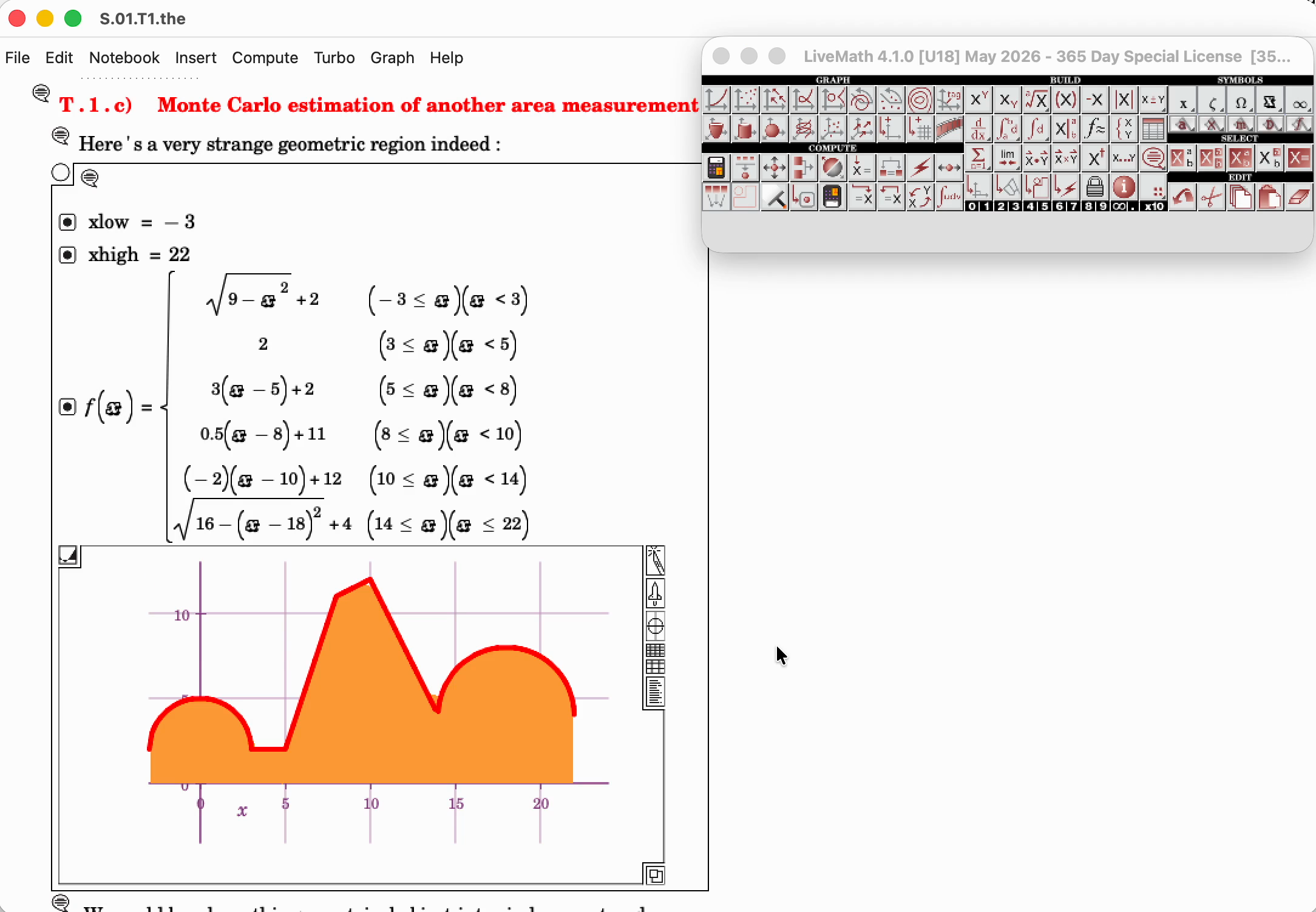
Basic Statistics is often required for students who are seeking to satisfy a quantitative general education requirement, or looking towards an MBA or other graduate school program that requires a basic Statistics and Probability course.
Completion of DMAT 125 - Introduction to Computational Statistics earns 4 academic credit semester hours with an official academic transcript from Roger Williams University, in Providence, Rhode Island, USA, which is regionally accredited by the New England Commission of Higher Education (NECHE), facilitating transfer of credits nationwide to other colleges and universities.
Introduction to Computational Statistics - DMAT 125 - Introduction
Basic Statistics is the classic course on the language and computations of data science, but without the calculus machinery found in the upper calculus-based Probability & Statistics course.
Basic Statistics introduces the study of data, measuring frequency, building cumulative distribution functions, investigating introductory Normal and Exponential distributions, studying data correlation, linear (and higher degree) curve fitting of data (regression), hypothesis testing and error estimation of measuring data. The wonderful (and bizarre) Central Limit Theorem is the culmination of the course - a very wild theorem that says if you take any data set S, the set S may not be normal (think bell-shaped curves), but if you takes sums of the data (not just averages!), the resulting changed data set will be normal (have bell-shaped curves).
Required for many undergraduate and graduate programs and courses of study, Introductory Statistics begins the study of data analysis used in some many majors and disciplines. This course is the classical "lower course" on Statistics, but starts the student into the now-popular study of Data Science, which is a combination of statistics and programming. (Students wishing to pursue a Data Science degree or certificate should look to the higher course on Probability Theory (calculus-based) and skip over this introductory DMAT 125 - Introduction to Computational Statistics course).
Different Approaches to Basic Statistics
The introductory Statistics courses around the U.S. usually fall into one of two main types - with Distance Calculus being a distinctly third-type!
Unlike its older sibling the Probability Theory course, the lower Basic Statistics course uses no calculus - the formulas only use algebra and the power of the software to carry out the computations in larger scale than could be accomplished by hand calculations.
DMAT 125 - Introduction to Computational Statistics course provides a thorough and comprehensive, yet not overwhelming, introduction to beginning Statistics.- Algebra II Refresher
Basic Statistics begins with some review of high school algebra by starting from scratch with solving basic equations, ranging then to functions, linear equations, polynomials, exponential and logarithmic functions - all base knowledge required for a mathematical study of basic statistics. This refresher aids students who have been away from academics for a while, as well as students with weaker mathematical backgrounds. For students with stronger math backgrounds, this refresher can be completed very quickly, and provides an excellent platform on which to learn the computer algebra software. - Working With Random Numbers
One of the main benefits of using a computer algebra system is the analysis of random numbers. You might think random numbers are nothing special to study - but it turns out these are the cornerstone of studying statistics and probability, and the usage of a computer algebra system such as LiveMath to generate random data and then analyze it is one of the big differences between this LiveMath-based Statistics course and the traditional textbook "here is some data" course. - Data Distributions
Looking at data by measuring frequencies and then building Cumulative Distributions Functions (CDF) is the first step in any data analysis. Utilizing LiveMath's random number generation and graphing capabilities, we explore this analysis to define data distributions, and then study the properties of these distributions, leading to the ever-important normal distribution. - Data Fitting
One of the key topics in any Basic Statistics course is: I have a big set of data, I graph it (somehow), and then ask: Can I put a line through this data plot? This leads to the topics of data correlation, and data-fitting, also called regression. Given a set of data, can I approximate that data by a linear, or quadratic, or cubic, or other type of function? - Central Limit Theorem
If you have taken any (meaningful!) Statistics course, you will have heard of the Central Limit Theorem. This theorem is so simple and profound, and quite mysterious why it works! We approach this CLT as mathematicians: given any data set S, this data many not be normally distributed, but any summation (including averages) of the data set will result in a normally distributed set. Wild wild stuff!! - Confidence Intervals
You see these all the time in the news: a survey of likely voters has a margin of error of 5.3%. How do they know this? Answer: confidence intervals!
DMAT 125 - Learning Outcomes
- To identify, manipulate, and understand the concept of data sampling
- To graphically identify and numerically compute the variance, mean, median, mode, and other measures of descriptive statistics
- To compute and plot various graphical descriptions of data, including histograms
- To compute, manipulate, and understand basic concepts of probability measure
- To compute, manipulate, and understand the concept of distributions
- To identify, manipulate, and understand the core Normal distribution and its properties
- To understand the Central Limit Theorem that averages of data samples tend to be normally distributed
- To identify, manipulate, and compute confidence intervals and hypothesis testing
- To identify, manipulate, and compute linear regression and goodness-of-fit testing
DMAT 125 - Syllabus of Topics
In 2023, Distance Calculus introduced a new catalog of courses. New DMAT 125 = Old DMAT 124 = Old MATH 124
Different Names for Basic Statistics
"Basic Statistics" is best described as the single semester lower-division non-calculus general Statistics course, which often has these names:
- Statistics
- Introductory Statistics
- Basic Statistics
- General Statistics
- Probability & Statistics (not calculus based)
It is important to note that Probability Theory is the higher track of Statistics, in comparison to the lower Basic Statistics course for (primarily) non-science majors.
If you are looking towards starting a study a Data Science, you should look towards taking the higher Probability Theory course - you do not need to take the lower non-calculus-based Basic Statistics course first.
Learning Outcomes for DMAT 125 - Introduction to Computational Statistics
- To identify, manipulate, and understand the concept of data sampling
- To graphically identify and numerically compute the variance, mean, median, mode, and other measures of descriptive statistics
- To compute and plot various graphical descriptions of data, including histograms
- To compute, manipulate, and understand basic concepts of probability measure
- To compute, manipulate, and understand the concept of distributions
- To identify, manipulate, and understand the core Normal distribution and its properties
- To understand the Central Limit Theorem that averages of data samples tend to be normally distributed
- To identify, manipulate, and compute confidence intervals and hypothesis testing
- To identify, manipulate, and compute linear regression and goodness-of-fit testing
Basic Statistics Requirements In Various Academic Disciplines and Programs
Academic programs that usually will accept the lower Basic Statistics course include:
- MBA & Business Schools
Many MBA & EMBA programs accept Basic Statistics to satisfy their statistics course requirement. - Pharmacy, Nursing, or Pre-Med Schools
- Architecture
- Baccelaureate General Education Requirements
- Other Graduate School Programs
- Primary/Secondary Education Teacher Certification
How Fast Can I Complete The Basic Statistics Course?
The lower DMAT 125 - Introduction to Computational Statistics course can be completed relatively quickly - it is not nearly as intense as the higher Probability Theory course - and Basic Statistics is intended for a general education audience.
If you need to complete the DMAT 125 - Introduction to Computational Statistics course on a fast track, the usual time needed to complete course is 3 weeks - with a dedicated effort of 15-25 hours of course study time per week - that's 2-4 hours per day. Many of our Distance Calculus students are under significant time constraints and need to finish their course very quickly, and we are very happy to accomodate such accelerated time schedules.
With that said, it is important to know that Distance Calculus cannot guarantee your particular completion date - this is dependent upon the quality of the work you submit, which is dependent upon your academic skills and course motivation. At Distance Calculus, we are very happy with a fast timeline for completion of a course, so long as the academic work is of the highest calibre. If you need to spend more time on this course in order to achieve your highest grade potential, we will insist you take that extra time that you need to succeed.
Distance Calculus Referenced Colleges & Universities (29 Years - 393+ Institutions)
Distance Calculus students have transferred course credits to these colleges and universities:
BASIC STATISTICS: ACADEMICS
80% Computer Algebra, 20% Pencil/Paper, 0% Multiple Choice
Through the usage of a computer algebra system like LiveMath™ - you will never miss a minus sign again!
Although the driving of a computer algebra system requires some up-front time to learn and master, once completed (rather quickly for most students), the time saved from having to be a "minus sign accountant" adds to the productivity of your study time. If you have ever spent hours looking for that "little numerical error", you know what we mean.
Command of a computer algebra software system is a modern-day necessity of mathematical academics. It is important, however, to retain a meaningful command of paper/pen/pencil manual computations as well. Our blend of curriculum strives for an 80%/20% split between computer algebra usage and manual computation and written skills. With each module in our curriculum, a concluding Literacy Sheet assignment ensures that each student has written mathematical competency in the subject area.
The proctored final exam is a written exam away from the computer. It is these Literacy Sheet assignments, and the continuing bridge from modern computer algebra software back to classical, manual mathematics that prepares the student for this written final exam.
We do not have any multiple-choice work. We are a real collegiate-level course program - not a "canned" set of multiple-choice question sheets which are common from large publishers and degree-mill schools.
Basic Statistics Example Curriculum
Videotext - A Modern Replacement of the Textbook
What is a videotext? It is like a textbook, except instead of being based upon printed information, this "text" is based upon video presentations as the core method of explaining the course topics. Instead of a huge, thick 1000-page Calculus textbook to lug around in your backpack, all of this new "videotext" can be loaded into your iPods or iPhones (and soon, the iPad!).Example Videos are in MP4/H.264 format, which play in most modern browsers without additional software. When additional software is required, a backup Flash player will play the video. As a backup to Flash, you may also use iTunes and/or VLC.
Here are some samples of the videotext from the course curriculum::
Although we are anywhere from a few miles to a few thousand miles apart, watching these screencast videos is like sitting next to the course instructor, watching his computer, learning the topics of Calculus at the same time as learning how to drive the computer algebra and graphing software LiveMath™. These LiveMath™ screencast videos make up the majority of the video presentations in the videotext.
Basic Statistics Screencast Video Questions
One extremely powerful aspect of the Distance Calculus course technologies is the usage of screencast video (and audio) recordings made by the students and the instructors, exchanged just as easily as emails back and forth.
If a picture is worth a thousand words, then a screencast movie is worth a million words - and saves boatloads of time and effort.
Instead of trying to type out a math question about a particular topic or homework question, the ease of "turning on the screen recorder" and talking and showing your question - in the span of a few minutes - can save hours of time trying to convert your question into a typed (and coherent) narrative question.
Basic Statistics Example Student Work and Grading
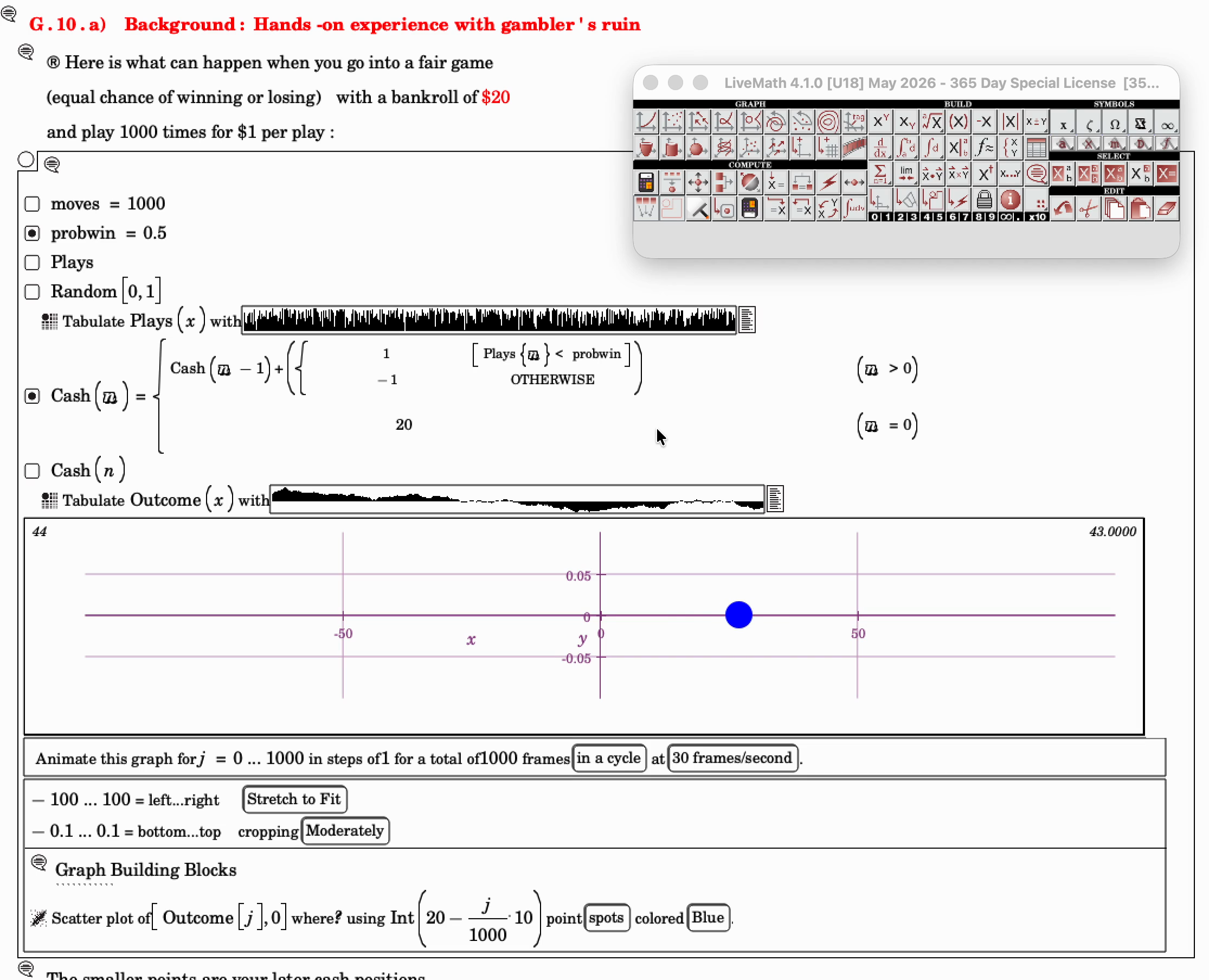
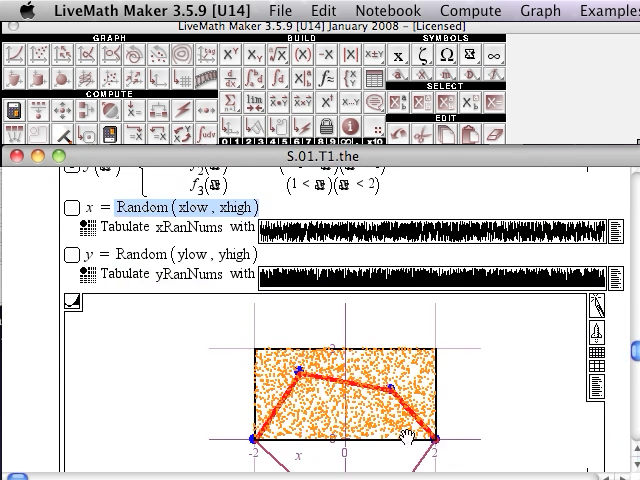
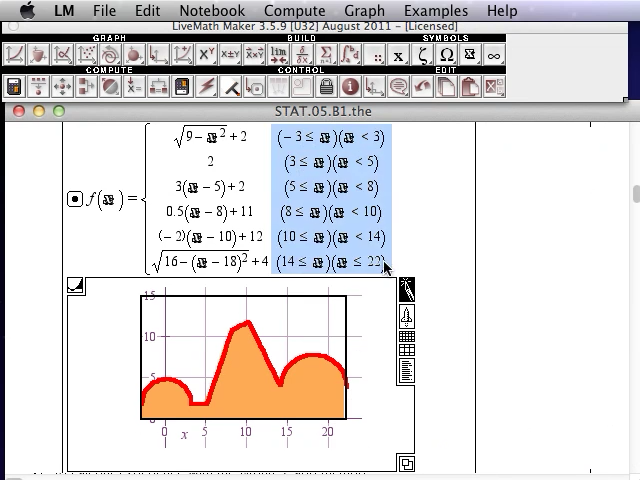
Course work occurs via LiveMath notebooks - interactive documents for mathematical computation. Students submit notebooks, instructors grade and give feedback, and notebooks go back and forth until mastery is achieved (typically 2-5 revisions).
Distance Calculus - Student Reviews
There is a steep learning curve early on to get used to the software and the kind of course this is.
Ultimately, I feel like what I learned will allow me to actually use the math and build upon it in the future. If you care about learning, rather than just passing a requirement, this is a great course for you.
Dist Calc saved a ton of hassle and time having to take calc at a local community college, which realistically would have delayed my entrance to BU LEAP by at least a year.
Would strongly recommend it.
First, this course uses software called LiveMath. This software can be a little bit challenging to get the hang of, but once you do get the hang of it, it's super easy. Remember that for all new things, it takes a bit to get used to it. Overall, I was highly satisfied with this course. I thought that the instructions were extremely detailed, including a video and a textbook explaining every different concept. In addition, this course offered exposure to a lot of different aspects of finite math. I think that many would agree with me on the following, that, you know, when a teacher is passionate about what they are teaching, it is so much more enjoyable, and you can definitely see that in this course. This course can be challenging at times. Maybe it'll be easy for you, maybe it'll be hard, but I think it's important to remember that the things that challenge us are, you know, the things that make us learn and the things that make us better. There's also a math chat option for if you need help or if you have any questions. Overall, I would recommend this course. I actually initially went into this course looking for an easy course to just help me get the credit requirements, but it ended up being an amazing learning experience and completely shifted my perspective on math overall. And another thing that I thought was great in this course is throughout so many different lectures, the professor would explain how each different thing can be applicable in life. And I think that, you know, that is a lot of what people think about when they are learning something. They're like, will I ever use this? Do I need to learn this? And a lot of this actually is really applicable. And I think that even if, you know, you may not be doing these math equations in your future, I think that, you know, the psychology behind these and the rules can be applied to so many different fuacets of life.
The only problem with the course is the lack of pen and paper work. This shouldn't come as a crazy surprise with an online course, but there is not much emphasis on symbolic computation. Mathematica or other software does most of the heavy computation for you. The lectures usually show how to solve the problems through paper, but those skills are rarely put into practice. Literacy Sheets act as a way to do some of that (especially with the Calculus II & III course).
All in all, this isn't a huge issue. I just memorize and practice things like double integration, Laplace, ODE solving, matrix diagonalized form, row operations, etc. With a little outside work, this resolves itself. Without Roger WIlliams, I probably would not have been able to take any of these math courses in highschool.
So overall, a great choice for highschool advanced math, especially with transferrable credits.




More Details
- How Our Courses Work
- About the Mastery Learning Format
- Asynchronous & Self-Paced
- Computer & Software Requirements
- Maximum Course Time (1 Year)
- Completion Time Estimates
- Academics
- Course Prerequisites
- Course Syllabi
- Grading Policy
- University Accreditation (NECHE)
- Course Articulation/Transfer
- How Exams Work
- Explore
- Honors Course Track
- Student Reviews
- Introductory Videos
- Who Can Enroll?
Frequent Questions
- Enrollment
- When Can I Enroll?
- When Can I Start My Course?
- Term Dates: Enroll Anytime!
- Costs & Tuition
- Credits & Transcripts
- Will My Credits Transfer?
- Letters of Recommendation
- Is My College On Your Transfer List?
- Other Questions
- Frequently Asked Questions
- Is This the Same as AP Calculus?
- Are These Computer-Based Courses?
- Are These Online Courses?
- Financial Aid?
Frequently Asked Questions
Are There Any Prerequisites for the Stastistics Course?
No, not really. The student is expected to have "High School Algebra" but nearly all U.S. college/university students have taken High School Algebra, probably Algebra II, as that is a universal requirement for college/university. We do start at the very beginning, and assume that even though you have taken High School Algebra, you may not remember much of it.
Does Statistics Use Calculus?
No, not in the lower Statistics course. For a Calculus-based investigation of the introductory topics of statistics, check out the Probability Theory course.
Do I Need To Take Precalculus Before Statiscs?
No. Precalculus is a prerequisite for the higher Calculus I STEM sequence; not for the lower Statistics, single-semester course on introductory statistics (non-calculus based).
Is Statistics Boring?
Well not from Distance Calculus! Our Statistics course is quite progressive, exploring the topics of Statistics with a laboratory-minded approach, using graphical, algebraic, and numerical tools to have a refreshing investigation of the topics of Statistics.
Is Statistics from Distance Calculus Accredited?
Yes, All Distance Calculus courses are offered through Roger Williams University in Providence, Rhode Island, USA, which is regionally accredited (the highest accreditation) through New England Commission of Higher Education (NECHE).