Honors Calculus I+II Combined Academic Credit Online Course For Data Science

A very popular academic goal is pursuit of advanced degrees in Data Science and related fields, which necessitates a strong background in freshman and sophomore level calculus.

Honors Calculus I+II for Data Science [DMAT 255 - Honors Calculus I+I For Data Science - 5 credits] is an accelerated, combined course for freshman calculus, specifically assembled for Data Science students. Set at the Honors level, DMAT 255 is equivalent to AP Calculus BC which bridges Calculus I and Calculus II topics in a single course/year, and upon completion, is equivalent to completion of Calculus II (DMAT 263/264).

Course
DMAT 255 - Honors Calculus I+II for Data Science
Credits
5 Semester Credit Hours
Delivery
Fully Online, Asynchronous, Self-Paced

DMAT 255 - Honors Calculus I+I For Data Science - 5 credits provides the data science-bound student with a single course re-entrance in the calculus curriculum to come up to speed with freshman calculus more quickly than having to take two separate courses in succession.

Honors Calculus I+I For Data Science engages the traditional freshman calculus topic set, beginning with derivatives, then moving on into integration theory, then onto polynomial approximations (Taylor's Theorem), preparing the DMAT 255 student for the various Sophomore level courses, such as Linear Algebra, Multivariable Calculus, Differential Equations, and the very important Probability Theory.

Many Data Science-bound students ask "How many math courses should I take to prepare for a Data Science degree?"

The short answer is: All of them.


Being a data scientist means you will simultaneously be a mathematician, a statistician (these are not! the same!), and a computer programmer. As a multi-disciplinarian, you need to be a "jack of all trades" as the saying goes.

DMAT 255 - Honors Calculus I+I For Data Science - is offered at the Honors level, because of the calibre of data science-bound students.

Nationally, "Honors" courses usually are centered on a mathematically rigorous development of the concepts of calculus, bringing many advanced topics from upper division courses such as Advanced Calculus and Real Analysis into the freshman honors calculus courses. While this may be a worthwhile approach for students who seek to become mathematics majors, it creates, for many students, an inflated level of course difficulty of questionable benefit to related fields of study.

Our approach to Honors courses is built upon a distinctly different educational philosophy:

  • Freshman & Sophomore Calculus is NOT the correct math level to increase rigor
    We believe that mathematical rigor is learned after exposure to the calculus, in the upper division, after some time and maturing of mathematical thought is allowed to organically develop. No student ever understood the concept of a derivative because the natural numbers were first axiomatically developed.
  • Honors means DEEPER, not just HARDER
    In mathematics, the potential for making any course harder is a rather simple proposition. Work SMARTER, not HARDER mandates that an honors course should not be more difficult just to say it is. A true honors student wants to go deeper into the topics, not flirt with academic demoralization via some mathematical bootcamp experience.
  • Technical Writing Curriculum
    While axiomatic development has its place in upper division math, core improvement of technical writing skills will benefit all students in all disciplines with immediate effect. If calculus is supposed to be mathematical preparation for science, technology, and engineering related fields, then development of technical writing skills should be as important as computational prowess.
  • Course Term Paper
    Each Honors course student will write a 10-20 page term paper on a topic chosen in collaboration with the course instructor, empowering the student to simultaneously improve technical writing skills and deepen knowledge in the student's chosen academic field via a uniquely creative exercise that will transcend the traditional course boundaries.

In summary, our Honors courses go deeper and broader in the curriculum, offer a notch more challenging course work set, and featuring a technical writing curriculum that truly prepares the student for further academics in the sciences.

Completion of DMAT 255 - Honors Calculus I+II for Data Science earns 5 academic credit semester hours with an official academic transcript from Roger Williams University, in Providence, Rhode Island, USA, which is regionally accredited by the New England Commission of Higher Education (NECHE), facilitating transfer of credits nationwide to other colleges and universities.


DMAT 255 - Honors Calculus I+II for Data Science is offered in the Fall, Winter, Spring, and Summer semesters with "revolving enrollment", which means you may enroll at any time, and start your course whenever you wish, independent of the traditional academic calendar.

DMAT 254 Honors Calculus I+II For Data Science differs from the mainstream DMAT 253 STEM Calculus I and DMAT 254 Honors STEM Calculus I courses in the following ways:

Topic
DMAT 253
STEM Calculus I
DMAT 254
Honors STEM Calculus I
DMAT 255
Honors Calculus I+II for Data Science
Precalculus Refresher
Yes
No
No
Limits
Graphical, Numerical, Basic Algebraic
+ Cantor Sets, Limits by Functional Comparison, Graphical ε/δ, Numerical Analysis Issues, L'Hopital
Abbreviated Limits, Numerical Analysis Issues
Derivatives
Graphical, Numerical, Algebraic Rules
+ Non-Differentiable Functions
+ Machine Derivative Issues
Applications of Derivatives
Basic Optimizations
+ Applications To Physics, Economics, Data Analysis
+ Applications To Data Science
Differential Equations
Linear, Logistical
+ Polynomial Approximations, Systems, Predator-Prey
+ Applications to Data Science
Integration
Graphical, Numerical, Algebraic Antiderivatives, Fundamental Theorem of Calculus
+ Numerical Integration Techniques, Monte-Carlo Method, Integration in Finite Terms
+ Data Science Integration Issues
Data Analysis
Functions Defined by Data
+ Rational Polynomial and Trigonometric Approximation
+ Data Interpolation
Integration Techniques
u-substitution, Integration by Parts
+ Integration via Differentiation, Iteration, Complex Exponentials
+ Data Interpolation, Iteration, Computable Limits
Fundamental Theorem
Functions Defined By Integrals
+ Generalization of Trigonometric Functions to Elliptic Functions
+ Special Functions
Geometric Measurements
Double Integrals over Rectangularish Regions, Surfaces of Revolution, Green's Theorem, Fubini's Theorem
+ Higher Questions on Parameterization of the Boundary, Parameterization of Algebraic Curves, Interpolation of Boundary Data
+ Connection to Data Measurements
Numerical Integration
Euler
+ Midpoint, Runge-Kutta, Higher Estimates, Monte-Carlo Method
+ Machine Integration Techniques
Sequences, Series
Ratio, Integral Convergence Tests
+ Root, Raabe's, p-Test, Machine Convergence Limitations, Famous Infinite Sums from Number Theory, Ramanujan's Summation
+ Abbreviated
Polynomial Approximations
Taylor's Theorem
+ Applications to Differential Equations, Rational Polynomial Approximations, Computing π
+ Data Splining
Integration Theory
Quadrature of Rational Polynomials, Exponential, and Trigonometric Functions
+ Integration in Finite Terms, Near Finite-Term Integrals, Liouville's Theorem, Machine Integration Engines
+ Limitation of Machine Integration
Technical Writing
Basic Exposition in Homework Problems
+ Technical Writing Curriculum, Term Paper
+ Term Paper Includes Programming Project on Topic from Data Science

HONORS Course Information Video


Honors Calculus I+II for Data Science - DMAT 255 - Introduction

Freshman Calculus is the gateway to collegiate mathematics. As such, Freshman Calculus is often a prerequisite course for many majors, both science and non-science.

Calculus I introduces the fundamental concept of the derivative, demonstrated numerically in this animation of numerical derivative computations:
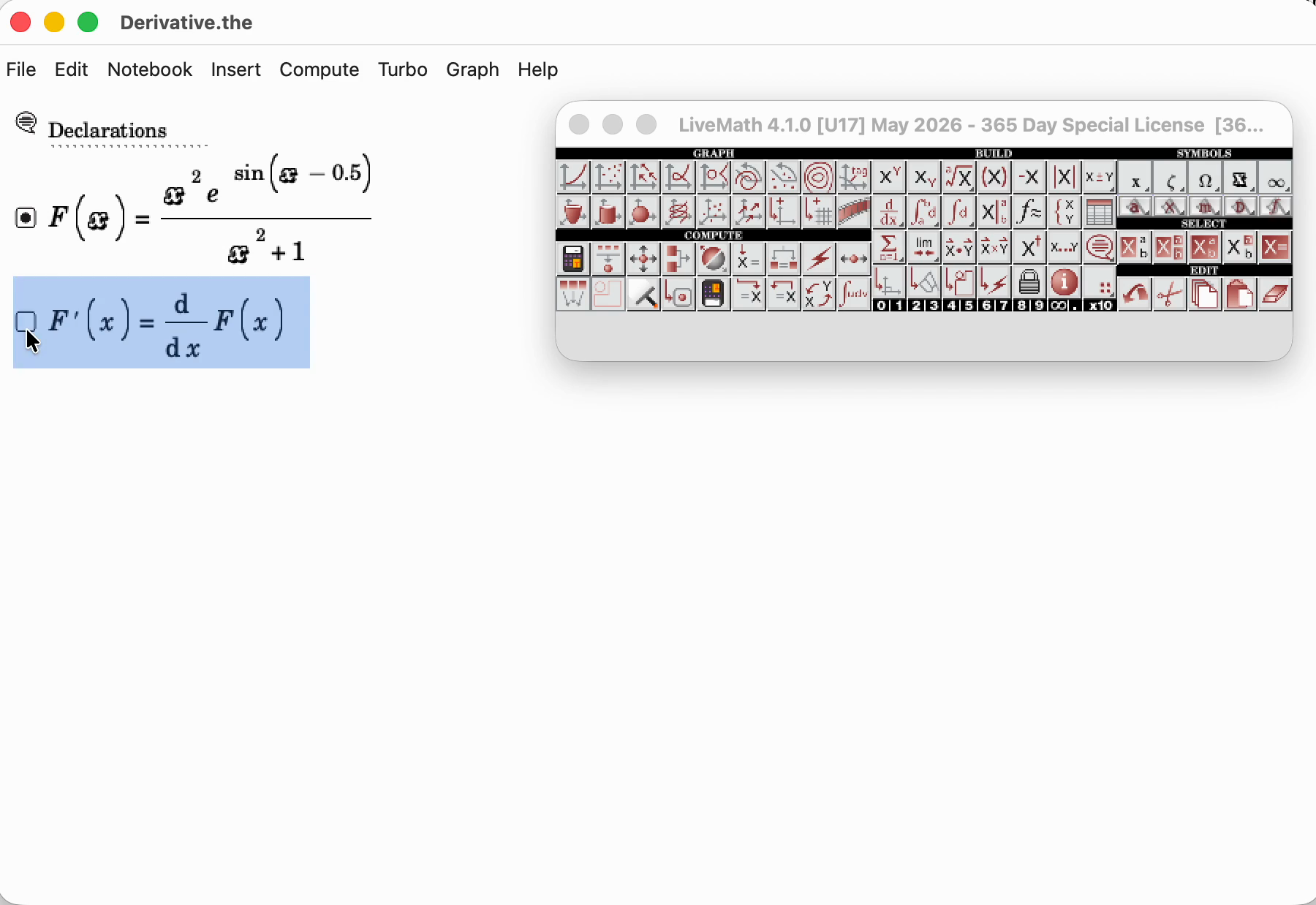
Numerical Derivative Computations

The derivative is also geometrically demonstrated in this animation showing a limit of secant lines approaching a tangent line at a point on a curve y=f(x):
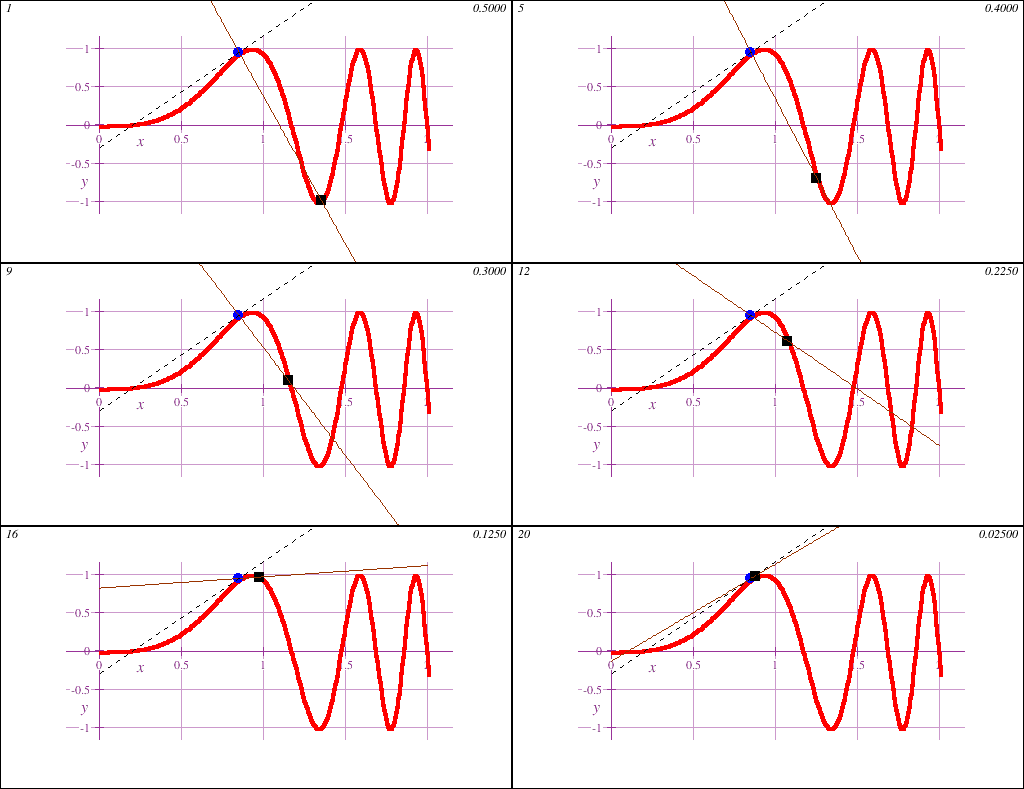
Secant Lines Approaching the Tangent Line

Freshman Calculus also introduces the fundamental concept of the integral, geometrically demonstrated in this animation showing the accumulation of signed area under a curve y=f(x) of increasing accuracy:
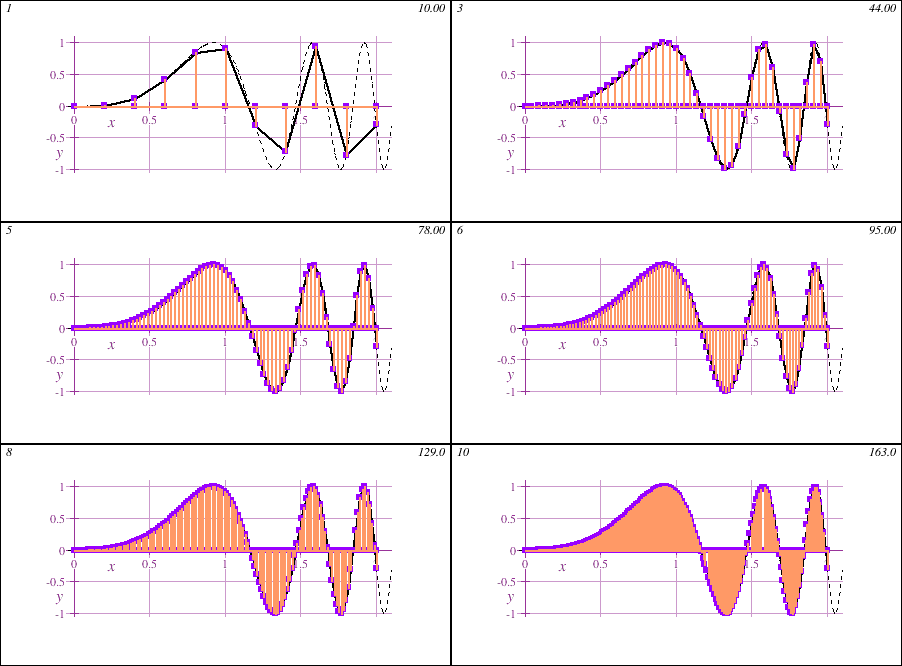
Rectangles Approximating Area Under a Curve

A core technique of integration in Calculus II is integration by substitution:
Integration by Substitution

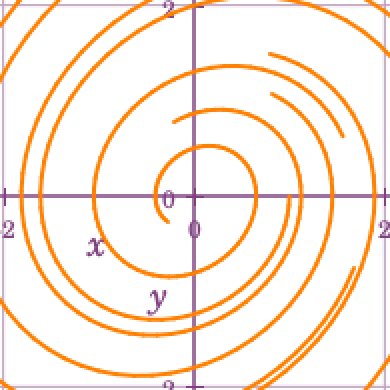
An Honors topic - the Double Folium curve, a 4th-degree algebraic curve with a triple singularity, parameterized via rational functions:
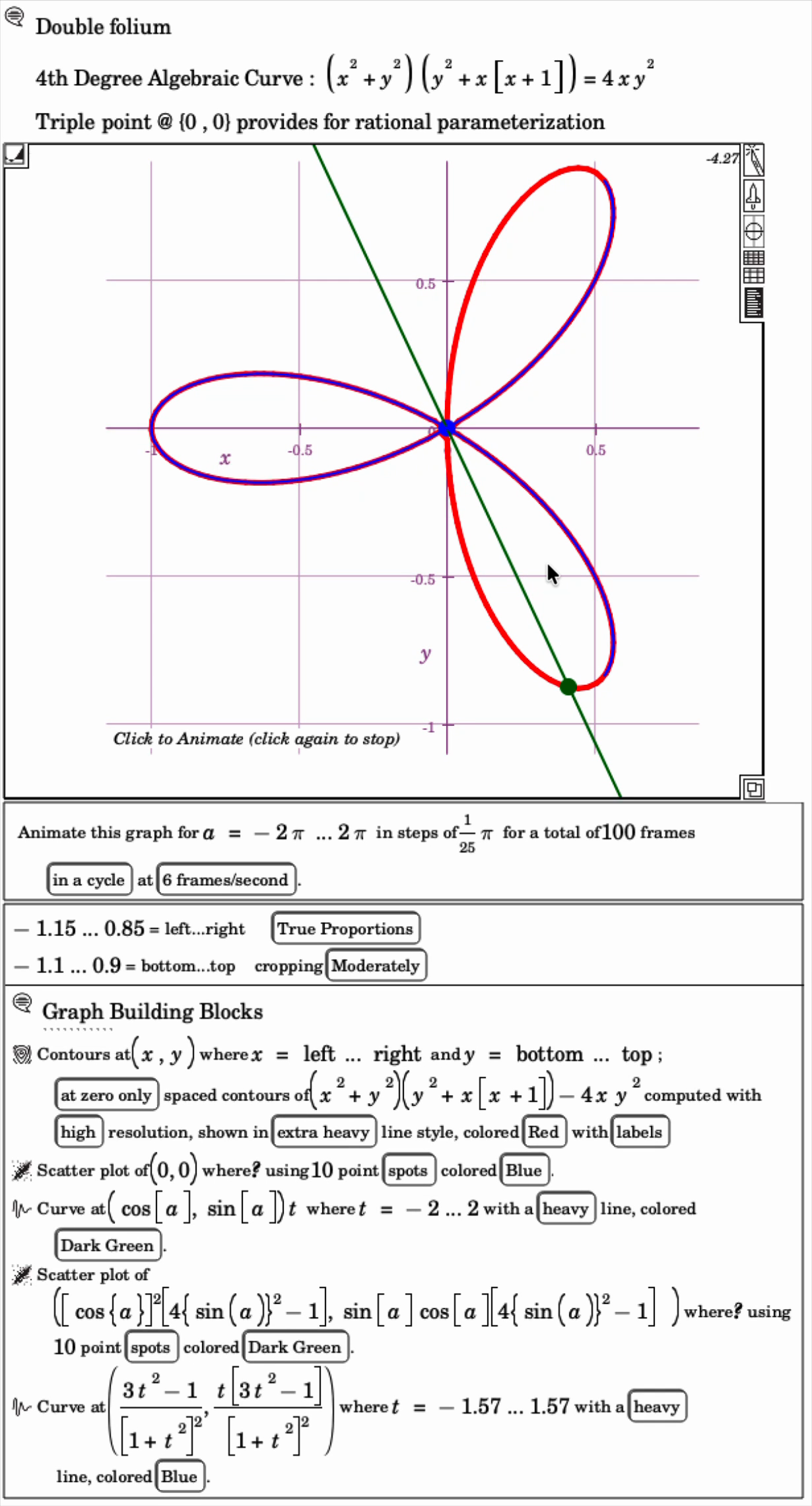
Double Folium Curve
Double Folium Curve

Main Themes of Honors Calculus I+II for Data Science - DMAT 255

  • Differential Calculus
    STEM Calculus I begins with investigating the phenomena of growth of the various types of functions, culminating with the derivative as a measurement of growth. Limits of functions and their usage in formulating the algebraic rules for computing derivatives - Newton's "calculus" - are examined both in classical algebraic terms, and numerically and graphically with modern computer algebra and graphing tools. Applications of the derivative to "max/min" problems, differential equations, related rates, implicit differentiation, sum/product/chain rules, rates of change, and parametric equations are then studied.
  • Integration Theory
    When you (or a computer) can algebraically integrate a function, how is that accomplished? Essentially, the Rules of Differentiation are "inverted" to the integral, providing the main strategies for attacking the algebraic integral - when possible.
  • Techniques of Integration
    One of the goals of Calculus II is to become an expert in algebraic integration: finding antiderivatives. Computer algebra tools can find antiderivatives automagically, so an exploration of the techniques of antiderivatives must contain an meaningful mixture of integration concepts, manual skills, and usage of computer algebra software. Traditional Calculus II courses explore these techniques purely from the paper/pencil standpoint, which has merits and drawbacks in this modern age. We strive for a balance between classical and modern computational mathematics in a unique way. For example, a more advanced integration technique known as Integration via Differentiation is presented, which is absent from all traditional textbooks, since it is computationally difficult with only manual tools - it is the leverage of computer algebra tools that makes this technique come alive.
  • Double Integrals and Gauss-Green Theorem
    Calculus II starts the dimensional generalization of integration theory, into double (or 2D) integrals, which can be used to measure volume and other applications. Double integrals initially come in two varieties: over 2D regions that are essentially rectangular, and over 2D regions that are not rectangular, but whose boundary curve can be formulated. In the latter case, the Gauss-Green Theorem is utilized; it is common for this theorem to be explored only in Multivariable Calculus, but we do this theorem early as an introduction to the higher dimensional Fundamental Theorem of Calculus.
  • When Algebraic Integration Just Can't Be Done
    The vast majority of functions cannot be algebraically integrated - there just is no algebraic antiderivative for such functions. The development of "Plan B" for attacking these types of algebraic integrals comes in the form of expanding the way we describe functions, not just with the elementary class of functions including such friends as sin(x), ex, x1/2, etc. but with a more generalized description based upon infinite polynomials. This raises all kinds of questions that have to be studied, but once accomplished, we are able to conquer these algebraic integrals.
  • Introduction to Vector Calculus
    To meet transferability requirements, Calculus II has a few introductory lessons on 3D geometry: lines, planes, vectors, dot products, cross products.

RWU Course Catalog - DMAT 255 • Honors Calculus I+II for Data Science
Course
DMAT 255
Course Title
Honors Calculus I+II for Data Science
Transcript Title
Honors Calc I+II for Data Sci (Combined)
Credits
5 Semester Credit Hours
Description
An honors-level single course introduction to differential and integral calculus for data science students, with emphasis on a modern, empirical exposition of the classical subject, condensing the essential topics from first year calculus. Topics include a study of the algebraic, numerical, and graphical aspects of polynomial, exponential, logarithmic, and trigonometric functions, limits, function growth, derivative analysis and optimization, introduction to differential equations, methods and applications of integration, the Fundamental Theorem of Calculus, calculus of data sets, numerical issues of derivative and integral computations, Monte-Carlo method, Taylor's Theorem and spline approximations, and methods of integration. Honors courses will include greater breadth and depth of topics, and develop technical writing skills, culminating in a combination programming project and mathematical term paper on an approved topic.
Prerequisite
Successful completion with B grade or higher in Precalculus with Trigonometry or equivalent, or consent of instructor; experience with a computer programming language.
E-Textbook
Calculus&Mathematica by Davis/Porta/Uhl
Software
LiveMath

DMAT 255 - Learning Outcomes

  1. To understand and compute algebraic, numerical, and graphical limits at finite and infinite values;
  2. To understand and compute the fundamental concept of the derivative;
  3. To understand and compute various measurements of growth of a function
  4. To algebraically compute derivatives of common functions using summation, product, quotient, and chain rules for derivatives;
  5. To understand and compute optimization of functions using derivatives, finding critical values;
  6. To understand and compute the second derivative;
  7. To understand and compute first order differential equations;
  8. To understand and compute parametric equations, including projectile motion;
  9. To understand and calculate numerically and graphically the core concepts of the integral for applications to signed area measurements;
  10. To compute numerically, algebraically, and graphically integrals of a variety of functions;
  11. To algebraically compute integrals of basic polynomial, exponential, and trigonometric functions, with an introduction to the algebraic substitution technique;
  12. To use of tools of differential and integral calculus in various applications
  13. To understand and compute the Fundamental Theorem of Calculus
  14. To understand and compute an integral functions, including inverse trigonometric and logarithmic integrals that do not algebraically resolve;
  15. To utilize computer algebra and graphing software to amplify traditional manual computation techniques.
  16. To understand spline interpolation with polynomial functions; points of contact
  17. To understand Taylor's Theorem, error analysis
  18. To understand convergences and divergence concepts of sequences, series, polynomial approximations
  19. To understand and compute double integrals
  20. To understand and compute 3D vector analysis, dot product, planes, and cross products
  21. To understand and compute partial derivatives and tangent planes to a surface
  22. Honors Additional Topics:
  23. *To investigate data interpolation and algebraic modeling of data sets using polynomial and trigonometric functions
  24. *To investigate numerical limits error analysis, the need for Lagrange, Newton, L'Hopital, Extrapolation, more advanced polynomial and rational polynomial approximation methods.
  25. *To understand the concept of algebraic integration in Finite Terms
  26. *To understand and compute integrals using complex integration techniques
  27. *To understand and compute numerical integration techniques of Newton, Midpoint, and Runge-Kutta, and higher RK approximations.
  28. *To understand and explore higher integral functions, such as those defined by elliptical and hyperbolic integrals
  29. *To explore and analyze Preditor-Prey systems of differential equations
  30. *To develop mathematical technical writing skills, culminating in a term paper on an approved topic
  31. *To utilize programming-based computer algebra software to make investigations for a programming term project in application to data science
  32. * = Additional topics for Honors course

DMAT 255 - Syllabus of Topics

1. Getting Started
1.1 Email and Chat
1.2 Learning About the Course
1.3 Required Hardware
1.4 Software Fundamentals
2. Growth: Preparing for the Derivative
2.1 Growth of Linear Functions
2.2 Growth of Power Functions
2.3 Growth of Exponential Functions
2.4 Dominance of Growth of Functions
2.5 Percentage Growth of Functions
2.6 Global Scale: Infinite Limits
2.7 Data Functions and Interpolation
2.8 Approximation of Functions by Linear Functions
3. Continuity
3.1 Limits
3.2 Continuous Functions
3.3 Jump Discontinuities
3.4 Piecewise Functions and Continuity
3.5 Limit Rules
4. Exponential Functions and Natural Logarithms
4.1 e = Euler’s Number
4.2 Natural Logarithm
4.3 Growth Analysis
4.4 Applications: Carbon Dating
4.5 Percentage Growth and Steady Growth of Exponential Functions
4.6 Data Functions and Logarithmic Analysis
4.7 Inverse Functions
4.8 Applications: Compound Growth Rates
4.9 Applications: World Population
5. The Derivative of Polynomial, Exponential, Logarithmic, and Fractional Powers
5.1 Instantaneous Growth Rates
5.2 Definition of the Derivative
5.3 Computing the Derivative Graphically
5.4 Computing the Derivative Algebraically
5.5 Computing the Derivative Numerically
5.6 Average Growth Rate vs. Instantaneous Growth Rate
5.7 Applications of the Derivative: Spread of Disease
5.8 Finding Maxima and Minima of Functions
5.9 Relating a Function and Its Derivative
6. Computing Derivatives
6.1 Sum, Difference, Product, Quotient Rule
6.2 Chain Rule
6.3 Instantaneous Percentage Growth
6.4 Growth Dominance
7. Using Derivatives
7.1 Finding Maxima and Minima
7.2 Finding Good Representative Plots
7.3 Applications: Maximizing Volume
7.4 The Second Derivative
7.5 Applications: The Space Shuttle Challenger
8. Integration
8.1 Measuring Area Under a Curve
8.2 Definition of the Integral
8.3 Properties of Integrals, Symmetry
8.4 Integrals of Data Functions
8.5 Numerical Methods: Rectangles, Trapezoids
8.6 Undefined Integrals
8.7 Numerical Calculation of Integrals
8.8* Monte-Carlo Method of Integration
9. Fundamental Theorem of Calculus
9.1 Derivative of an Integral
9.2 Integral of a Derivative
9.3 Fundamental Formula
9.4 Distance, Velocity, and Acceleration
9.5 Improper Integrals
9.6 More Properties of Integrals
9.7 Applications: Measure Accumulation Totals
9.8 Indefinite Integrals and Antiderivatives
9.9 u-Substitution
9.10 Inverse Circular and Hyperbolic Trigonometric Functions
10.* Limits Revisited
10.1* Limitations of Numerics with Limits
10.2* Lagrange, Newton, Extrapolation Numerical Methods
10.3* L'Hopital's Rule for Limits
11.* Preditor-Prey Systems
11.1* Parametric Solutions of Differential Equations
11.2* Preditor-Prey Models
11.3* Applications
12.* Data Interpolation
12.1* Linear and Quadratic Approximations
12.2* Polynomial Approximations and Interpolation
12.3* Trigonometric Function Interpolation
13.* Algebraic Integration Theory
13.1* Machine Integration Engines
13.2* Integration in Finite Terms
13.3* Integratability and Limitations
13.4* Defining advanced special functions using integrals or series
14. Taylor’s Expansion of a Function
14.1 Splines and Smooth Splines
14.2 Points of Contact
14.3 Application: Landing an Airplane
14.4 Taylor Expansion
14.5 Recognizing Familiar Expansions
14.6 Using Expansions for Approximations
14.7 Derivatives and Integrals of Expansions
14.8 Expansions At Other Points
14.9 Newton’s Method
14.10 Convergence Intervals and Barriers
14.11 Calculating Limits: L’Hopital’s Rule
14.12* Expansions and Solving Differential Equations
14.13* Complex Exponentials
14.14* Euler, Midpoint, Runge-Kutta Integral Estimates
15.* Differential Equations
15.1* Types of Differential Equations
15.2* Linkage to Algebraic and Numerical Integration Theory
15.3* Power Series Solutions to Differential Equations
15.4* Elliptical and Hyperbolic Integration Functions
15.5* Exploring Special Named Functions
16. Polar Coordinates
16.1 Basic Graphing
16.2 Recognizable Curves
16.3 Differentiation and Integration in Polar Coordinates
17. Vector Analysis
17.1 Vector Arithmetic
17.2 Dot Product, Cross Product
17.3 Planes
17.4 Partial Derivatives
17.5 Tangent Planes
18.* Mathematical Writing
18.1* Cogent writing
18.2* Mathematical Presentation
18.3* Term Paper Topic and Research


Distance Calculus Referenced Colleges & Universities (29 Years - 393+ Institutions)

Distance Calculus students have transferred course credits to these colleges and universities:

Agnes Scott College • Aiken Technical College • Albany College of Pharmacy and Health Science • Alma College • American Graduate University • American Public University • American University • Andrews University • Arizona State University • Armstrong Atlantic State Univeristy • Athens State University • Auburn University • Auburn University MBA Program • Augusta State University • Austin Peay State University • Azusa Pacific University • Babson College • Baruch College • Baylor University • Belmont University • Beloit College • Bentley University • Berklee College of Music • Berry College • Bethany College • Binghamton University • Bloomsburg University • Bluefield State College • Bluegrass Community and Technical College • Borough of Manhattan Community College • Boston Conservatory • Boston University • Bryant University • Buena Vista University • California Lutheran University • California Polytechnic State University, San Luis Obispo • California state University • California State University Channel Islands • California State University, Dominguez Hills • California State University, Sacramento • Carleton College • Carnegie Mellon University • Cedarville University • Central Michigan University • Central Washington University • Champlain College • Chapman University • Charter Oak State College • Chicago State University • Clark University • Clarkson University • Clemson University • Cleveland State University • Coastal Carolina University • College of Santa Fe • College of William & Mary • Colorado Mesa University • Colorado State University • Columbia University • Columbia University School of Business • Cornell Univeristy • Cornell University • Covenant College • CUNY Medgar Evers College • Denison University • DePaul University • Drexel University • Duke University - Fuqua School of Business • Duke University School of Law • Duke University, Durham NC • Duke University, Fuqua School of Business, Law School, Graduate Programs • East Stroudsburg University • Eastern Illinois University • Eastern Kentucky University • Eastern Mennonite University • Eastern Nazarene College • Elon University • Embry Riddle Aeronautical University • Embry Riddle University • Endicott College • Evangel University • Excelsior College • Fairifield University • Fairleigh Dickenson University • Ferris State University • Florida A & M University • Florida Agricultural and Mechanical University • Florida Atlantic University • Florida Institute of Technology • Florida International University • Florida State College, Jacksonville • Florida State University • Fordham University • Fox Valley Technical College • Franklin University • Freed-Hardamen University • Fresno State University • Friends University • Gannon University • George Mason university • George Washington University • George Washington University School of Business • Georgetown University • Georgia Institute of Technology • Georgia State • Georgia State University • Georgia Tech • Gordon College • Governor's State University • Green Mountain College • Griffith University • Grinnell College • Grove City College • Hamline University • Hampshire College • Hampton University • Harvard University, Kennedy School of Government • Harvard University: Kennedy School of Government, Medical Schools • Hillsdale College • Hillsdale University • Hiram College • Hofstra University • Howard University • Huntingdon College • Illinois Institute for Technology • Illinois Institute of Technology • Indiana University • Iowa State University • Jacksonville State University • James Madison University • Jeff State Community College • Johns Hopkins Univerisity • Johns Hopkins University • Kalamazoo College • Kansas State University • Kaplan University • Kennesaw State University • Kentucky State University • Kettering University • Kings College, University of London • La Sierra University • Lebanon Valley College • Lee University • LeTourneau University • Liberty University • Lincoln University of Pennsylvania • Lipscomb University • Loma Linda University • London School of Economics • Loyola Marymount University • Luther College • Macon State College • Marian University • Marquette University • Mars Hill College • Marshall University • Mary Baldwin College • Massachusetts Maritime Academy • McHenry County College • Mercer University • Mercyhurst College • Meredith College • Mesa State College • Messiah College • Miami University • Michigan State University • Michigan Technological University • Middle Tennessee State University • Middlebury College • Millersville University • Missouri University of Science and Technology • Montana State University • Montana Tech • Montclair University • Morehead State University • Murray State University • Naval Post Graduate School • New Mexico Military Institute • New Mexico State University • New York University • North Carolina Agricultural and Technical State Univerisity • Northeastern University • Northern Arizona University • Northern Michigan University • Northwest Nazarene University • Northwestern University • Oberlin College • Occidental College • Oglethorpe University • Oklahoma Baptist University • Old Dominion University • Olympic College • Orange Coast College • Oregon State University • Pacific Lutheran University • Penn State University • Pennsylvania State University • Pepperdine University • Pomona College • Portland State University • Princeton University • Purdue University • Quinnipiac University • Randolph-Macon College • Regent University • Regis University • Rensselaer Polytechnic Institute • Rhode Island School of Design • Rice University • Robert Morris University • Rochester Institute of Technology • Roger Williams Univerity • Roger Williams University • Roosevelt University • Rowan University • Rutgers University • Saint Anselm College • Saint Joseph's University • Saint Louis University • Saint Michael's College • Salve Regina University • Samford University • San Diego State University • Santa Fe Community College • Shepherd University • Smith College • South Dakota School of Mines and Technology • Southern Adventist University • Southern Methodist University • St. Anselm College • St. John's College • St. Mary's College of Maryland • Stanford University • Stanford University, MBA • State University at Buffalo Law School • State University at Buffalo, Law School • State University of New York • Stevens Institute of Technology • Strayer University • SUNY Binghamton • Swarthmore College • Syracuse University • Texas A&M University • Texas A&M • Texas A&M University • Texas Tech University • The Art Institute of Atlanta • The Catholic University of America • The Citadel • The Citadel, Military College of South Carolina • The College of New Jersey • The College of St. Scholastica • The George Washington University • The Master's College • The New England Institute of Art • The Ohio State Universtity • The University of Alabama • The University of South Carolina • The University of Texas at Austin • The University of Virginia • Thomas Edison State College • Trinity University • TUI University • Tulane University • Union University • United States Air Force Academy • United States Military Academy • Univeristy of Puget Sound • University of Alabama, Huntsville • University of Arizona • University of Arkansas, Little Rock • University of Auckland, New Zealand • University of California, Berkeley • University of California, Los Angeles • University of California, Santa Barbara • University of California, Santa Cruz • University of Central Florida • University of Central Oklahoma • University of Central Texas • University of Chicago • University of Cincinnati • University of Colorado • University of Colorado, Boulder • University of Colorado,Colorado Springs • University of Connecticut • University of Dallas • University of Findlay • University of Florida • University of Georgia • University of Hartford • University of Hawai'i-Manoa • University of Illinois • University of Kentucky • University of La Verne • University of Maine • University of Maryland • University of Massachusetts • University of Massachusetts, Amherst • University of Memphis • University of Michigan • University of Michigan: MBA, Medical Schools, Graduate Programs • University of Minnesota • University of Minnesota, School of Public Health • University of Minnesota, Twin Cities • University of Minnesota-Twin Cities • University of Mississippi • University of Missouri • University of Missouri, Columbia • University of Montana • University Of Mount Union • University of Nebraska • University of Nevada • University of New Hampshire Law School • University of New Haven • University of New Orleans • University of North Carolina • University of North Carolina at Chapel Hill • University of North Carolina, Chapel Hill • University of North Carolina, MBA • University of North Dakota • University of North Texas • University of Northern Iowa • University of Notre Dame • University of Oklahoma • University of Otago • University of Pennsylvania • University of Pennsylvania Architectural School • University of Pennsylvania, Wharton School of Business • University of Phoenix • University of Pittsburgh • University of Portland • University of Redlands • University of Richmond • University of San Francisco • University of South Carolina • University of Southern California • University of Southern Indiana • University of Sussex • University of Tampa • University of Tennessee • University of Texas • University of Texas at Austin • University of Texas, Arlington • University of Texas, Austin • University of Texas, Brownsville • University of Texas, Dallas • University of Texas, Houston • University of Utah • University of Virginia • University of Warwick • University of West Alabama • University of West Florida • University of West Georgia • University of Wisconsin • University of Wisconsin, Madison • University of Wyoming • University West Florida • US Air Force Academy • Utah State University • Utah Valley University • Valdosta State University • Valley Forge Military College • Vanderbilt University • Villanova University • Virginia Military Institute • Virginia Tech • Walla Walla University • Washing State University • Washington and Lee University • Washington State University • Webster University • West Chester University • West Virginia University • West Virginia Wesleyan College • Western Governors University • Western Kentucky University • Western Michigan University • Westminster College • Wharton School of Business, University of Pennsylvania • Wheaton College • Wheaton College (IL) • Wheaton College Illinois • Whitman College • Whittier College • Widener University • William and Mary • William Jewell College • Winthrop University • Woodbury University • Wright State University • Yale University • Yeshiva University • Yonsei University


Distance Calculus - Student Reviews

Howard B.★★★★★
Posted: May 17, 2025
Courses Completed: Applied Calculus
I truly loved this class—it's one of the most enjoyable math courses I’ve ever taken.

Pros:

-- Exceptional Instruction and Support: Dr. Curtis was incredibly responsive and helpful whenever I had questions. The TA was also very supportive, and thanks to their guidance, I was proud to earn a 100% in the course—even without having taken pre-calculus beforehand.

-- Innovative Software Platform: The custom software used in the course made a huge difference for me. I found it intuitive and engaging, and it helped reinforce the concepts in a way traditional textbooks never did.

-- Thorough, Rigorous Curriculum: The structure of the course really pushed me to stay organized and plan ahead. I felt like I was being challenged in all the right ways.

Potential Considerations for Others:

-- Requires Strong Time Management: If you haven’t taken pre-calc, like me, you’ll need to be extra proactive. The course can move quickly if you need, and pacing yourself is essential.

-- Software Learning Curve: While I personally loved the software, students who aren’t comfortable adapting to new digital tools might need a bit of extra time upfront to get used to it.

-- Helpful to Have Supplementary Resources: One improvement might be to offer a short list of "starter resources" (videos, concept overviews, etc.) for students who need a broader intro to calculus before diving in.

Overall, I highly recommend this course to motivated students, especially those comfortable with self-paced learning and open to using new tools. Dr. Curtis is a fantastic instructor, and the course setup really works.
Transferred Credits To: MIT
Henry F.★★★★★
Posted: Dec 18, 2025
Courses Completed: Differential Equations
Transferred Credits To: Saint Joseph High School
Andris H.★★★★★
Posted: May 3, 2020
Courses Completed: Applied Calculus
I found out from my MBA program that I needed to finish calculus before starting the MBA. They told me 3 weeks before term started! I was able to finish Applied Calculus from Distance Calculus. Definitely a great class. Thanks Distance Calculus!
Transferred Credits To: SUNY Stony Brook
M M.★★★★★
Posted: Feb 8, 2026
Courses Completed: Precalculus, Calculus I
The courses were excellent. Very flexible and engaging and the platform offers a lot of upper-level courses. Dr. Curtis is an outstanding professor and very responsive. I would take again.
Transferred Credits To: None yet
Tanja B.★★★★★
Posted: Jan 28, 2026
Courses Completed: Calculus I
After two failed attempts at my university, this course helped me understand Calculus. The live maths tool along with Dr. Curtis were especially helpful, allowing me to visualize concepts and expand my understanding. The explanations were clear, the examples practical, and I could learn at my own pace, which built my confidence. Thank you.
Transferred Credits To: University of Namibia
John ★★★★★
Posted: Nov 20, 2025
Courses Completed: Precalculus, Applied Calculus
Great course. Professor Curtis and the TAs graded quickly and gave really helpful feedback that made the class feel smooth and manageable. Definitely recommend it.
Transferred Credits To: Binghamton University (School of Managment)
Video Player