Precalculus Online Course with Trigonometry for Academic Credit
Precalculus - DMAT 135 - Computational Precalculus with Trigonometry
is a catch-all phrase for all of the algebra and trigonometry usually studied in high school.
Course
DMAT 135 - Computational Precalculus with Trigonometry
The topics of any standard Precalculus course will include:
Solving Equations (both easy and more difficult)
Linear Equations
Quadratic Equations
The Quadratic Formula
Polynomials
Factoring Polynomials
Rational Polynomials
Functions
Exponential and Logarithmic Functions
Trigonometry Concepts
Trigonometric Functions
Systems of Equations - Linear and More Complicated Equations
Complex Numbers
Equations and Inequalities
Conic Sections
Completion of the Distance Calculus @ Roger Williams University DMAT 135 - Computational Precalculus with Trigonometry
course earns 4 academic credit semester hours,
earning an official academic transcript from Roger Williams University,
in Providence, Rhode Island, USA, which is regionally accredited by the New England
Commission of Higher Education (NECHE), facilitating transfer of credits nationwide to other colleges and universities.
Online Precalculus Course for College Credit Introductory Video
Distance Calculus @ Roger Williams University - Math 136 - Precalculus is a self-paced, asynchronous, live-lecture-free,
high-tech, empirical, investigation-driven approach to the traditional topics of high-school (and lower college) Precalculus.
The Distance Calculus Approach To Precalculus
Our online Precalculus course Math 136 from Distance Calculus @ Roger Williams University has the following
educational assumptions and goals:
Adult Students
Distance Calculus is intended for adult students (although we do have advanced High School students in the upper courses like
Multivariable Calculus, Differential Equations,
Linear Algebra, and Probability Theory),
and our Precalculus course is designed for adult learners - especially those looking to continue into our
Engineering Calculus sequence.
Rote Learning Should Be Left in High School
All Distance Calculus students have already gone through high school. Repeating such a high school "rote skills" Precalculus
course seems unlikely to produce success to adult learners
Computer Algebra and Graphing Throughout The Curriculum
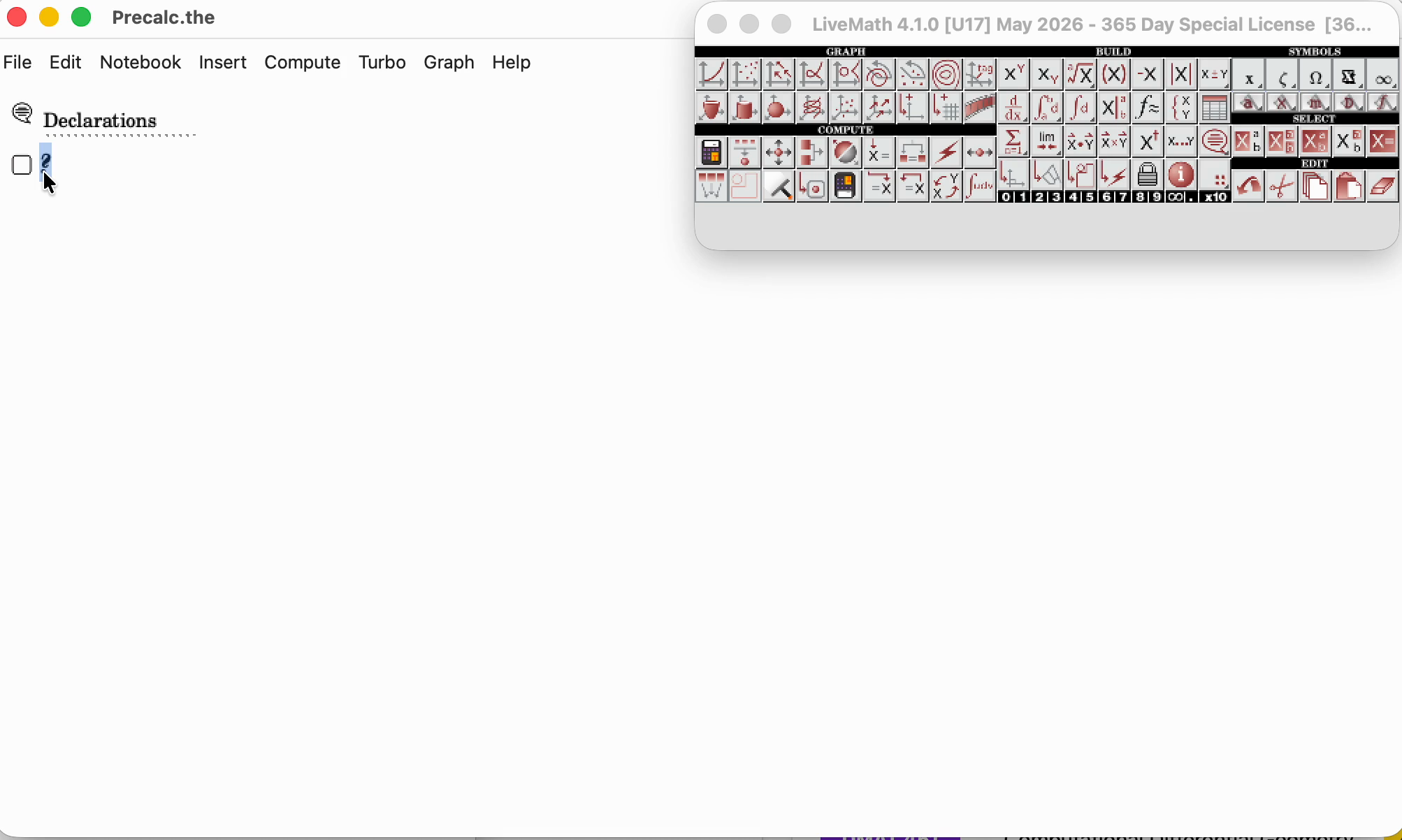
As all Distance Calculus courses are based upon curricula written in LiveMath and/or Mathematica - both powerful computer algebra
and graphing systems, we extend these tools in the Precalculus course which change the nature of the curriculum, far more than
just using a simple graphing calculator as an ancillary tool to a traditional "rote" curriculum
Empirical Learning
Instead of a "proofs-based" Precalculus course, we use the powerful computer algebra and graphing platform LiveMath to conduct
graphical, numerical, and algebraic experiments - like you would in a biology or chemistry or physics laboratory - to
empirically investigate the topics of traditional high school precalculus. "Rote" learning is replaced with
investigating the topics much more thoroughly using modern technical tools at a much deeper level, because the "Do these 1-99 odd
factoring problems" is now replaced with "Use Factor Command" - and then we ask when we can use factoring, what it does for us,
and what do we do when we cannot factor!
Asynchronous Studying
This means that the course happens on your schedule, not at fixed times. You may
work as intensely as you wish, take a break for a week or two, and then resume,
all on your needs.
Mastery Learning
The student will learn the current module of material thoroughly before moving on
to the next topic. This eliminates the "slippery slope" problem of not mastering
a previous topic when faced with a new topic.
Synchronous Communications
The majority of communication between the student and the instructors will occur
via Chat, so that problems, questions, issues, that come up are
solved in real time.
ChalkTalk Video
Video presentations of problems solved manually, "by hand", providing
the basis of the classical study of precalculus topics - we have a balance of 80% Computer Algebra and 20% By Hand Manual Computations
split of the problems. There are core problems that all students who complete a Precalculus course should be able to do by hand,
which is reinforced by the Computer Algebra assignments.
Examples of Distance Calculus Unique Approach in Precalculus
Many prospective students will have completed Algebra at some level in high school,
perhaps many years ago, and they are looking for a comprehensive course on Precalculus
before they start the Engineering Calculus I sequence. Below we list a few topics that
demonstrate the enhanced curriculum of our Precalculus course, which studies the same
topics as high school Algebra and Trigonometry, but we are able to go to much deeper levels of
investigation because of the usage of the computer algebra platform LiveMath.
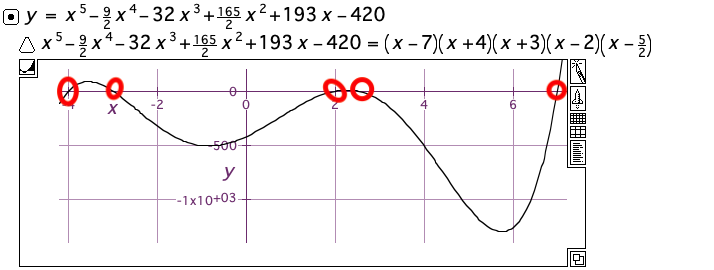
Factoring A Polynomial By Graphing Analysis
Factoring is now made rather trivial using LiveMath's Factor command:
You would never attempt to factor such a polynomial in high school algebra class by hand! After we
make the standard connection to the x-axis crossings/touches for this polynomial function graphed:
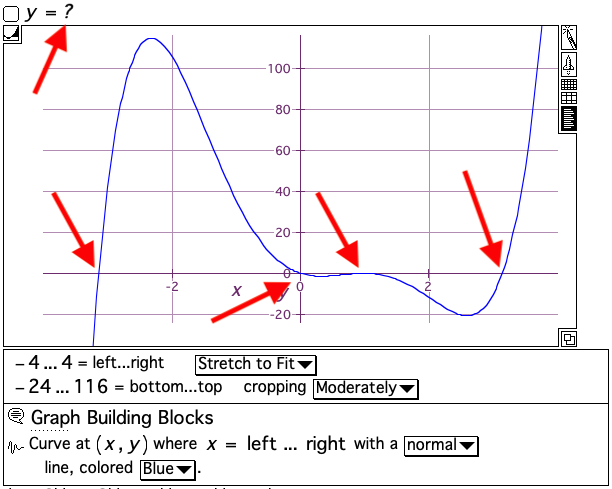
We then ask the question in reverse:
Suppose you are given the graph of a function whose algebraic formula you do not know - can you reconstruct
the algebraic formula (assuming it is a polynomial function) from just the graph?
How Complex Roots Affect A Polynomial Function Graph
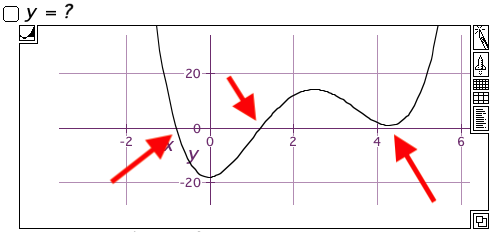
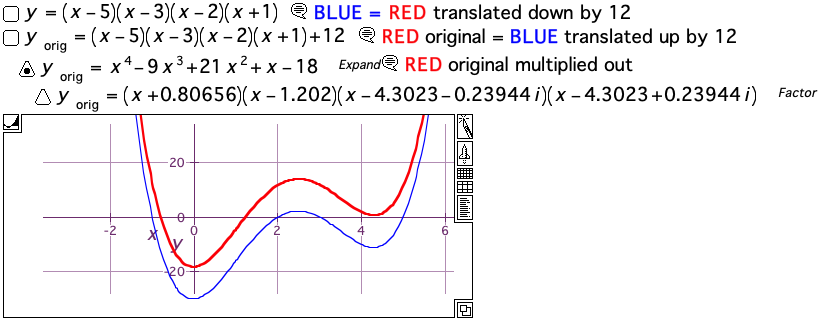
Here's what looks to be a degree 4 polynomial function - can we find its algebraic formula?
Only problem is: there are only 2 real x-axis crossings! That function wiggles, but not far enough down to
actually cross the x-axis! Turns out this wiggle is the affect of complex roots at work. But we can
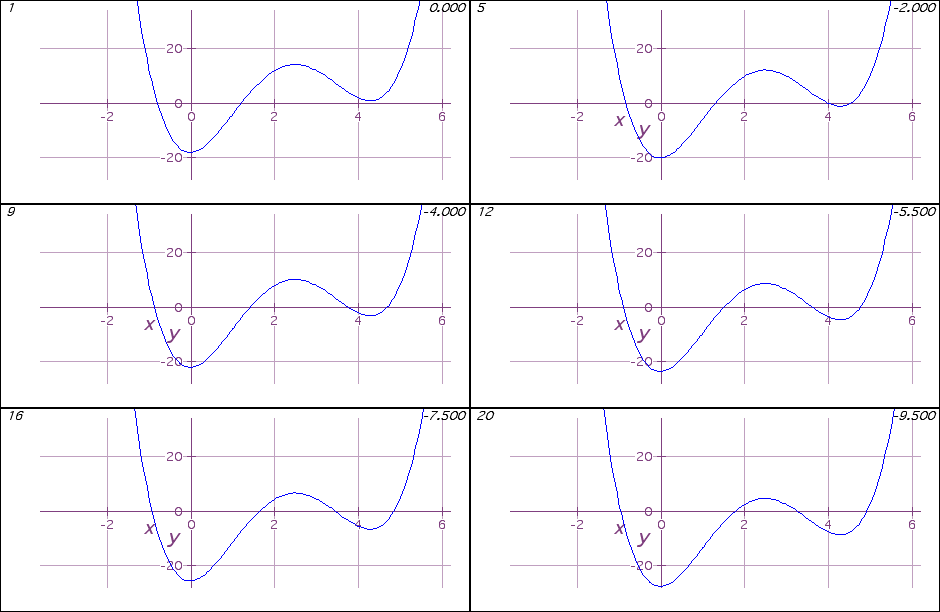
still analyze this graphically by vertically translating the graph down to force that wiggle to cross the x-axis (and cross
at nice roots, too!):
Vertical Translation of Polynomial Function
Computational Precalculus
From that translation we can get 4 real roots, create the factorization, and then ... don't forget ...
reverse the vertical translation back up, and voila!
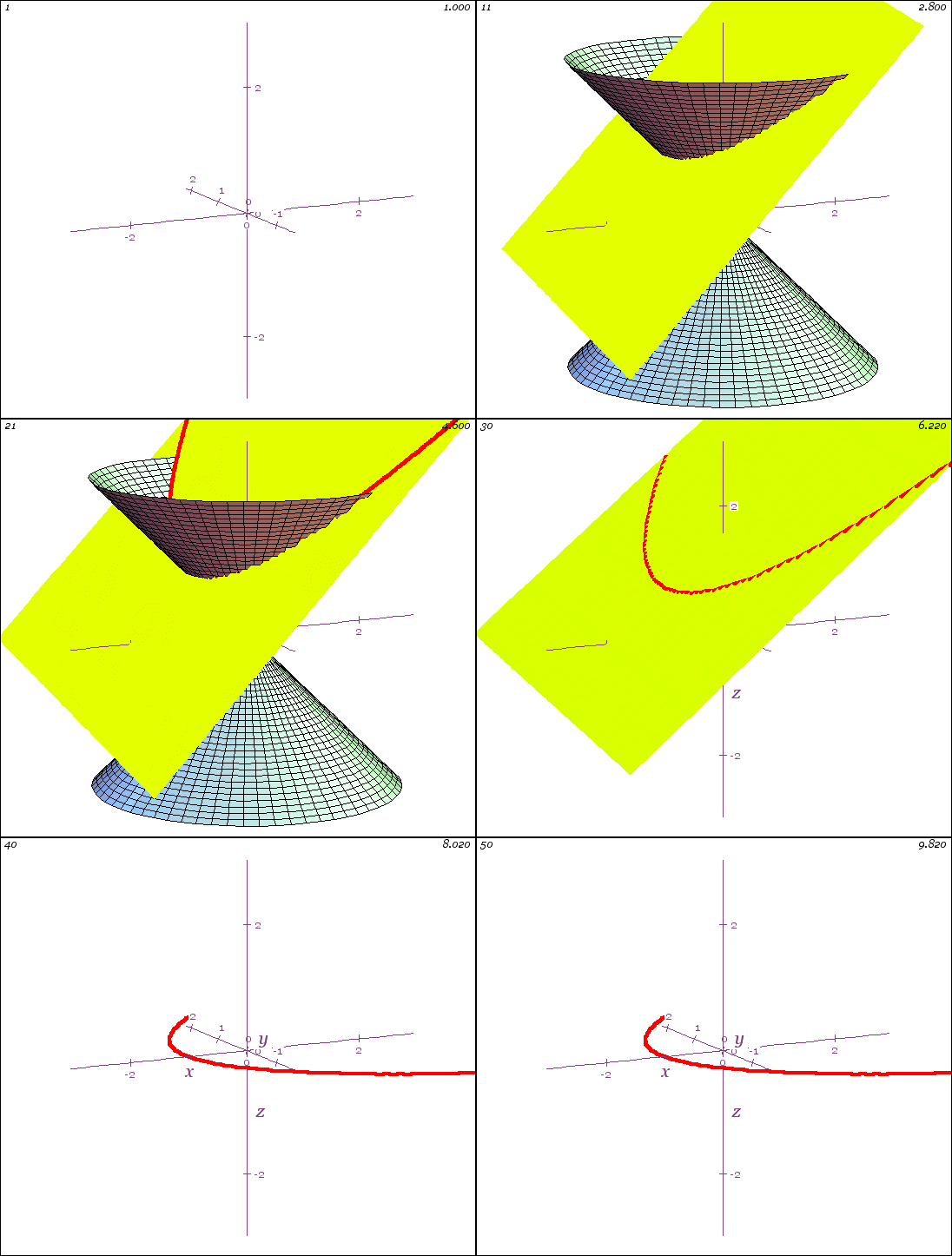
Conic Sections - Parabolas in 3D Animations
Remember parabolas, hyperbolas, ellipses in high school algebra? Well, they
never looked this cool in 3D animations on those little TI-83 calculators!
Conic Section: Parabola from Cone Slice
In our Precalculus course, the equations and analytical geometry study of
parabolas, hyperbolas, and ellipses takes on a 3D feel, where we study
much harder problems: how do we convert these slicing equations into
standard form, and rotate everything "just so" to get the standard equations
to pop out?
Other Online Precalculus Courses vs. Distance Calculus
The Distance Calculus Precalculus online course was created as a
support course for our Calculus I - Engineering Calculus sequence.
Many students who need to complete Calculus I or higher in the
engineering sequence are often not prepared for starting
Calculus I - especially
the considerably-different Calculus I online course offered via Distance Calculus.
There are many Precalculus online courses available around the internet. In almost all cases,
these other Precalculus online courses are just a re-hash of the high school algebra II and trigonometry
experience - more of the same - endless hand-calculation problem sets ("1-99 odd"), perhaps with
usage of a graphing calculator (high school Precalculus courses now routinely include the Texas Instrument
TI-83 or similar graphing calculators), and probably with a multiple choice engine where your
instructor becomes an automated machine checking answers instead of a human being.
These other online Precalculus online courses all share the same process: a paper or e-paper textbook is
provided to the student, and long problem sets of factoring polynomials, applying the quadratic formula,
interpreting word problems into solvable equations, etc.
The Educational term for these courses is: learning by rote - doing a hand-technique over and over again,
until the technical process is imprinted in your mind. Many students who go through these types of precalculus courses
are so trained that when they see an equation like the following:
x2 + 5x - 8 = 0
They immediately say "Oh, I know the quadratic formula:"
\(\frac {-b\pm\sqrt{b^2 - 4ac}}{2a}\)
But often these students are completely stumped what to do if the equation instead looks like this:
x3 + 5x + 8 = e2x
There often is a disconnect between generally solving equations for (numerical) solutions, and applying (historical) formulas
that work only in special cases (purely quadratic equations).
Many students are very successful at "rote" Precalculus courses. As almost all of the other Precalculus online courses on the internet
are exactly these "rote" courses, if you are looking for such a "plug-and-chug" Precalculus online course, you have many options, and
Distance Calculus is not for you.
If, on the other hand, diving back into another high-school-like Precalculus "rote" course does not sound appealing to you, then read on about
our Distance Calculus Precalculus online course.
A single course on the study of linear, quadratic, polynomial, rational, exponential, logarithmic, and trigonometric functions via algebraic, numerical, graphical, and narrative viewpoints, preparing the student for the Calculus sequence.
Prerequisite
Successful completion of 3 years high school mathematics (C- or higher) or instructor consent.
E-Textbook
"The Primitives of Precalculus" by Robert R. Curtis, Ph.D.
To identify, manipulate, and understand the algebraic, numerical, and graphical fundamentals of linear functions, including slope, intercepts, linear growth, and intersections of linear plots.
To identify, manipulate, and understand the algebraic, numerical, and graphical fundamentals of quadratic functions, including standard form, vertices, factoring, the quadratic formula, and complex numbers.
To identify, manipulate, and understand the algebraic, numerical, and graphical fundamentals of polynomial functions, including factoring, roots, polynomial growth, inverse functions, and the Fundamental Theorem of Algebra
To identify, manipulate, and understand the algebraic, numerical, and graphical fundamentals of rational polynomial functions, including asymptotes, common roots, solving equations.
To identify, manipulate, and understand the algebraic, numerical, and graphical fundamentals of inequalities, including solving inequalities, ranges, systems of inequalities.
To identify, manipulate, and understand the algebraic, numerical, and graphical fundamentals of exponential and logarithmic functions, including bases, exponential and logarithmic growth, solving equations involving exponentials and logarithms, and inverse function relations.
To identify, manipulate, and understand the algebraic, numerical, and graphical fundamentals of trigonometric functions, including trigonometric ratio definitions, the six trigonometric functions, trigonometric identities, solving trigonometric equations, and applications of trigonometry.
To identify, manipulate, and understand the algebraic, numerical, and graphical fundamentals of conic sections, including intersections of planes and cones, the classical conic section types, and transformation of coordinates.
DMAT 135 - Syllabus of Topics
1. Getting Started
1.1. Email and Chat
1.2. Learning About the Course
1.3. Required Computer Hardware
1.4. Software Fundamentals
2. The Big Picture
2.1. Solving (easy) equations in 1 variable.
2.2. What if you can’t solve for x?
2.3. Finding solutions numerically
2.4. Finding solutions graphically
2.5. Solving equations of more than 1 variable
3. Functions
3.1. Function notation
3.2. Data sets
3.3. Graphing functions
3.4. Data sets and smooth curves
3.5. Domain and Range
3.6. Algebraic combinations of functions
4. Linear Functions
4.1. Algebraic definition
4.2. Slope
4.3. Graphing linear functions by hand
4.4. Properties of linear functions
4.5. Linear data sets
5. Quadratic Functions
5.1. Algebraic definition
5.2. Graphing and Properties of Quadratic Functions
In 2023, Distance Calculus introduced a new catalog of courses. New DMAT 135 = Old DMAT 136 = Old MATH 136
Description
The focus of this course is on functions, which are of central importance in Calculus. Topics include definitions, properties, and applications of algebraic, inverse, exponential, logarithmic and trigonometric functions. (4 credits)
One of the ongoing themes of the Precalculus curriculum is bridging between the classical approach to
Precalculus with pen/paper - or chalk on a chalkboard - and using the modern LiveMath computer algebra
and graphing platform. Often the video assignments come in pairs, with the same core topic explained
in both ChalkTalk format and also in LiveMath format.
Introduction to Cubic Functions
Solving Equations and Inequalities
Complex Number Multiplication and Division
Exponential and Logarithm Functions
Trigonometric Functions
Student Work Assignments
Students will complete a variety of types of homework assignments, including:
Written Solution Sets
Students will complete written solution sets, take a photo with your phone, and turn them in on-line for
grading. These problem sets will be from the classical side of the precalculus
curriculum - the "math you need to be able to do by hand."
Computer Algebra Notebook Solution Sets
Students will complete notebook questions in using LiveMath software
dealing with more modern types of questions in Precalculus requiring technological
approaches.
Video Solution Sets
Students will complete some Video Solutions of various problems,
and turn these videos in on-line for grading, expanding upon both types of
solution sets with more of a "Now You Explain It".
Similar to our Distance Calculus course structure, this course is based upon heavy
amounts of communication between the student and the instructional team. All assignments
are based upon the mastery learning model, and turned in recursively back-and-forth
between student and instructor until 100% mastery is achieved.
This is an excellent course for the computer novice. Even if checking your email is a
not a "natural" activity for you, the Distance Precalculus course is an excellent way to
simultaneously prepare for Calculus, and conquer whatever
computer "phobia" fears you may have.
Distance Calculus students have transferred course credits to these colleges and universities:
Agnes Scott College • Aiken Technical College • Albany College of Pharmacy and Health Science • Alma College • American Graduate University • American Public University • American University • Andrews University • Arizona State University • Armstrong Atlantic State Univeristy • Athens State University • Auburn University • Auburn University MBA Program • Augusta State University • Austin Peay State University • Azusa Pacific University • Babson College • Baruch College • Baylor University • Belmont University • Beloit College • Bentley University • Berklee College of Music • Berry College • Bethany College • Binghamton University • Bloomsburg University • Bluefield State College • Bluegrass Community and Technical College • Borough of Manhattan Community College • Boston Conservatory • Boston University • Bryant University • Buena Vista University • California Lutheran University • California Polytechnic State University, San Luis Obispo • California state University • California State University Channel Islands • California State University, Dominguez Hills • California State University, Sacramento • Carleton College • Carnegie Mellon University • Cedarville University • Central Michigan University • Central Washington University • Champlain College • Chapman University • Charter Oak State College • Chicago State University • Clark University • Clarkson University • Clemson University • Cleveland State University • Coastal Carolina University • College of Santa Fe • College of William & Mary • Colorado Mesa University • Colorado State University • Columbia University • Columbia University School of Business • Cornell Univeristy • Cornell University • Covenant College • CUNY Medgar Evers College • Denison University • DePaul University • Drexel University • Duke University - Fuqua School of Business • Duke University School of Law • Duke University, Durham NC • Duke University, Fuqua School of Business, Law School, Graduate Programs • East Stroudsburg University • Eastern Illinois University • Eastern Kentucky University • Eastern Mennonite University • Eastern Nazarene College • Elon University • Embry Riddle Aeronautical University • Embry Riddle University • Endicott College • Evangel University • Excelsior College • Fairifield University • Fairleigh Dickenson University • Ferris State University • Florida A & M University • Florida Agricultural and Mechanical University • Florida Atlantic University • Florida Institute of Technology • Florida International University • Florida State College, Jacksonville • Florida State University • Fordham University • Fox Valley Technical College • Franklin University • Freed-Hardamen University • Fresno State University • Friends University • Gannon University • George Mason university • George Washington University • George Washington University School of Business • Georgetown University • Georgia Institute of Technology • Georgia State • Georgia State University • Georgia Tech • Gordon College • Governor's State University • Green Mountain College • Griffith University • Grinnell College • Grove City College • Hamline University • Hampshire College • Hampton University • Harvard University, Kennedy School of Government • Harvard University: Kennedy School of Government, Medical Schools • Hillsdale College • Hillsdale University • Hiram College • Hofstra University • Howard University • Huntingdon College • Illinois Institute for Technology • Illinois Institute of Technology • Indiana University • Iowa State University • Jacksonville State University • James Madison University • Jeff State Community College • Johns Hopkins Univerisity • Johns Hopkins University • Kalamazoo College • Kansas State University • Kaplan University • Kennesaw State University • Kentucky State University • Kettering University • Kings College, University of London • La Sierra University • Lebanon Valley College • Lee University • LeTourneau University • Liberty University • Lincoln University of Pennsylvania • Lipscomb University • Loma Linda University • London School of Economics • Loyola Marymount University • Luther College • Macon State College • Marian University • Marquette University • Mars Hill College • Marshall University • Mary Baldwin College • Massachusetts Maritime Academy • McHenry County College • Mercer University • Mercyhurst College • Meredith College • Mesa State College • Messiah College • Miami University • Michigan State University • Michigan Technological University • Middle Tennessee State University • Middlebury College • Millersville University • Missouri University of Science and Technology • Montana State University • Montana Tech • Montclair University • Morehead State University • Murray State University • Naval Post Graduate School • New Mexico Military Institute • New Mexico State University • New York University • North Carolina Agricultural and Technical State Univerisity • Northeastern University • Northern Arizona University • Northern Michigan University • Northwest Nazarene University • Northwestern University • Oberlin College • Occidental College • Oglethorpe University • Oklahoma Baptist University • Old Dominion University • Olympic College • Orange Coast College • Oregon State University • Pacific Lutheran University • Penn State University • Pennsylvania State University • Pepperdine University • Pomona College • Portland State University • Princeton University • Purdue University • Quinnipiac University • Randolph-Macon College • Regent University • Regis University • Rensselaer Polytechnic Institute • Rhode Island School of Design • Rice University • Robert Morris University • Rochester Institute of Technology • Roger Williams Univerity • Roger Williams University • Roosevelt University • Rowan University • Rutgers University • Saint Anselm College • Saint Joseph's University • Saint Louis University • Saint Michael's College • Salve Regina University • Samford University • San Diego State University • Santa Fe Community College • Shepherd University • Smith College • South Dakota School of Mines and Technology • Southern Adventist University • Southern Methodist University • St. Anselm College • St. John's College • St. Mary's College of Maryland • Stanford University • Stanford University, MBA • State University at Buffalo Law School • State University at Buffalo, Law School • State University of New York • Stevens Institute of Technology • Strayer University • SUNY Binghamton • Swarthmore College • Syracuse University • Texas A&M University • Texas A&M • Texas A&M University • Texas Tech University • The Art Institute of Atlanta • The Catholic University of America • The Citadel • The Citadel, Military College of South Carolina • The College of New Jersey • The College of St. Scholastica • The George Washington University • The Master's College • The New England Institute of Art • The Ohio State Universtity • The University of Alabama • The University of South Carolina • The University of Texas at Austin • The University of Virginia • Thomas Edison State College • Trinity University • TUI University • Tulane University • Union University • United States Air Force Academy • United States Military Academy • Univeristy of Puget Sound • University of Alabama, Huntsville • University of Arizona • University of Arkansas, Little Rock • University of Auckland, New Zealand • University of California, Berkeley • University of California, Los Angeles • University of California, Santa Barbara • University of California, Santa Cruz • University of Central Florida • University of Central Oklahoma • University of Central Texas • University of Chicago • University of Cincinnati • University of Colorado • University of Colorado, Boulder • University of Colorado,Colorado Springs • University of Connecticut • University of Dallas • University of Findlay • University of Florida • University of Georgia • University of Hartford • University of Hawai'i-Manoa • University of Illinois • University of Kentucky • University of La Verne • University of Maine • University of Maryland • University of Massachusetts • University of Massachusetts, Amherst • University of Memphis • University of Michigan • University of Michigan: MBA, Medical Schools, Graduate Programs • University of Minnesota • University of Minnesota, School of Public Health • University of Minnesota, Twin Cities • University of Minnesota-Twin Cities • University of Mississippi • University of Missouri • University of Missouri, Columbia • University of Montana • University Of Mount Union • University of Nebraska • University of Nevada • University of New Hampshire Law School • University of New Haven • University of New Orleans • University of North Carolina • University of North Carolina at Chapel Hill • University of North Carolina, Chapel Hill • University of North Carolina, MBA • University of North Dakota • University of North Texas • University of Northern Iowa • University of Notre Dame • University of Oklahoma • University of Otago • University of Pennsylvania • University of Pennsylvania Architectural School • University of Pennsylvania, Wharton School of Business • University of Phoenix • University of Pittsburgh • University of Portland • University of Redlands • University of Richmond • University of San Francisco • University of South Carolina • University of Southern California • University of Southern Indiana • University of Sussex • University of Tampa • University of Tennessee • University of Texas • University of Texas at Austin • University of Texas, Arlington • University of Texas, Austin • University of Texas, Brownsville • University of Texas, Dallas • University of Texas, Houston • University of Utah • University of Virginia • University of Warwick • University of West Alabama • University of West Florida • University of West Georgia • University of Wisconsin • University of Wisconsin, Madison • University of Wyoming • University West Florida • US Air Force Academy • Utah State University • Utah Valley University • Valdosta State University • Valley Forge Military College • Vanderbilt University • Villanova University • Virginia Military Institute • Virginia Tech • Walla Walla University • Washing State University • Washington and Lee University • Washington State University • Webster University • West Chester University • West Virginia University • West Virginia Wesleyan College • Western Governors University • Western Kentucky University • Western Michigan University • Westminster College • Wharton School of Business, University of Pennsylvania • Wheaton College • Wheaton College (IL) • Wheaton College Illinois • Whitman College • Whittier College • Widener University • William and Mary • William Jewell College • Winthrop University • Woodbury University • Wright State University • Yale University • Yeshiva University • Yonsei University
Distance Calculus - Student Reviews
Teddy M.★★★★☆
Posted: Feb 28, 2020
Courses Completed: Precalculus, Calculus I
Pros: once you get going, you can go really fast. The visual textbook is pretty cool. The instructors were very responsive.
Cons: the movies are great, but the software crashes more than it should. Sometimes it is just a hassle doing things in the software instead of on paper, but once I got used to the software, it was ok.
Transferred Credits To: Texas Christian University
Bradley R.★★★★★
Posted: May 18, 2025
Courses Completed: Probability Theory
A great way to learn probability theory through visualizations, code, and math. Rather than just solving equations through pencil and paper, this course helped me to see how how probability distributions form and behavior through simulations and visuals. I would recommend this course to anyone looking for a way a more interactive way to learn mathematics and at their own pace.
Transferred Credits To: none yet
Emma C.★★★★★
Posted: Jul 22, 2021
Courses Completed: Linear Algebra
This was a great course. Flexible and informative with a great professor. It's a great option if you need to fill a prerequisite fast or if you enjoy working at your own pace.
Transferred Credits To: University of Virginia
Ryan★★★★★
Posted: Aug 28, 2026
Courses Completed: Finite Math
I will preface this review by saying that if you are looking to take the easiest course possible, cheat through it, and learn as little as possible, this is not the course for you. Below, I will provide my uncensored opinions to this course:
First, this course uses software called LiveMath. This software can be a little bit challenging to get the hang of, but once you do get the hang of it, it's super easy. Remember that for all new things, it takes a bit to get used to it. Overall, I was highly satisfied with this course. I thought that the instructions were extremely detailed, including a video and a textbook explaining every different concept. In addition, this course offered exposure to a lot of different aspects of finite math. I think that many would agree with me on the following, that, you know, when a teacher is passionate about what they are teaching, it is so much more enjoyable, and you can definitely see that in this course. This course can be challenging at times. Maybe it'll be easy for you, maybe it'll be hard, but I think it's important to remember that the things that challenge us are, you know, the things that make us learn and the things that make us better. There's also a math chat option for if you need help or if you have any questions. Overall, I would recommend this course. I actually initially went into this course looking for an easy course to just help me get the credit requirements, but it ended up being an amazing learning experience and completely shifted my perspective on math overall. And another thing that I thought was great in this course is throughout so many different lectures, the professor would explain how each different thing can be applicable in life. And I think that, you know, that is a lot of what people think about when they are learning something. They're like, will I ever use this? Do I need to learn this? And a lot of this actually is really applicable. And I think that even if, you know, you may not be doing these math equations in your future, I think that, you know, the psychology behind these and the rules can be applied to so many different fuacets of life.
Transferred Credits To: GWU
Aiden B.★★★★★
Posted: Jul 29, 2026
Courses Completed: Calculus II, Multivariable Calculus, Differential Equations, Linear Algebra
After completing all the math offered by my highschool, I switched over to Roger Williams for Calculus II and onward. Overall, it has been a pretty great way to understand the topics online, with transferrable college credits. The exams are not terrible, and the courses cover the vast majority (if not all) of topics covered by traditional courses, with some unique ones added to. So far, I have taken four courses, with another one or two before I graduate.
The only problem with the course is the lack of pen and paper work. This shouldn't come as a crazy surprise with an online course, but there is not much emphasis on symbolic computation. Mathematica or other software does most of the heavy computation for you. The lectures usually show how to solve the problems through paper, but those skills are rarely put into practice. Literacy Sheets act as a way to do some of that (especially with the Calculus II & III course).
All in all, this isn't a huge issue. I just memorize and practice things like double integration, Laplace, ODE solving, matrix diagonalized form, row operations, etc. With a little outside work, this resolves itself. Without Roger WIlliams, I probably would not have been able to take any of these math courses in highschool.
So overall, a great choice for highschool advanced math, especially with transferrable credits.
Email: abarger@protonmail.com
Lucas L.★★★★★
Posted: Jun 25, 2026
Courses Completed: Multivariable Calculus
The professor as well as the TAs give great feedback when you need help with problems and the videos are great at explaining concepts. Return time on work is good and the work is not too much to handle.
Are There Any Prerequisites for the Precalculus Course?
No, not really. The student is expected to have "High School Algebra" but nearly all U.S. college/university students
have taken High School Algebra, probably Algebra II, as that is a universal requirement for college/university. We do start
at the very beginning, and assume that even though you have taken High School Algebra, you may not remember much of it.
Does Precalculus Include Trigonometry?
Yes. Precalculus is often called "Precalculus With Trigonometry" to remind everyone of the trigonometry component.
Essentially Precalculus is, as the name suggests, the course you take before Calculus I.
Do I Need To Take Precalculus Before Applied Calculus?
No. Precalculus is a prerequisite for the higher Calculus I STEM sequence; not for the lower Applied Calculus,
single-semester course on calculus.
Is Precalculus Boring?
Well not from Distance Calculus! Our Precalculus course is quite progressive, exploring the topics of Precalculus
with a laboratory-minded approach, using graphical, algebraic, and numerical tools to have a refreshing investigation
(or re-investigation) of the topics of Precalculus, including Trigonometry.
Is Precalculus from Distance Calculus Accredited?
Yes, All Distance Calculus courses are offered through Roger Williams University in Providence, Rhode Island, USA,
which is regionally accredited (the highest accreditation) through New England Commission of Higher Education (NECHE).