STEM Calculus III - DMAT 273 - is a SPECIAL BRIDGE COURSE in the freshman (engineering) calculus sequence (STEM:
Science, Technology, Engineering, and Mathematics) which is NOT NEEDED by MOST STUDENTS.
Common Semester Sequence For Calculus
The common sequence for lower division calculus looks something like this at most colleges/universities in the U.S.:
Some U.S. Colleges/Universites are on the QUARTER System instead of the Semester System, additionally split their lower division Calculus sequence like this:
For those students who are attempting to articulate to a Quarter-like Calculus sequence, we offer the Special Bridge Calculus III course,
which, topic-wise, is 50% of our DMAT 263 - Calculus II course + 20% of our DMAT 355 - Multivariable Calculus course.
WARNING: If you are taking our standard Freshman and Sophomore Calculus sequence, you
DO NOT NEED to take this DMAT 273 - Calculus III special bridge course.
All Students Applying To Enroll in DMAT 273 - Calculus III will be screened to
assure they are taking this extra course due to articulation needs at their college/university.
Completion of DMAT 273 - STEM Calculus II earns 3 academic credit semester hours with an official academic transcript from Roger Williams University,
in Providence, Rhode Island, USA, which is regionally accredited by the New England
Commission of Higher Education (NECHE), facilitating transfer of credits nationwide to other colleges and universities.
Distance Calculus students have transferred course credits to these colleges and universities:
Agnes Scott College • Aiken Technical College • Albany College of Pharmacy and Health Science • Alma College • American Graduate University • American Public University • American University • Andrews University • Arizona State University • Armstrong Atlantic State Univeristy • Athens State University • Auburn University • Auburn University MBA Program • Augusta State University • Austin Peay State University • Azusa Pacific University • Babson College • Baruch College • Baylor University • Belmont University • Beloit College • Bentley University • Berklee College of Music • Berry College • Bethany College • Binghamton University • Bloomsburg University • Bluefield State College • Bluegrass Community and Technical College • Borough of Manhattan Community College • Boston Conservatory • Boston University • Bryant University • Buena Vista University • California Lutheran University • California Polytechnic State University, San Luis Obispo • California state University • California State University Channel Islands • California State University, Dominguez Hills • California State University, Sacramento • Carleton College • Carnegie Mellon University • Cedarville University • Central Michigan University • Central Washington University • Champlain College • Chapman University • Charter Oak State College • Chicago State University • Clark University • Clarkson University • Clemson University • Cleveland State University • Coastal Carolina University • College of Santa Fe • College of William & Mary • Colorado Mesa University • Colorado State University • Columbia University • Columbia University School of Business • Cornell Univeristy • Cornell University • Covenant College • CUNY Medgar Evers College • Denison University • DePaul University • Drexel University • Duke University - Fuqua School of Business • Duke University School of Law • Duke University, Durham NC • Duke University, Fuqua School of Business, Law School, Graduate Programs • East Stroudsburg University • Eastern Illinois University • Eastern Kentucky University • Eastern Mennonite University • Eastern Nazarene College • Elon University • Embry Riddle Aeronautical University • Embry Riddle University • Endicott College • Evangel University • Excelsior College • Fairifield University • Fairleigh Dickenson University • Ferris State University • Florida A & M University • Florida Agricultural and Mechanical University • Florida Atlantic University • Florida Institute of Technology • Florida International University • Florida State College, Jacksonville • Florida State University • Fordham University • Fox Valley Technical College • Franklin University • Freed-Hardamen University • Fresno State University • Friends University • Gannon University • George Mason university • George Washington University • George Washington University School of Business • Georgetown University • Georgia Institute of Technology • Georgia State • Georgia State University • Georgia Tech • Gordon College • Governor's State University • Green Mountain College • Griffith University • Grinnell College • Grove City College • Hamline University • Hampshire College • Hampton University • Harvard University, Kennedy School of Government • Harvard University: Kennedy School of Government, Medical Schools • Hillsdale College • Hillsdale University • Hiram College • Hofstra University • Howard University • Huntingdon College • Illinois Institute for Technology • Illinois Institute of Technology • Indiana University • Iowa State University • Jacksonville State University • James Madison University • Jeff State Community College • Johns Hopkins Univerisity • Johns Hopkins University • Kalamazoo College • Kansas State University • Kaplan University • Kennesaw State University • Kentucky State University • Kettering University • Kings College, University of London • La Sierra University • Lebanon Valley College • Lee University • LeTourneau University • Liberty University • Lincoln University of Pennsylvania • Lipscomb University • Loma Linda University • London School of Economics • Loyola Marymount University • Luther College • Macon State College • Marian University • Marquette University • Mars Hill College • Marshall University • Mary Baldwin College • Massachusetts Maritime Academy • McHenry County College • Mercer University • Mercyhurst College • Meredith College • Mesa State College • Messiah College • Miami University • Michigan State University • Michigan Technological University • Middle Tennessee State University • Middlebury College • Millersville University • Missouri University of Science and Technology • Montana State University • Montana Tech • Montclair University • Morehead State University • Murray State University • Naval Post Graduate School • New Mexico Military Institute • New Mexico State University • New York University • North Carolina Agricultural and Technical State Univerisity • Northeastern University • Northern Arizona University • Northern Michigan University • Northwest Nazarene University • Northwestern University • Oberlin College • Occidental College • Oglethorpe University • Oklahoma Baptist University • Old Dominion University • Olympic College • Orange Coast College • Oregon State University • Pacific Lutheran University • Penn State University • Pennsylvania State University • Pepperdine University • Pomona College • Portland State University • Princeton University • Purdue University • Quinnipiac University • Randolph-Macon College • Regent University • Regis University • Rensselaer Polytechnic Institute • Rhode Island School of Design • Rice University • Robert Morris University • Rochester Institute of Technology • Roger Williams Univerity • Roger Williams University • Roosevelt University • Rowan University • Rutgers University • Saint Anselm College • Saint Joseph's University • Saint Louis University • Saint Michael's College • Salve Regina University • Samford University • San Diego State University • Santa Fe Community College • Shepherd University • Smith College • South Dakota School of Mines and Technology • Southern Adventist University • Southern Methodist University • St. Anselm College • St. John's College • St. Mary's College of Maryland • Stanford University • Stanford University, MBA • State University at Buffalo Law School • State University at Buffalo, Law School • State University of New York • Stevens Institute of Technology • Strayer University • SUNY Binghamton • Swarthmore College • Syracuse University • Texas A&M University • Texas A&M • Texas A&M University • Texas Tech University • The Art Institute of Atlanta • The Catholic University of America • The Citadel • The Citadel, Military College of South Carolina • The College of New Jersey • The College of St. Scholastica • The George Washington University • The Master's College • The New England Institute of Art • The Ohio State Universtity • The University of Alabama • The University of South Carolina • The University of Texas at Austin • The University of Virginia • Thomas Edison State College • Trinity University • TUI University • Tulane University • Union University • United States Air Force Academy • United States Military Academy • Univeristy of Puget Sound • University of Alabama, Huntsville • University of Arizona • University of Arkansas, Little Rock • University of Auckland, New Zealand • University of California, Berkeley • University of California, Los Angeles • University of California, Santa Barbara • University of California, Santa Cruz • University of Central Florida • University of Central Oklahoma • University of Central Texas • University of Chicago • University of Cincinnati • University of Colorado • University of Colorado, Boulder • University of Colorado,Colorado Springs • University of Connecticut • University of Dallas • University of Findlay • University of Florida • University of Georgia • University of Hartford • University of Hawai'i-Manoa • University of Illinois • University of Kentucky • University of La Verne • University of Maine • University of Maryland • University of Massachusetts • University of Massachusetts, Amherst • University of Memphis • University of Michigan • University of Michigan: MBA, Medical Schools, Graduate Programs • University of Minnesota • University of Minnesota, School of Public Health • University of Minnesota, Twin Cities • University of Minnesota-Twin Cities • University of Mississippi • University of Missouri • University of Missouri, Columbia • University of Montana • University Of Mount Union • University of Nebraska • University of Nevada • University of New Hampshire Law School • University of New Haven • University of New Orleans • University of North Carolina • University of North Carolina at Chapel Hill • University of North Carolina, Chapel Hill • University of North Carolina, MBA • University of North Dakota • University of North Texas • University of Northern Iowa • University of Notre Dame • University of Oklahoma • University of Otago • University of Pennsylvania • University of Pennsylvania Architectural School • University of Pennsylvania, Wharton School of Business • University of Phoenix • University of Pittsburgh • University of Portland • University of Redlands • University of Richmond • University of San Francisco • University of South Carolina • University of Southern California • University of Southern Indiana • University of Sussex • University of Tampa • University of Tennessee • University of Texas • University of Texas at Austin • University of Texas, Arlington • University of Texas, Austin • University of Texas, Brownsville • University of Texas, Dallas • University of Texas, Houston • University of Utah • University of Virginia • University of Warwick • University of West Alabama • University of West Florida • University of West Georgia • University of Wisconsin • University of Wisconsin, Madison • University of Wyoming • University West Florida • US Air Force Academy • Utah State University • Utah Valley University • Valdosta State University • Valley Forge Military College • Vanderbilt University • Villanova University • Virginia Military Institute • Virginia Tech • Walla Walla University • Washing State University • Washington and Lee University • Washington State University • Webster University • West Chester University • West Virginia University • West Virginia Wesleyan College • Western Governors University • Western Kentucky University • Western Michigan University • Westminster College • Wharton School of Business, University of Pennsylvania • Wheaton College • Wheaton College (IL) • Wheaton College Illinois • Whitman College • Whittier College • Widener University • William and Mary • William Jewell College • Winthrop University • Woodbury University • Wright State University • Yale University • Yeshiva University • Yonsei University
STEM Calculus III Introductory Videos
STEM Calculus III Course Introduction
The third quarter/semester of 1st year Calculus is the preparatory course for all of the 2nd year
courses (Multivariable Calculus, Differential Equations, Linear Algebra). Often referred to as
"the last course on single-variable differential and integral calculus", STEM Calculus III contains the topics
from the last half of our DMAT 263 - Calculus II course on sequences, series, Taylor's Theorem - via Splines - and
first portion of the DMAT 355 - Multivariable Calculus & Vector Analysis.
STEM Calculus III is comprised of two distinct parts:
Taylor's Theorem
The general concept of approximating functions using infinite polynomials, which requires the
discussion on sequences, series, convergence, divergence, and error analysis.
Introduction to Multivariable Calculus
A selection of topics from the Multivariable Calculus course, specially about planes, dot products, and partial derivatives,
with these topics having very little to do with the Taylor's Theorem portion of the course, but added only because of
historical and articulation needs. These topics are usually the last few chapters in the big, thick first year Calculus course textbook.
RWU Course Catalog - DMAT 273 • STEM Calculus III
Course
DMAT 273
Course Title
STEM Calculus III
Transcript Title
Calculus III
Credits
3 Semester Credit Hours
Description
A third course in the differential and integral calculus for engineering and science with emphasis on computational techniques, graphical analysis, and algebraic methods. Topics include splines, barriers, Taylor's Theorem, L'Hopital's Rule, infinite sequences and series, selected topics from three dimensional calculus and geometry.
Prerequisite
Successful completion (C- or higher) of Calculus II or equivalent, or consent of instructor.
E-Textbook
Calculus & LiveMath by Robert R. Curtis, Ph.D., adapted from Davis/Porta/Uhl Calculus&Mathematica courseware series
To understand and compute parametric and Polar function integrals
To understand and compute splines and polynomial approximations
To understand and compute with Taylor's Theorem
To understand and compute with L'Hopital's Rule and using expansions to compute limits
To understand and compute sequences and series
To understand and compute convergence or divergence of sequences and series
To understand and compute 3D vector analysis, dot product, planes, and cross products
To understand and compute partial derivatives and tangent planes to a surface
DMAT 273 - Syllabus of Topics
1. Getting Started
1.1. Email and Chat
1.2. Learning About the Course
1.3. Required Hardware
1.4. Software Fundamentals
2. Taylor’s Expansion of a Function
2.1 Splines and Smooth Splines
2.2 Points of Contact
2.3 Application: Landing an Airplane
2.4 Taylor Expansion
2.5 Recognizing Familiar Expansions
2.6 Using Expansions for Approximations
2.7 Derivatives and Integrals of Expansions
2.8 Expansions At Other Points
2.9 Newton’s Method
2.10 Calculating Limits: L’Hopital’s Rule
3. Sequences and Series
3.1 Sequences of Numbers
3.2 Series of Numbers
3.3 Convergence
3.4 Convergence of Taylor Expansions
3.5 Barriers: Radius of Convergence
3.6 Shared Convergence Intervals for Derivatives and Integrals of Functions
3.7 Applications: Drug Dosing
4. Power Series
4.1 Basic Definition
4.2 Convergence Intervals of Power Series
4.3 Ratio Test and Other Convergence Tests
4.4 Finding Series Convergence Values via Power and Taylor Series
5. Polar Coordinates
5.1 Basic Graphing
5.2 Recognizable Curves
5.3 Differentiation and Integration in Polar Coordinates
6. Vector Analysis
6.1 Vector Arithmetic
6.2 Dot Product, Cross Product
6.3 Planes
6.4 Partial Derivatives
6.5 Tangent Planes
Calculus III - Example Curriculum
Videotext - A Modern Replacement of the Textbook
What is a videotext? It is like a textbook, except instead of being based upon
printed information, this "text" is based upon video presentations as the core method
of explaining the course topics. Instead of a huge, thick 1000-page Calculus textbook
to lug around in your backpack, all of this new "videotext" can be loaded into your
iPods or iPhones (and soon, the iPad!).
Example Videos are in MP4/H.264 format, which play in most modern browsers without
additional software. When additional software is required, a backup Flash player will
play the video. As a backup to Flash, you may also use iTunes and/or VLC.
Although we are anywhere from a few miles to a few thousand miles apart, watching these
screencast videos is like sitting next to the course instructor, watching his computer,
learning the topics of Calculus at the same time as learning how to drive the computer
algebra and graphing software LiveMath™. These LiveMath™ screencast
videos make up the majority of the video presentations in the videotext.
Calculus III - Screencast Video Questions
One extremely powerful aspect of the Distance Calculus course technologies is the usage
of screencast video (and audio) recordings made by the students and the instructors,
exchanged just as easily as emails back and forth.
If a picture is worth a thousand words, then a screencast movie is worth a million words -
and saves boatloads of time and effort.
Instead of trying to type out a math question about a particular topic or homework question,
the ease of "turning on the screen recorder" and talking and showing your question - in the span
of a few minutes - can save hours of time trying to convert your question into a typed
(and coherent) narrative question.
Example Student/Instructor Question/Answer Movies
When a student asks a question in a homework notebook, sometimes the best way to explain
the answer is via a screen movie. We utilize easy-to-use software to create screen movies with audio so that you
can communicate with your instructor "as if they were sitting at the computer with you". Students don't ask questions
like this everytime they have a question, but it is a good way to ask questions after text chats aren't working.
If a picture is worth a thousand words, and a movie is worth a thousand pictures, then a movie with audio is worth 1000*1000*1000 = 1,000,000,000 (billion) words!
Calculus III - Example Student Work and Grading
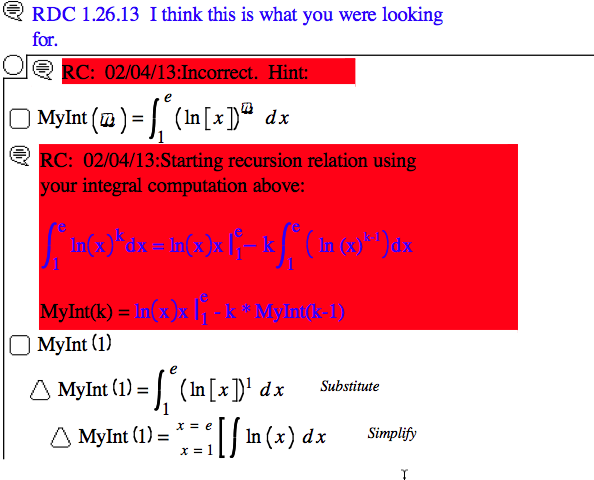
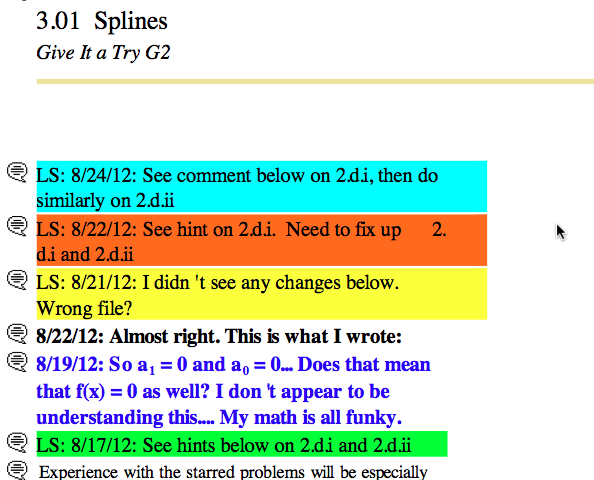
Course work occurs via LiveMath notebooks - interactive documents for mathematical computation. Students submit notebooks, instructors grade and give feedback, and notebooks go back and forth until mastery is achieved (typically 2-5 revisions).
A fantastic course! I was able to complete it in about half a year (with a few gaps) alongside other coursework I was completing. There are no deadlines except the one-year mark after registering, so you work at your own rate and schedule.
Probability Theory is required for me to apply to Master's programs in Statistics, so I was glad when I found Distance Calculus. While the course was slightly less difficult than I originally expected, there were parts that definitely slowed me down and made me think. (Also, although calculus is not everywhere in the course, it is everywhere in normal and exponential variables and beyond, so make sure to review derivatives and integrals (single and double)!) I used Mathematica for my software, and it helped speed along calculations and proved to be the perfect stage and tool for this material. I think visual learners will absolutely revel in how the material is presented in this course. (I know I did!) As there is plenty of writing and calculation to do, you have many opportunities to develop and strengthen your voice as a mathematician. The modern format of 80% electronic notebook work and 20% handwritten work is an excellent mixture for studying probability theory and grasping its core ideas. Dr. Curtis is clear in his answers to any questions and concerns you may have and is highly responsive to email and chat, and to responses you leave in your notebooks. He truly wants to help you and to see you succeed, and he is always on your side.
I highly recommend Probability Theory with Distance Calculus!
Email: comojica@ucdavis.edu
Emmy★★★★★
Posted: May 26, 2025
Courses Completed: Applied Calculus
Distance Calculus was the perfect answer to getting ahead in math over the summer of my junior year in HS. I was able to complete the entire course over the summer. The teacher was responsive and the course was understandable. Highly recommend.
Transferred Credits To: Syracuse University
Genevieve P.★★★★★
Posted: Sep 20, 2020
Courses Completed: Applied Calculus
I found out from my grad school after being accepted that I needed a Calculus course before starting their MBA program. I had less than 6 weeks to do it (and as a non-STEM undergrad no less). The video lectures were informative, the pre-calc refresher was great to get re-conditioned, and the asynchronous format worked so well as I did this at night/weekends after work. I completed it in 4 weeks. Professor Curtis was extremely responsive, graded assignments quickly, and a supportive guide providing constructive feedback to me to excel at the assignments. I highly recommend this course for those who need a pre-req in a hurry or like learning on their own schedule. Thanks, Distance Calculus and Professor Curtis!
Transferred Credits To: Massachusetts Institute of Technology (MIT)
Ryan★★★★★
Posted: Aug 28, 2026
Courses Completed: Finite Math
I will preface this review by saying that if you are looking to take the easiest course possible, cheat through it, and learn as little as possible, this is not the course for you. Below, I will provide my uncensored opinions to this course:
First, this course uses software called LiveMath. This software can be a little bit challenging to get the hang of, but once you do get the hang of it, it's super easy. Remember that for all new things, it takes a bit to get used to it. Overall, I was highly satisfied with this course. I thought that the instructions were extremely detailed, including a video and a textbook explaining every different concept. In addition, this course offered exposure to a lot of different aspects of finite math. I think that many would agree with me on the following, that, you know, when a teacher is passionate about what they are teaching, it is so much more enjoyable, and you can definitely see that in this course. This course can be challenging at times. Maybe it'll be easy for you, maybe it'll be hard, but I think it's important to remember that the things that challenge us are, you know, the things that make us learn and the things that make us better. There's also a math chat option for if you need help or if you have any questions. Overall, I would recommend this course. I actually initially went into this course looking for an easy course to just help me get the credit requirements, but it ended up being an amazing learning experience and completely shifted my perspective on math overall. And another thing that I thought was great in this course is throughout so many different lectures, the professor would explain how each different thing can be applicable in life. And I think that, you know, that is a lot of what people think about when they are learning something. They're like, will I ever use this? Do I need to learn this? And a lot of this actually is really applicable. And I think that even if, you know, you may not be doing these math equations in your future, I think that, you know, the psychology behind these and the rules can be applied to so many different fuacets of life.
Transferred Credits To: GWU
Aiden B.★★★★★
Posted: Jul 29, 2026
Courses Completed: Calculus II, Multivariable Calculus, Differential Equations, Linear Algebra
After completing all the math offered by my highschool, I switched over to Roger Williams for Calculus II and onward. Overall, it has been a pretty great way to understand the topics online, with transferrable college credits. The exams are not terrible, and the courses cover the vast majority (if not all) of topics covered by traditional courses, with some unique ones added to. So far, I have taken four courses, with another one or two before I graduate.
The only problem with the course is the lack of pen and paper work. This shouldn't come as a crazy surprise with an online course, but there is not much emphasis on symbolic computation. Mathematica or other software does most of the heavy computation for you. The lectures usually show how to solve the problems through paper, but those skills are rarely put into practice. Literacy Sheets act as a way to do some of that (especially with the Calculus II & III course).
All in all, this isn't a huge issue. I just memorize and practice things like double integration, Laplace, ODE solving, matrix diagonalized form, row operations, etc. With a little outside work, this resolves itself. Without Roger WIlliams, I probably would not have been able to take any of these math courses in highschool.
So overall, a great choice for highschool advanced math, especially with transferrable credits.
Email: abarger@protonmail.com
Lucas L.★★★★★
Posted: Jun 25, 2026
Courses Completed: Multivariable Calculus
The professor as well as the TAs give great feedback when you need help with problems and the videos are great at explaining concepts. Return time on work is good and the work is not too much to handle.