Honors Multivariable Calculus Online Course for Academic Credit
Honors Multivariable Calculus is the honors sophomore-level Calculus course completed after the freshman Calculus I-II calculus courses. Multivariable Calculus investigates the calculus of functions of 2 (or more) input variables, which leads to graphs in 3D for 2 input variables, and higher dimensions which we cannot graph so easily, but we can still study and analyze by learning and developing the mechanisms in the 3D case.
Nationally, "Honors" courses usually are centered on a mathematically rigorous development of the concepts of calculus, bringing many advanced topics from upper division courses such as Advanced Calculus and Real Analysis into the freshman honors calculus courses. While this may be a worthwhile approach for students who seek to become mathematics majors, it creates, for many students, an inflated level of course difficulty of questionable benefit to related fields of study.
Our approach to Honors courses is built upon a distinctly different educational philosophy:
- Freshman & Sophomore Calculus is NOT the correct math level to increase rigor
We believe that mathematical rigor is learned after exposure to the calculus, in the upper division, after some time and maturing of mathematical thought is allowed to organically develop. No student ever understood the concept of a derivative because the natural numbers were first axiomatically developed. - Honors means DEEPER, not just HARDER
In mathematics, the potential for making any course harder is a rather simple proposition. Work SMARTER, not HARDER mandates that an honors course should not be more difficult just to say it is. A true honors student wants to go deeper into the topics, not flirt with academic demoralization via some mathematical bootcamp experience. - Technical Writing Curriculum
While axiomatic development has its place in upper division math, core improvement of technical writing skills will benefit all students in all disciplines with immediate effect. If calculus is supposed to be mathematical preparation for science, technology, and engineering related fields, then development of technical writing skills should be as important as computational prowess. - Course Term Paper
Each Honors course student will write a 10-20 page term paper on a topic chosen in collaboration with the course instructor, empowering the student to simultaneously improve technical writing skills and deepen knowledge in the student's chosen academic field via a uniquely creative exercise that will transcend the traditional course boundaries.
In summary, our Honors courses go deeper and broader in the curriculum, offer a notch more challenging course work set, and featuring a technical writing curriculum that truly prepares the student for further academics in the sciences.
Our Multivariable Calculus course via Distance Calculus @ Roger Williams University is a beautiful course, full of graphical, numerical, and symbolic investigations using the LiveMath computer algebra and graphing system.
Below you will be able to read more about our Multivariable Calculus course, and watch a few videos explaining some aspects of the course and the curriculum.
Completion of DMAT 356 - Honors Multivariable Calculus earns 5 academic credit semester hours with an official academic transcript from Roger Williams University, in Providence, Rhode Island, USA, which is regionally accredited by the New England Commission of Higher Education (NECHE), facilitating transfer of credits nationwide to other colleges and universities.
DMAT 356 Honors Multivariable Calculus differs from the mainstream DMAT 355 Multivariable Calculus course in the following ways:
Multivariable Calculus
Honors Multivariable Calculus
Other Names for Our Multivariable Calculus - DMAT 355/356
"Multivariable Calculus" has many different names at various other academic institutions. Our "Multivariable Calculus" course is often called these other calculus course names:- Vector Calculus
- Calculus III
- Calculus of Several Variables
- Calculus IV
- Calculus 3
- Calculus 4
"Calculus III" is sometimes a course after Calculus II that has power series, Taylor's Theorem, and some 3D Calculus, perhaps stopping at partial derivatives. Our course is the fuller Vector Calculus course, culminating with the theorems of Green, Gauss, Stokes, and the Divergence Theorem. Sometimes this level of Vector Calculus or Multivariable Calculus is referred to as the "higher Multivariable Calculus course".
Our Multivariable Calculus course is not "Advanced Calculus", which is usually an upper division course for math majors, using texts like Rudin or Apostol, which are courses beginning a study of real analysis, focusing on rigorous mathematical proofs of concepts of calculus.
Multivariable Calculus Online Course for Credit Introductory Videos
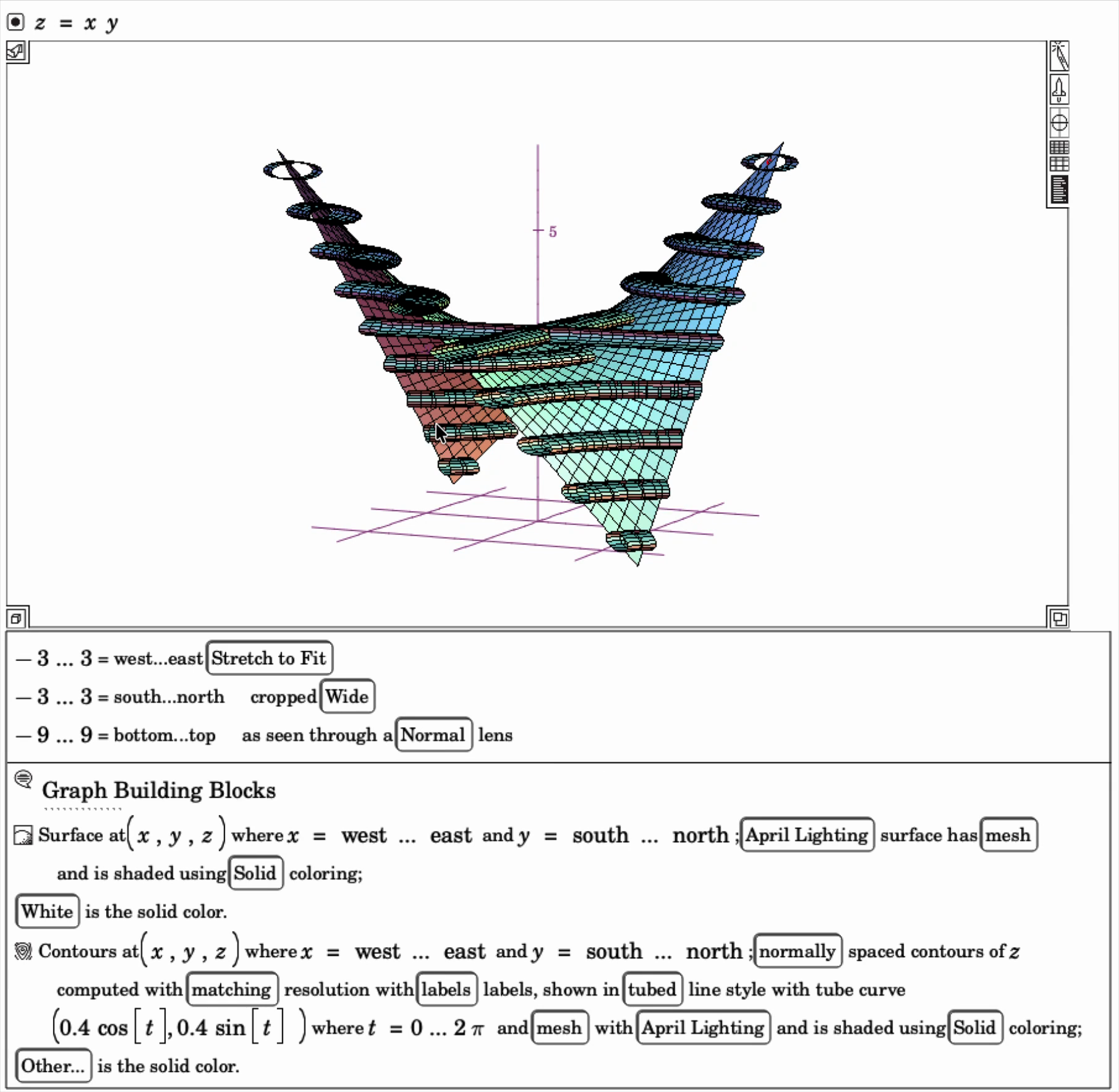
Contour Tubes on a Surface
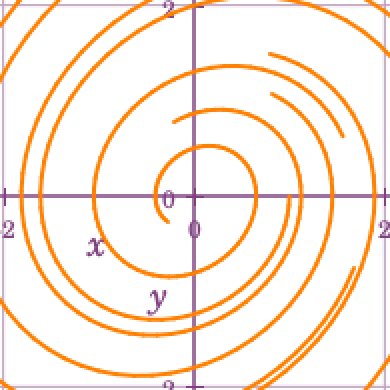
Level Curves
Multivariable Calculus Online Course for Credit Introduction
Aften enduring the first-year Calculus I and Calculus II courses on single-variable differentiation and integration theory, undergraduates earn admission to the course where Calculus actually gets fun: 3D Calculus - the Calculus of many variables.Seems easy, right? Instead of functions of one variable - f(x) - we now study functions of two variables:
How does this change to 2 input variables x,y change the theorems of Calculus? What does the Fundamental Theorem of Calculus look like for f(x,y)? What does it mean to take "the derivative" of f(x,y)? What does it mean to take "the integral" of f(x,y)?
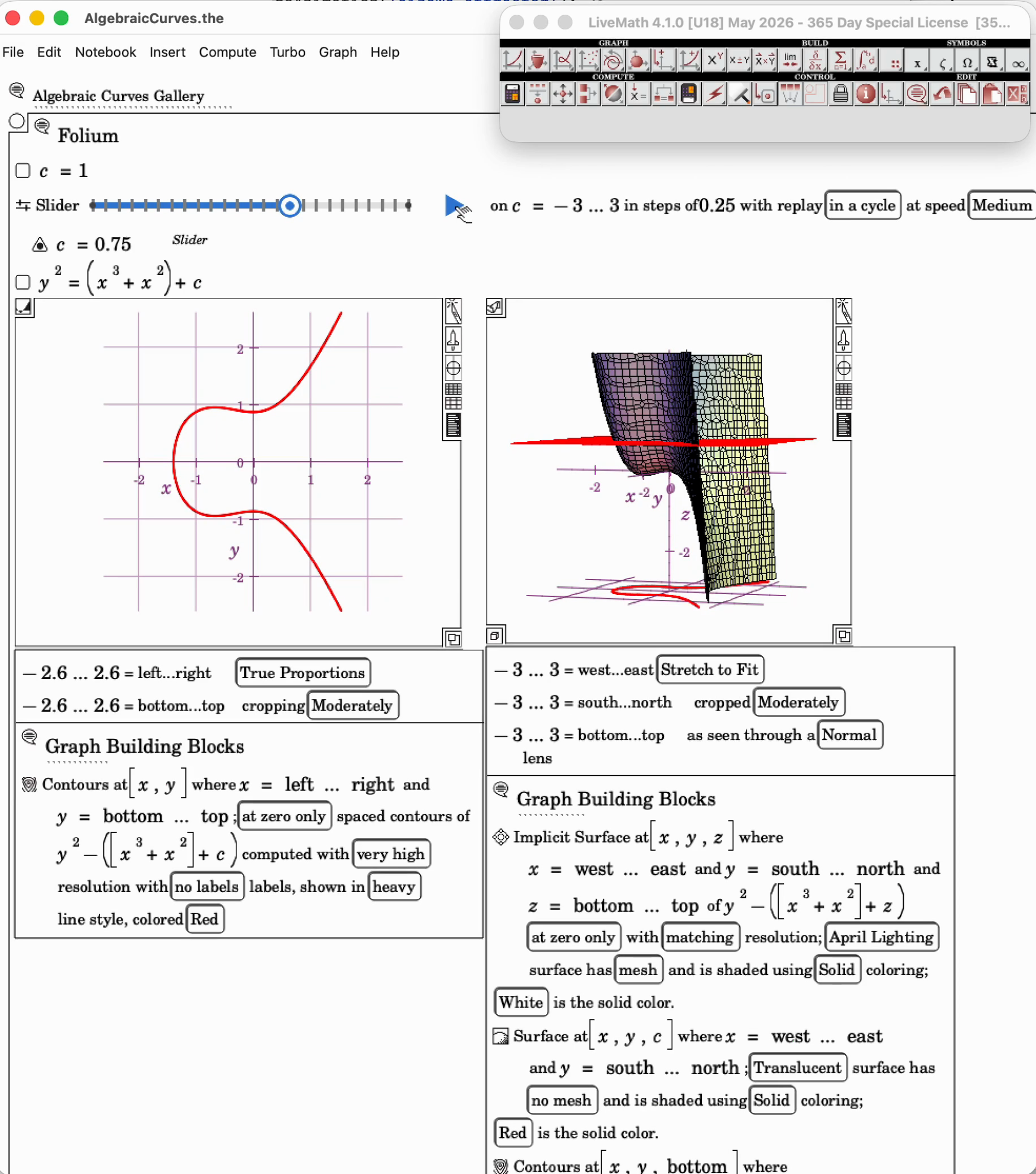
In Multivariable Calculus, the graphics from the computer algebra software really come alive.
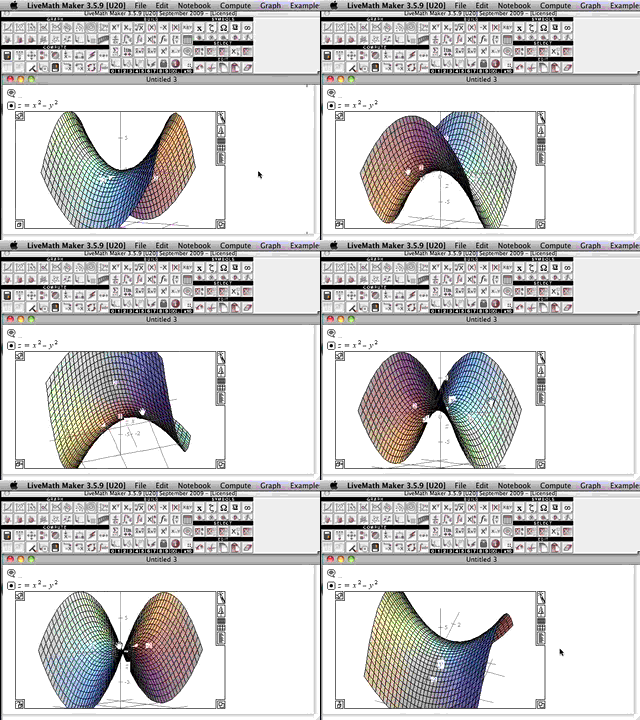
Our Multivariable Calculus Online course has the following main components:
- Getting Started in LiveMath
A very short mini-course on getting up to speed using our computer algebra and graphing software, LiveMath. 10 short assignments. - Vectors
2D and 3D vectors, graphing them, adding/subtracting, dot and cross products, planes in 3D, getting ready for Vector Fields - Differentiation in 2 or more variables
The generalization of the derivative f'(x) is the gradient vector field ∇f(x,y). In 2D Calculus, the derivative function f'(x) is graphed along with the original function f(x), and the derivative f'(x) is used to measure change (and critical change points) on the function f(x). In 3D Calculus, the "derivative" of f(x,y) is a vector field made from partial derivatives, and can be visualized as lying in the input 2D x-y-plane. We learn how this gradient vector field is used to analyze the properties of the f(x,y) function. - Integration in 2 or more variables
In 2D Calculus, we take integrals of functions f(x), which give us information about the function with different interpretations (area, physics computations, accumulation). In 3D Calculus, the integral is formulated in various ways. Adding a second input variable turns out to complicate matters considerably, and we have to formulate "what does this mean" to overcome these obsticles. Just like derivatives → partial derivatives, we will explore what is meant by single integral, multiple integral, curve integral, and surface integral. - Fundamental Theorem of Calculus
The Fundamental Theorem of Calculus in 1 variable says basically that if you integrate a derivative, you get back to the original function f(x)
DMAT 356 - Learning Outcomes
- To understand the core geometrical elements of Euclidean space
- To understand and compute vector operations and their geometrical interpretations
- To understand and compute partial derivatives and gradient functions
- To understand and compute curves, level curves, surfaces, and level surfaces to multidimensional functions
- To understand and compute vector-valued functions and their geometric representations
- To understand and compute the classical optimization procedure of Lagrange Multipliers
- To understand, compute, and graph vector fields and their associated metrics
- To understand and compute path integrals of vector fields
- To understand, compute, and graph sources, sinks, and singularities of vector fields
- To understand and compute the divergence of a vector field, and its associated computations
- To understand and compute the rotation and curl of a vector field, and its associated computations.
- To understand and compute path integrals in the presence of singularities
- To understand and compute multiple integrals, and their associated geometrical interpretations
- To understand and utilize Fubini's Theorem for reordering integrations
- To understand and compute Jacobian transformations of multiple integrals
- To understand and compute cylindrical, spherical, and other coordinate systems, and their associated measurments with derivatives and integrals
- To understand an introduction to the Generalized Fundamental Theorem of Calculus, and its variations in the Divergence Theorem, and the Theorems of Gauss, Green, and Stokes.
- Honors Topics:
- * To understand and compute curves with dictated curvature
- * To understand and compute examples in data fitting by polynomials and trigonometric functions
- * To understand and compute higher dimensional optimizations using multivariable derivatives
- * To understand and compute potential functions as antiderivatives of gradient functions
- * To understand an introduction to Electric and Hamiltonian Fields
- * To understand and compute 3D path integrals and surface integrals, both directly and using the reductions afforded by the Generalized Fundamental Theorem of Calculus
- * To develop mathematical technical writing skills, culminating in a term paper on an approved topic
DMAT 356 - Syllabus of Topics
Multivariable Calculus vs. Calculus III
Multivariable Calculus is a course known by many different names at various Colleges/Universities, including:- Calculus III
The third semester of a 4-credit hour Calculus sequence, as it is in our Distance Calculus calculus courses program. - Calculus IV
Usually the fourth quarter of a 3-credit hour Calculus sequence. - Vector Calculus
An appropriate title in that we study vector fields and the generalization of the derivative; most textbooks for this course entitled this way, too. - Multivariable Calculus
The most descriptive moniker, encompassing all aspects of Calculus of more than 1 variable.
At some schools, the Multivariable Calculus curriculum is called "Calculus III", or even "Calculus IV", with the intention of the higher multivariable calculus topics of vector fields, partial derivatives, multiple integrals, gradients, the path and surface integral, and the Gauss/Stokes/Divergence Theorems.
One common way to identify the Vector Calculus / Multivariable Calculus course is how this higher courses basically starts with partial derivatives, then goes through path integration of vector fields in 2D and 3D, multiple integrals, and then the named theorems of Green, Gauss, and Stokes. These core topics will help identify Multivariable Calculus in the list of other calculus courses at other institutions.
Green's Theorem, Stokes' Theorem, Divergence Theorem
Excellent Re-Entry Point to Calculus
When non-traditional, older students are returing to academics, after a break that can span years or even decades, a most common question is: Where should I re-enter in the Calculus sequence?If you have completed the Calculus I and Calculus II courses previously (even decades ago), and the concepts of differentiation and integration are remembered at a modest level, then an excellent course to return to the Calculus sequence is via the Multivariable Calculus course.
For the student, Multivariable Calculus is where you usually learn - really learn - the topics from Calculus I and II - not because Multivariable Calculus is harder, but just that you revisit the topics from Calculus I and II, but now looking for how these concepts will generalize from a single variable to multiple variables. It is through this generalization process that many students have the "ah-ha!" moment with the original topics from single variable calculus.
In case you did complete Calculus I and Calculus II previously, but you do not remember the basics of differentiation and integration, then returning to Calculus I or Calculus II is the best plan for success in Multivariable Calculus.
Example Multivariable Calculus Student Profiles
Case 1: Calculus I Done, Calculus II Done; Marching Forward in Multivariable Calculus
Phew! Getting through Calculus I and Calculus II is an achievement!
But if you are a science major, most likely Multivariable Calculus is next on your to-do list.
One indicator of how fast a student can complete Multivariable is the grade earned in Calculus II.
Case 2: Undergraduate Science Major
Marco is a undergraduate engineering major, and part of his degree program dictates that he finish Multivariable Calculus. Marco did pretty well in Calculus I and Calculus II. Rather than more lectures/taking notes/Problems 1-99 odd, Marco wants to change things up, and to take the Multivariable Calculus course via the Distance Calculus calculus courses.How fast can Marco complete the Multivariable Calculus online course?
The answer to this question depends mostly on when Marco plans to work on the course.
The most successful time for Marco would be during winter, spring, or summer breaks from his regular course load. By modifying his schedule to work on the Multivariable course during these "off times", Marco will be able to concentrate and focus just on the Multivariable Calculus course, and his tendency towards success will increase dramatically.
If Marco must complete the Multivariable Calculus course during the regular semester, as part of the other 3-5 courses he is taking, trying to fit Multivariable Calculus in there will be challenging (although not as challenging as trying to do the same for Calculus II, as it turns out). Here are some timelines for such a plan:
Case 3: Returning To Graduate School: Rushed
Karen just got accepted into Graduate School in Economics towards a Ph.D. She has a conditional acceptance, and must finish Multivariable Calculus in a very short time. Karen also works full time.What must Karen do to finish Multivariable Calculus Online Course?
The "short time" needs to be on the order of 3-4 weeks for Multivariable Calculus. Anything less is quite impossible. While Multivariable Calculus is a bit easier than Calculus II, the Multivariable Calculus course still has its challenges, and time-on-task will still require a significant time committment with enough rest spots for the concepts to "sink into the brain sponge".
Karen will need to plan for large blocks of time to dedicate towards the course. If shooting for 4 weeks completion, then at least 8-10 hours per day. If shooting for 6 weeks completion, then 6-8 hours per day, every day. It will be a very challenging 4-6 weeks.
Karen should also be ready that the course takes a little longer than the planned 4-5 weeks. Going a week or two over to 6-8 weeks is quite common. Usually graduate schools are quite understanding of the situation of "I'm almost done", and in many cases, the graduate school will give a short extension to aid the student with harsh deadlines.
Karen must understand that even though there are some tough deadlines with this plan, that does not mean that "corners are cut" in the Multivariable course because of these extenuating circumstances. There is only 1 way through the course, and that is the right way.
Case 4: Returning To Graduate School: Methodical
Thomas is applying to Graduate School in Biostatistics towards a Ph.D., and will start in 1 year. Thomas knows she must complete Multivariable Calculus prior to starting that course work (and even before submitting the graduate school application).What will the Multivariable Calculus online course look like for Thomas?
Thomas is not in a rush, yet he wants to finish the course methodically, in a timely manner, as quickly as possible. As Thomas is a Ph.D. bound student, he is highly motivation and task-completion oriented. Some timelines for Thomas for Multivariable Calculus might look like this:
Case 5: Lack of Success in Classroom Multivariable Calculus Course
Mike took Calculus I and Calculus II and did OK in the courses, earning C grades. Then Mike went onto Multivariable Calculus, hoping to improve his grades above the C level. One thing led to another, and Mike didn't succeed in the traditional, classroom Multivariable Calculus course.Mike loathes the thought of returning to the classroom lecture for Multivariable. The lectures were not that much fun going through them the first time, and trying to sit through them a second time will be more than just painful.
Mike wants to change gears, and try something new - taking Multivariable Calculus online course via the Distance Calculus calculus courses.
Typically, students like Mike will take the course over the summer months, and be able to focus just on the Multivariable Calculus course, without being overwhelmed by multiple courses all vying for Mike's attention.
Mike should plan to take a step back, a deep breath, and engage the online course as if starting on a marathon race. Just because Mike "had Multivariable Calculus already", this poor foundational knowledge will not help Mike succeed in this second (and quite different attempt).
Mike would be approaching Multivariable Calculus from a completely different viewpoint than his previous attempt, which certainly goes a long way to minimizing the "review" nature of repeating a course. When going through the new Multivariable Calculus course, all will see things he saw before (e.g. partial derivatives, path integrals, etc.), but completely different types of questions that he probably saw in the classroom/textbook course. An open mind, and genuine academic curiousity to investigate and embrace the new style of work will be required for success.
Mike should plan for a minimum of 12 weeks to engage the online course, even during the summer. It will take time for the course concepts and materials to "sink in" and become comfortable.
We have had many students like Mike succeed in Multivariable Calculus where their classroom experience with Multivariable Calculus was a failure. However, we have also had many students like Mike who discover that the reason they didn't succeed in their first attempt at Multivariable Calculus was an indicator that their math skills are not strong, their interest in math is weaker, and their chosen course study plan may need to change upon failure in two different course paradigms.
Case 6: Life After AP Calculus BC Exam
Rebecca is a hot-shot high school student. She has completed AP Calculus BC exam (equivalent to Calculus II), and now she is ready for the next course. Few (if any) high schools offer the course after AP Calculus BC, which is the Multivariable Calculus course.Rebecca will most likely be able to finish the Multivariable Calculus online course very quickly with a dedicated effort that is quite natural for her. 6-8 weeks is the common time frame.
However, Rebecca may discover that Multivariable Calculus via Distance Calculus is an adult course, and quite unlike the high school course paradigm that he has been so successful in previous. Some students like Rebecca can find Multivariable Calculus more difficult than they anticipated, and they have to dedicate more time and effort than they had planned to budget for.
While Rebecca can earn collegiate credits for Multivariable Calculus in a similar way that AP Calculus BC would earn, Rebecca would not benefit from the inflated GPA multiplier that AP courses help with high school GPAs.
80% Computer Algebra, 20% Pencil/Paper, 0% Multiple Choice
Through the usage of a computer algebra system like LiveMath™ - you will never miss a minus sign again!
Although the driving of a computer algebra system requires some up-front time to learn and master, once completed (rather quickly for most students), the time saved from having to be a "minus sign accountant" adds to the productivity of your study time. If you have ever spent hours looking for that "little numerical error", you know what we mean.
Command of a computer algebra software system is a modern-day necessity of mathematical academics. It is important, however, to retain a meaningful command of paper/pen/pencil manual computations as well. Our blend of curriculum strives for an 80%/20% split between computer algebra usage and manual computation and written skills. With each module in our curriculum, a concluding Literacy Sheet assignment ensures that each student has written mathematical competency in the subject area.
The proctored final exam is a written exam away from the computer. It is these Literacy Sheet assignments, and the continuing bridge from modern computer algebra software back to classical, manual mathematics that prepares the student for this written final exam.
We do not have any multiple-choice work. We are a real collegiate-level course program - not a "canned" set of multiple-choice question sheets which are common from large publishers and degree-mill schools.
Multivariable Calculus Online Course for Credit Example Curriculum
Videotext - A Modern Replacement of the Textbook
What is a videotext? It is like a textbook, except instead of being based upon printed information, this "text" is based upon video presentations as the core method of explaining the course topics. Instead of a huge, thick 1000-page Calculus textbook to lug around in your backpack, all of this new "videotext" can be loaded into your iPods or iPhones (and soon, the iPad!).
Example Videos are in MP4/H.264 format, which will play in all modern web browsers.
Our videotext features two main types of videos:
Although we are anywhere from a few miles to a few thousand miles apart, watching these screencast videos is like sitting next to the course instructor, watching his computer, learning the topics of Calculus at the same time as learning how to drive the computer algebra and graphing software LiveMath™. These LiveMath™ screencast videos make up the majority of the video presentations in the videotext.
Multivariable Calculus Screencast Video Questions
One extremely powerful aspect of the Distance Calculus course technologies is the usage of screencast video (and audio) recordings made by the students and the instructors, exchanged just as easily as emails back and forth.
If a picture is worth a thousand words, then a screencast movie is worth a million words - and saves boatloads of time and effort.
Instead of trying to type out a math question about a particular topic or homework question, the ease of "turning on the screen recorder" and talking and showing your question - in the span of a few minutes - can save hours of time trying to convert your question into a typed (and coherent) narrative question.
Example Instructor Question/Answer Movie
When a student asks a question in a homework notebook, sometimes the best way to explain the answer is via a screen movie.
Distance Calculus Referenced Colleges & Universities (29 Years - 393+ Institutions)
Distance Calculus students have transferred course credits to these colleges and universities:
Distance Calculus - Student Reviews
First, this course uses software called LiveMath. This software can be a little bit challenging to get the hang of, but once you do get the hang of it, it's super easy. Remember that for all new things, it takes a bit to get used to it. Overall, I was highly satisfied with this course. I thought that the instructions were extremely detailed, including a video and a textbook explaining every different concept. In addition, this course offered exposure to a lot of different aspects of finite math. I think that many would agree with me on the following, that, you know, when a teacher is passionate about what they are teaching, it is so much more enjoyable, and you can definitely see that in this course. This course can be challenging at times. Maybe it'll be easy for you, maybe it'll be hard, but I think it's important to remember that the things that challenge us are, you know, the things that make us learn and the things that make us better. There's also a math chat option for if you need help or if you have any questions. Overall, I would recommend this course. I actually initially went into this course looking for an easy course to just help me get the credit requirements, but it ended up being an amazing learning experience and completely shifted my perspective on math overall. And another thing that I thought was great in this course is throughout so many different lectures, the professor would explain how each different thing can be applicable in life. And I think that, you know, that is a lot of what people think about when they are learning something. They're like, will I ever use this? Do I need to learn this? And a lot of this actually is really applicable. And I think that even if, you know, you may not be doing these math equations in your future, I think that, you know, the psychology behind these and the rules can be applied to so many different fuacets of life.
The only problem with the course is the lack of pen and paper work. This shouldn't come as a crazy surprise with an online course, but there is not much emphasis on symbolic computation. Mathematica or other software does most of the heavy computation for you. The lectures usually show how to solve the problems through paper, but those skills are rarely put into practice. Literacy Sheets act as a way to do some of that (especially with the Calculus II & III course).
All in all, this isn't a huge issue. I just memorize and practice things like double integration, Laplace, ODE solving, matrix diagonalized form, row operations, etc. With a little outside work, this resolves itself. Without Roger WIlliams, I probably would not have been able to take any of these math courses in highschool.
So overall, a great choice for highschool advanced math, especially with transferrable credits.







More Details
- How Our Courses Work
- About the Mastery Learning Format
- Asynchronous & Self-Paced
- Computer & Software Requirements
- Maximum Course Time (1 Year)
- Completion Time Estimates
- Academics
- Course Prerequisites
- Course Syllabi
- Grading Policy
- University Accreditation (NECHE)
- Course Articulation/Transfer
- How Exams Work
- Explore
- Honors Course Track
- Student Reviews
- Introductory Videos
- Who Can Enroll?
Frequent Questions
- Enrollment
- When Can I Enroll?
- When Can I Start My Course?
- Term Dates: Enroll Anytime!
- Costs & Tuition
- Credits & Transcripts
- Will My Credits Transfer?
- Letters of Recommendation
- Is My College On Your Transfer List?
- Other Questions
- Frequently Asked Questions
- Is This the Same as AP Calculus?
- Are These Computer-Based Courses?
- Are These Online Courses?
- Financial Aid?