Distance Calculus for Current High School Students
What Comes After AP Calculus BC?
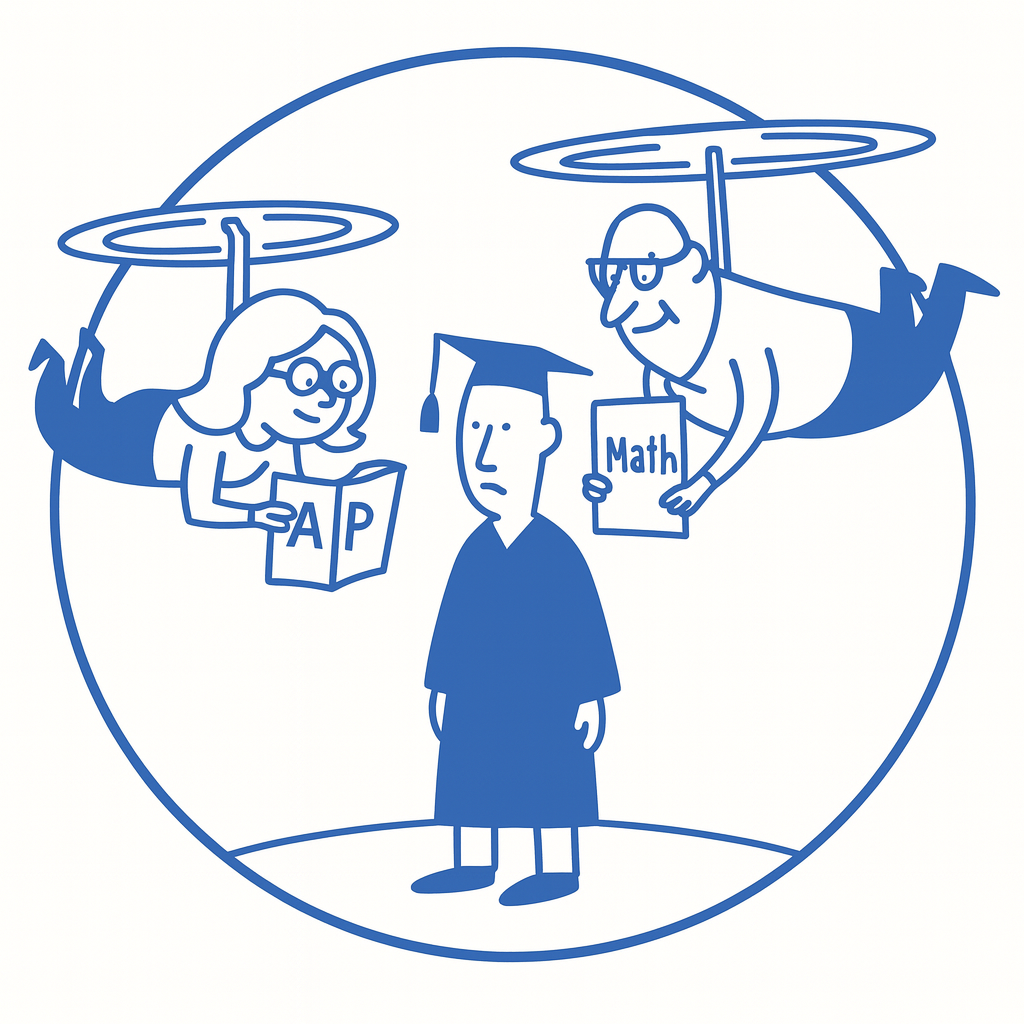
The high school AP Calculus program is a tremendous launchpad: every year it sends thousands of strong students into outstanding university careers. But it has one structural limit - it stops at AP Calculus BC, which is roughly equivalent to a college Calculus II course. For students who finish AP Calculus BC in their junior year, or even in their sophomore or freshman year, almost no high school has a next course to offer. That's exactly where Distance Calculus becomes a remarkable resource for advanced high school students.
We carry the entire sophomore-level mathematics curriculum and a growing list of upper-division courses:
Courses Popular with High School Students
- DMAT 355 - Multivariable Calculus (4 credits) - The natural next step after AP Calculus BC
- DMAT 321 - Differential Equations (3 credits) - Essential for engineering-bound students
- DMAT 335 - Linear Algebra (4 credits) - Critical for data science and computer science paths
- DMAT 311 - Probability Theory (3 credits) - Foundation for statistics and data science
- Honors versions of all the above - Stand out in your college applications
Completing one or more Distance Calculus courses after AP Calculus BC genuinely supercharges the early years of your eventual university career.
Don't Replace AP Calculus BC - Continue Past It
A common question we get is whether high school students should use Distance Calculus to replace their school's AP Calculus AB or BC course. In almost every case, our answer is no: stay inside your high school's existing AP program for first-year calculus. There are exceptional situations where a student's high school AP Calculus program just isn't working for them, and in those cases Distance Calculus 1 and 2 are an excellent option - but for the typical strong student, the AP path is the right path through Calculus I and II.
There's a concrete reason for this. AP courses are weighted in your high school GPA - many schools apply a 1.3x multiplier, which is why some students post GPAs above 5.0. Distance Calculus courses are college courses, not high school courses, and they do not inflate your high school GPA. If GPA weighting matters to you, that alone is a reason to stay with the AP program.
On the other hand, Distance Calculus does offer real advantages over the AP path for students for whom that path isn't fitting:
- No high-stakes AP exam. Many universities only grant credit for a 4 or 5 on the AP, and even those policies are tightening every year - AP credit transfer is becoming harder, not easier.
- An official university transcript from Roger Williams University, regardless of your AP score.
- You don't need to know yet which college you're going to. The credit is real and transferable; you'll bring the transcript with you wherever you end up.
The "Day-One Transfer" Advantage
Once you decide which college or university you're enrolling at - usually in your senior year as you approach 18, or earlier for students who finish high school ahead of schedule - you'll present every transcript you've earned from outside institutions on day one of your university admission. That's the famous "day-one transfer": your incoming credits are evaluated alongside your enrollment, before you've taken a single class on the new campus.
The vast majority of colleges and universities look on day-one transfers very favorably. They want your transition to be as smooth as possible - you're a brand-new student, and the school is invested in placing you correctly. The same schools tend to be quite a bit more critical when their existing students try to take coursework off-campus mid-degree; once you're enrolled, they generally want you in their courses on their curriculum. So the day-one window is the moment when transfer credit is most welcomed - and it's exactly the window your Distance Calculus transcript walks into.
Distance Calculus Fits the High-School Schedule
High school students have impacted lives. You're juggling sports practices, clubs, leadership commitments, three or four AP exams in different subjects, and college applications. Adding a synchronous college math class at a local university often isn't realistic - the lectures meet at fixed times, you may not be able to physically get there between practices, and those courses have no flexibility when AP exam season hits in April or May.
Distance Calculus is fully asynchronous and self-paced, which is exactly what an impacted schedule needs. You fit the course into the time you have:
- Saturday morning at 9 AM, before basketball practice at 11.
- Three afternoons a week after school.
- One study-hall period per day dedicated to Distance Calculus.
- Long evening sprints during the slower stretches of your school year.
Most high school students end up working in sprints: a few weeks of intense daily progress when their schedule allows it, then a deliberate pause when AP review or finals or a tournament demands their full attention, then back into the course. That rhythm is fine here. It would be a disaster in a synchronous course.
The Honest Trade-off: No Bell, No Hall Pass, No Vice Principal
There's one part of Distance Calculus that high school students consistently struggle with: the complete absence of synchronous structure. You're used to walking into Math at 8:15, working until the 9:15 bell, and being marked absent if you don't show. Distance Calculus has none of that. If you decide to disappear for a month, no one is going to call your home or send the attendance dean to your locker. There's no vice principal here.
For high school students, we strongly suggest that parents and guardians take on a portion of that vice-principal role - gentle but consistent oversight, weekly check-ins, "How's the course coming?" conversations. We're also happy to lay out a proposed paced schedule with target dates so the student has structure to push against. What we can't do is enforce hard deadlines: the heart of Distance Calculus is mastery learning, where you stay on a module until you've truly mastered it before advancing, and that work is fundamentally incompatible with rigid weekly due dates.
Here's the upside of that adjustment, though: the self-motivation and self-management skills you build doing Distance Calculus as a high school student are exactly the skills you'll need to thrive in college. Universities don't run on bell schedules either. In that sense, Distance Calculus is an excellent bridge between the high school and the university approach to course attendance - you graduate high school already practiced at being your own academic manager.
The Honors Track Is an Especially Good Fit
Honors courses at Distance Calculus are an excellent option for advanced high school students. The first thing to know is that the Honors versions are not super-extra-double-difficult. They are just a notch more difficult and a notch longer than the standard course - that "notch" being literally one extra credit hour, alongside slightly expanded coverage and slightly deeper problem sets.
The Term Paper
The single biggest difference between an Honors course and the standard version is the term paper. The term paper is also the single best reason for a college-bound high school student to take the Honors track: it's a structured opportunity to practice technical writing in mathematics - a skill that is enormously valuable at university and is becoming more valuable, not less, in the era of ubiquitous chatbots.
You will be required to write in your college classrooms. You need to know how to do it yourself, without leaning on a writing assistant. Mathematical and scientific writing is also fundamentally different from the writing you do in English composition class - the structure, the precision, the conventions, the way an argument is built - and the only way to develop that voice is to do it.
Here's how the term paper works in practice:
- You choose your topic in coordination with your course professor, so you get to pursue something you're genuinely interested in.
- You then do real source research, learning to identify references in what we call the Goldilocks zone - not too easy, not too hard. For almost any math topic you Google, you'll find pages that explain it at a hand-wavy elementary level and pages that explain it at a graduate-research level. Part of the term paper exercise is learning to recognize which sources are actually at the right level for your paper's voice.
- You write the paper yourself, in mathematical/technical-writing voice, with feedback from your professor.
Term Papers Strengthen Your College Application Portfolio
When you start applying to four-year colleges and universities, having one or more math term papers in your application portfolio is a remarkable differentiator. Admissions committees see report cards and AP scores from every applicant; they see a Distance Calculus Honors term paper from very few. That kind of artifact stands out precisely because it's not standard.
Letters of Recommendation
High school students applying to college almost always need letters of recommendation. Distance Calculus offers something rare: upon successful completion of any course at an A or B grade, we provide customized letters of recommendation written specifically for the student and sent directly to any college or university the student requests.
Because Distance Calculus is a one-on-one mentored course rather than a 200-seat lecture hall, by the time you finish a course, your professor genuinely knows your work, your strengths, and your habits as a student. Writing a letter of recommendation at the end of a successfully completed course isn't a chore here - it's a real pleasure, because we have specific, concrete, personal things to say about you.
Benefits at a Glance
- Real college credit - Transferable to virtually any U.S. university
- Strengthen college applications - Show admissions you're ready for advanced work
- Honors term papers - Portfolio pieces that stand out beyond report cards and AP scores
- Customized letters of recommendation - From a professor who actually knows your work, for any A or B completion
- Flexible schedule - Work around sports, clubs, AP exams, and applications
- Technical writing practice - Genuine skill-building in the chatbot era
Start Your Enrollment Application
Distance Calculus - Student Reviews
There is a steep learning curve early on to get used to the software and the kind of course this is.
Ultimately, I feel like what I learned will allow me to actually use the math and build upon it in the future. If you care about learning, rather than just passing a requirement, this is a great course for you.
First, this course uses software called LiveMath. This software can be a little bit challenging to get the hang of, but once you do get the hang of it, it's super easy. Remember that for all new things, it takes a bit to get used to it. Overall, I was highly satisfied with this course. I thought that the instructions were extremely detailed, including a video and a textbook explaining every different concept. In addition, this course offered exposure to a lot of different aspects of finite math. I think that many would agree with me on the following, that, you know, when a teacher is passionate about what they are teaching, it is so much more enjoyable, and you can definitely see that in this course. This course can be challenging at times. Maybe it'll be easy for you, maybe it'll be hard, but I think it's important to remember that the things that challenge us are, you know, the things that make us learn and the things that make us better. There's also a math chat option for if you need help or if you have any questions. Overall, I would recommend this course. I actually initially went into this course looking for an easy course to just help me get the credit requirements, but it ended up being an amazing learning experience and completely shifted my perspective on math overall. And another thing that I thought was great in this course is throughout so many different lectures, the professor would explain how each different thing can be applicable in life. And I think that, you know, that is a lot of what people think about when they are learning something. They're like, will I ever use this? Do I need to learn this? And a lot of this actually is really applicable. And I think that even if, you know, you may not be doing these math equations in your future, I think that, you know, the psychology behind these and the rules can be applied to so many different fuacets of life.
The only problem with the course is the lack of pen and paper work. This shouldn't come as a crazy surprise with an online course, but there is not much emphasis on symbolic computation. Mathematica or other software does most of the heavy computation for you. The lectures usually show how to solve the problems through paper, but those skills are rarely put into practice. Literacy Sheets act as a way to do some of that (especially with the Calculus II & III course).
All in all, this isn't a huge issue. I just memorize and practice things like double integration, Laplace, ODE solving, matrix diagonalized form, row operations, etc. With a little outside work, this resolves itself. Without Roger WIlliams, I probably would not have been able to take any of these math courses in highschool.
So overall, a great choice for highschool advanced math, especially with transferrable credits.






More Details
- How Our Courses Work
- About the Mastery Learning Format
- Asynchronous & Self-Paced
- Computer & Software Requirements
- Maximum Course Time (1 Year)
- Completion Time Estimates
- Academics
- Course Prerequisites
- Course Syllabi
- Grading Policy
- University Accreditation (NECHE)
- Course Articulation/Transfer
- How Exams Work
- Explore
- Honors Course Track
- Student Reviews
- Introductory Videos
- Who Can Enroll?
Frequent Questions
- Enrollment
- When Can I Enroll?
- When Can I Start My Course?
- Term Dates: Enroll Anytime!
- Costs & Tuition
- Credits & Transcripts
- Will My Credits Transfer?
- Letters of Recommendation
- Is My College On Your Transfer List?
- Other Questions
- Frequently Asked Questions
- Is This the Same as AP Calculus?
- Are These Computer-Based Courses?
- Are These Online Courses?
- Financial Aid?