Returning to Academics

Getting Back on Track with Mathematics
A significant fraction of our students are returning to academics after a stretch of time away from academic mathematics - sometimes a few years, sometimes a few decades. We see you, we know how to work with you, and we have built our courses specifically with this transition in mind. Whether you're returning to finish a degree, changing careers, or preparing for graduate school, Distance Calculus provides a supportive, flexible environment to complete your math requirements.
Common Situations
- Finishing a degree - You need one or two math courses to complete your bachelor's degree
- Career change - Your new field requires calculus, statistics, or linear algebra
- Graduate school prep - You need math prerequisites for an MBA, data science, or other graduate program
- Refresher needed - It's been years since your last math class and you need to rebuild skills
The Re-entry Problem in Traditional Courses
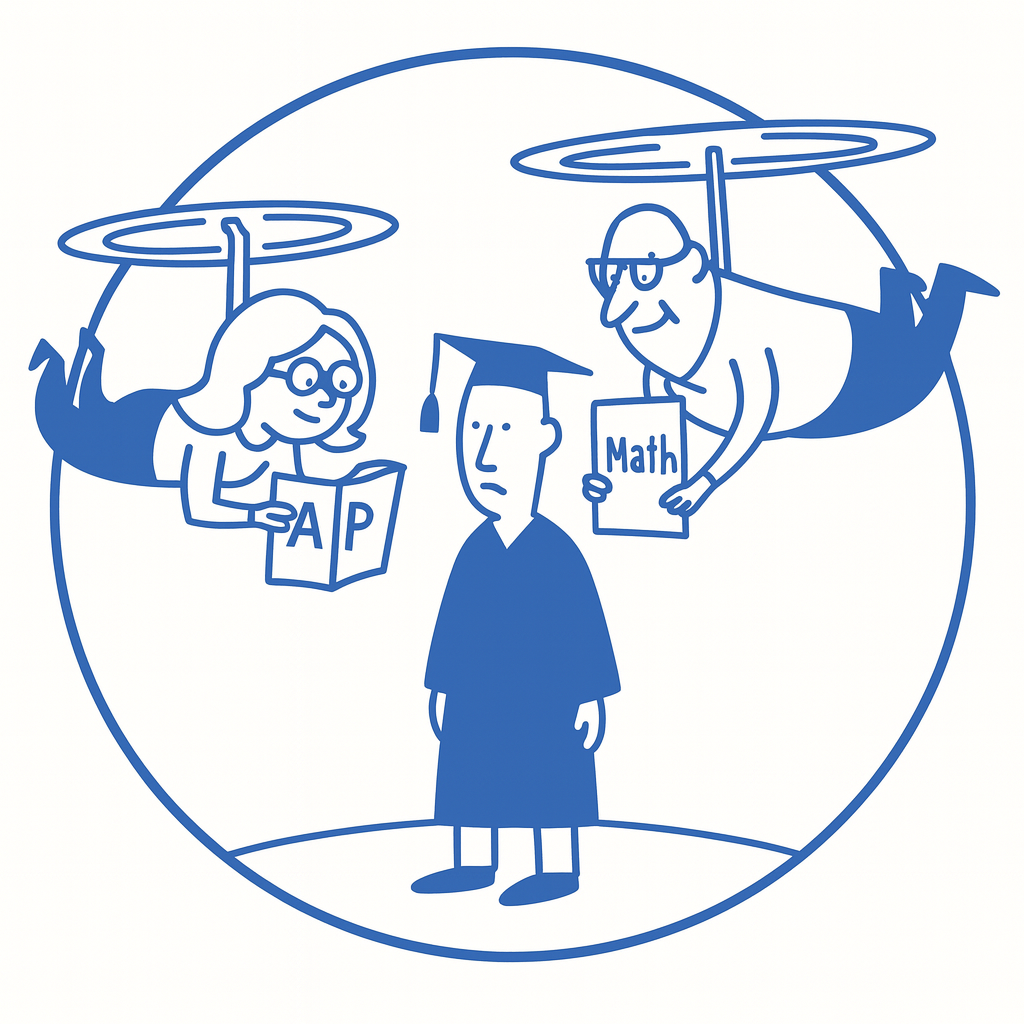
Re-entering academic mathematics through a traditional textbook lecture course can be unexpectedly hard. The fundamental assumption of those courses is that on day one you already know the prerequisite material cold, ready to launch directly into new content. There's typically no real review - or at most a single class period that nominally surveys the prerequisite, which is nowhere near enough for a student who hasn't done this material in five, ten, twenty, or thirty years. By week two you're already underwater, and the structure of the course gives you no good way to catch up.
Customized Review Modules When You Need Them
Distance Calculus handles this very differently. Because our courses are asynchronous and online, we have the flexibility to add review material precisely where it would help you, without slowing down anyone else. We don't push returning students into repeating entire prior courses - that's almost always overkill. Instead, if (for example) you're starting in Multivariable Calculus but you haven't actively used Calculus I and Calculus II in twenty years, we can insert sample modules from Calculus I and Calculus II that you work through as a warm-up before launching into multivariable content.
Students who don't need that review simply skip those modules - or never see them in the first place. That's the quiet power of one-on-one mentored online courses: the course meets each student where they are.
Anxiety, Mastery Learning, and the Slow Start
Returning students often arrive with some honest anxiety about doing collegiate mathematics again. Our standard advice is: start slow, deliberately. Don't try to prove anything in the first two weeks. The mastery-learning structure of Distance Calculus is what makes that strategy actually work - you stay on each module until you've genuinely mastered it, with no weekly quiz hanging over your head and no Tuesday homework due dates pushing you forward before you're ready.
We have seen this pattern over and over: a student who is nervous about restarting math has a deliberately slow first few weeks, their confidence builds, and then quite suddenly they snap back to the form they remember enjoying when they did college math the first time. The mastery model gives that pattern room to unfold; the lecture-and-quiz model usually doesn't.
Older Students - Yes, Absolutely Yes
We get regular inquiries from students in their 50s, 60s, 70s, and beyond asking whether it's reasonable for them to return to collegiate mathematics. Our answer is, in nearly every case, a resounding yes.
Distance Calculus is in many ways a better environment for older returning students than a re-entry course at a local college would be. There are no weekly quizzes, no Tuesday-night homework deadlines, no lecture cadence to keep up with. The course adapts to your life, not the other way around.
And here's something we have observed consistently over decades of teaching: maturity is not a barrier to success in mathematics - it's an amplifier of it. Older returning students bring a level of self-discipline, patience, and perseverance to the course that younger students simply have not had time to develop yet. Where a 19-year-old might give up on a hard problem after twenty minutes, a 65-year-old will often sit with it for two hours and crack it. Students in these age brackets almost always succeed, and the most common pattern is one course leading to the next, leading to the next - with results that get more impressive with each course completed.
Why Distance Calculus Works for Returning Students
- Self-paced - Up to 1 year to complete each course; work around your job and family
- Asynchronous - No scheduled lectures or meetings to attend
- Customized warm-up modules - Optional review material from earlier courses inserted where you need it
- Mastery learning - No weekly quizzes; you stay on each module until you genuinely understand it
- Human instructors - Real professors and TAs who understand the re-entry experience
- Start with Precalculus if needed - Precalculus with Trigonometry is an excellent fundamentals rebuild
Start Your Enrollment Application
Distance Calculus - Student Reviews
It does take a good amount of time to do all the lessons, so definitely keep on top of them, but all the exercises helped me to really understand the material. And the nice thing is you can do it on your own time at home.
First, this course uses software called LiveMath. This software can be a little bit challenging to get the hang of, but once you do get the hang of it, it's super easy. Remember that for all new things, it takes a bit to get used to it. Overall, I was highly satisfied with this course. I thought that the instructions were extremely detailed, including a video and a textbook explaining every different concept. In addition, this course offered exposure to a lot of different aspects of finite math. I think that many would agree with me on the following, that, you know, when a teacher is passionate about what they are teaching, it is so much more enjoyable, and you can definitely see that in this course. This course can be challenging at times. Maybe it'll be easy for you, maybe it'll be hard, but I think it's important to remember that the things that challenge us are, you know, the things that make us learn and the things that make us better. There's also a math chat option for if you need help or if you have any questions. Overall, I would recommend this course. I actually initially went into this course looking for an easy course to just help me get the credit requirements, but it ended up being an amazing learning experience and completely shifted my perspective on math overall. And another thing that I thought was great in this course is throughout so many different lectures, the professor would explain how each different thing can be applicable in life. And I think that, you know, that is a lot of what people think about when they are learning something. They're like, will I ever use this? Do I need to learn this? And a lot of this actually is really applicable. And I think that even if, you know, you may not be doing these math equations in your future, I think that, you know, the psychology behind these and the rules can be applied to so many different fuacets of life.
The only problem with the course is the lack of pen and paper work. This shouldn't come as a crazy surprise with an online course, but there is not much emphasis on symbolic computation. Mathematica or other software does most of the heavy computation for you. The lectures usually show how to solve the problems through paper, but those skills are rarely put into practice. Literacy Sheets act as a way to do some of that (especially with the Calculus II & III course).
All in all, this isn't a huge issue. I just memorize and practice things like double integration, Laplace, ODE solving, matrix diagonalized form, row operations, etc. With a little outside work, this resolves itself. Without Roger WIlliams, I probably would not have been able to take any of these math courses in highschool.
So overall, a great choice for highschool advanced math, especially with transferrable credits.



More Details
- How Our Courses Work
- About the Mastery Learning Format
- Asynchronous & Self-Paced
- Computer & Software Requirements
- Maximum Course Time (1 Year)
- Completion Time Estimates
- Academics
- Course Prerequisites
- Course Syllabi
- Grading Policy
- University Accreditation (NECHE)
- Course Articulation/Transfer
- How Exams Work
- Explore
- Honors Course Track
- Student Reviews
- Introductory Videos
- Who Can Enroll?
Frequent Questions
- Enrollment
- When Can I Enroll?
- When Can I Start My Course?
- Term Dates: Enroll Anytime!
- Costs & Tuition
- Credits & Transcripts
- Will My Credits Transfer?
- Letters of Recommendation
- Is My College On Your Transfer List?
- Other Questions
- Frequently Asked Questions
- Is This the Same as AP Calculus?
- Are These Computer-Based Courses?
- Are These Online Courses?
- Financial Aid?