

Our Linear Algebra course differs from a classroom/textbook-based course in that we
employ Mastery Learning so that you complete all assignments at 100% to assure competancy, as
well as our curriculum shifting the course to a laboratory-style course, where theorem/lemma/proof
type exposition is replaced by running experiments in Mathematica as you would in a science laboratory to
empirically deduce the concepts and behaviors of Linear Algebra, both solvable (classically) via hand-based techiques,
as well as studying Linear Algebra that can only be solved and investigated graphically and numerically using
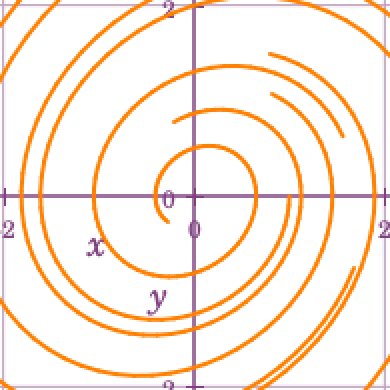
a computer. The Linear Algebra curriculum is highly visual and based upon observations of experiments run in Mathematica.
Linear Algebra Course - Distance Calculus Course Information
Linear Algebra course can best be described as a "first course in the study of Linear Algebra and Matrix Theory".
This course has many names, all being equivalent:
Our Linear Algebra course differs from a classroom/textbook-based course in that we employ Mastery Learning so that you complete all assignments at 100% to assure competancy, as well as our curriculum shifting the course to a laboratory-style course, where theorem/lemma/proof type exposition is replaced by running experiments in Mathematica as you would in a science laboratory to empirically deduce the concepts and behaviors of Linear Algebra, both solvable (classically) via hand-based techiques, as well as studying Linear Algebra that can only be solved and investigated graphically and numerically using a computer. The Linear Algebra curriculum is highly visual and based upon observations of experiments run in Mathematica.
At Distance Calculus, we call our "Linear Algebra" course as Linear Algebra - DMAT 335 - 3 credits.
Below are some links for further information about the Linear Algebra course via Distance Calculus @ Roger Williams University.


This course has many names, all being equivalent:
- Linear Algebra
- Matrix Theory
- Linear Systems of Equations
- Linear Spaces
Our Linear Algebra course differs from a classroom/textbook-based course in that we employ Mastery Learning so that you complete all assignments at 100% to assure competancy, as well as our curriculum shifting the course to a laboratory-style course, where theorem/lemma/proof type exposition is replaced by running experiments in Mathematica as you would in a science laboratory to empirically deduce the concepts and behaviors of Linear Algebra, both solvable (classically) via hand-based techiques, as well as studying Linear Algebra that can only be solved and investigated graphically and numerically using a computer. The Linear Algebra curriculum is highly visual and based upon observations of experiments run in Mathematica.
At Distance Calculus, we call our "Linear Algebra" course as Linear Algebra - DMAT 335 - 3 credits.
Below are some links for further information about the Linear Algebra course via Distance Calculus @ Roger Williams University.
Freshman Mathematics Courses
Semester
Credit
Hours
Credit
Hours
Sophomore Mathematics Courses
Semester
Credit
Hours
Credit
Hours
General Mathematics Courses
Semester
Credit
Hours
Credit
Hours
Mathematics Major Courses
Semester
Credit
Hours
Credit
Hours
- Linear Algebra Online Course Summer 2026
- Linear Algebra Online Course Fall 2026
- Linear Algebra Online Course Winter 2026
- Elementary Linear Algebra Online Course For Credit
- Online Elementary Linear Algebra Online Course For Credit
- Can I Take Linear Algebra in High School?
- Can I Take Linear Algebra Without Calculus 2?
- AP Advanced Placement Linear Algebra
- Is Linear Algebra Hard
- Linear Algebra with Mathematica
- Linear Algebra Online Course FAST
- Linear Algebra Quick Online Course For Credit Start Immediately
- Linear Algebra Accredited Online Course
- Linear Algebra Summer 2026 Online Course
- Linear Algebra Winter 2026 Online Course
- Linear Algebra Summer Course
- Linear Algebra Winter Course
- Linear Algebra Spring Course
- Linear Algebra Fall 2026 Online Course
- Linear Algebra Fall Course
- Linear Algebra Online Accredited
Distance Calculus - Student Reviews
Posted: Jan 13, 2020
Courses Completed: Calculus II
This is the most interactive and productive online course I have ever taken. I had taken calculus before but never understood some of the underlying concepts until I took this course.
If you want to really learn calculus in a way that will stay with you for the rest of your life, take this course.
If you want to really learn calculus in a way that will stay with you for the rest of your life, take this course.
Transferred Credits To: The college of New Jersey
Posted: May 6, 2025
Courses Completed: Calculus II, Multivariable Calculus
Is the course perfect? No. However, it was by far the best option available. I have learned quite a few things not normally taught in a Calculus course. However, the course lacks a lot of paper solving and integrating, which is to be expected in an online course.
Posted: Jan 15, 2021
Courses Completed: Probability Theory
Dr. Curtis gave helpful and timely feedback, and made the teaching videos very engaging! The course model and associated software was easy to acclimate to.
Transferred Credits To: Cedarville University
Posted: Aug 28, 2026
Courses Completed: Finite Math
I will preface this review by saying that if you are looking to take the easiest course possible, cheat through it, and learn as little as possible, this is not the course for you. Below, I will provide my uncensored opinions to this course:
First, this course uses software called LiveMath. This software can be a little bit challenging to get the hang of, but once you do get the hang of it, it's super easy. Remember that for all new things, it takes a bit to get used to it. Overall, I was highly satisfied with this course. I thought that the instructions were extremely detailed, including a video and a textbook explaining every different concept. In addition, this course offered exposure to a lot of different aspects of finite math. I think that many would agree with me on the following, that, you know, when a teacher is passionate about what they are teaching, it is so much more enjoyable, and you can definitely see that in this course. This course can be challenging at times. Maybe it'll be easy for you, maybe it'll be hard, but I think it's important to remember that the things that challenge us are, you know, the things that make us learn and the things that make us better. There's also a math chat option for if you need help or if you have any questions. Overall, I would recommend this course. I actually initially went into this course looking for an easy course to just help me get the credit requirements, but it ended up being an amazing learning experience and completely shifted my perspective on math overall. And another thing that I thought was great in this course is throughout so many different lectures, the professor would explain how each different thing can be applicable in life. And I think that, you know, that is a lot of what people think about when they are learning something. They're like, will I ever use this? Do I need to learn this? And a lot of this actually is really applicable. And I think that even if, you know, you may not be doing these math equations in your future, I think that, you know, the psychology behind these and the rules can be applied to so many different fuacets of life.
First, this course uses software called LiveMath. This software can be a little bit challenging to get the hang of, but once you do get the hang of it, it's super easy. Remember that for all new things, it takes a bit to get used to it. Overall, I was highly satisfied with this course. I thought that the instructions were extremely detailed, including a video and a textbook explaining every different concept. In addition, this course offered exposure to a lot of different aspects of finite math. I think that many would agree with me on the following, that, you know, when a teacher is passionate about what they are teaching, it is so much more enjoyable, and you can definitely see that in this course. This course can be challenging at times. Maybe it'll be easy for you, maybe it'll be hard, but I think it's important to remember that the things that challenge us are, you know, the things that make us learn and the things that make us better. There's also a math chat option for if you need help or if you have any questions. Overall, I would recommend this course. I actually initially went into this course looking for an easy course to just help me get the credit requirements, but it ended up being an amazing learning experience and completely shifted my perspective on math overall. And another thing that I thought was great in this course is throughout so many different lectures, the professor would explain how each different thing can be applicable in life. And I think that, you know, that is a lot of what people think about when they are learning something. They're like, will I ever use this? Do I need to learn this? And a lot of this actually is really applicable. And I think that even if, you know, you may not be doing these math equations in your future, I think that, you know, the psychology behind these and the rules can be applied to so many different fuacets of life.
Transferred Credits To: GWU
Posted: Jul 29, 2026
Courses Completed: Calculus II, Multivariable Calculus, Differential Equations, Linear Algebra
After completing all the math offered by my highschool, I switched over to Roger Williams for Calculus II and onward. Overall, it has been a pretty great way to understand the topics online, with transferrable college credits. The exams are not terrible, and the courses cover the vast majority (if not all) of topics covered by traditional courses, with some unique ones added to. So far, I have taken four courses, with another one or two before I graduate.
The only problem with the course is the lack of pen and paper work. This shouldn't come as a crazy surprise with an online course, but there is not much emphasis on symbolic computation. Mathematica or other software does most of the heavy computation for you. The lectures usually show how to solve the problems through paper, but those skills are rarely put into practice. Literacy Sheets act as a way to do some of that (especially with the Calculus II & III course).
All in all, this isn't a huge issue. I just memorize and practice things like double integration, Laplace, ODE solving, matrix diagonalized form, row operations, etc. With a little outside work, this resolves itself. Without Roger WIlliams, I probably would not have been able to take any of these math courses in highschool.
So overall, a great choice for highschool advanced math, especially with transferrable credits.
The only problem with the course is the lack of pen and paper work. This shouldn't come as a crazy surprise with an online course, but there is not much emphasis on symbolic computation. Mathematica or other software does most of the heavy computation for you. The lectures usually show how to solve the problems through paper, but those skills are rarely put into practice. Literacy Sheets act as a way to do some of that (especially with the Calculus II & III course).
All in all, this isn't a huge issue. I just memorize and practice things like double integration, Laplace, ODE solving, matrix diagonalized form, row operations, etc. With a little outside work, this resolves itself. Without Roger WIlliams, I probably would not have been able to take any of these math courses in highschool.
So overall, a great choice for highschool advanced math, especially with transferrable credits.
Email: abarger@protonmail.com
Posted: Jun 25, 2026
Courses Completed: Multivariable Calculus
The professor as well as the TAs give great feedback when you need help with problems and the videos are great at explaining concepts. Return time on work is good and the work is not too much to handle.
Transferred Credits To: University of Wisconsin






More Details
- How Our Courses Work
- About the Mastery Learning Format
- Asynchronous & Self-Paced
- Computer & Software Requirements
- Maximum Course Time (1 Year)
- Completion Time Estimates
- Academics
- Course Prerequisites
- Course Syllabi
- Grading Policy
- University Accreditation (NECHE)
- Course Articulation/Transfer
- How Exams Work
- Explore
- Honors Course Track
- Student Reviews
- Introductory Videos
- Who Can Enroll?
Frequent Questions
- Enrollment
- When Can I Enroll?
- When Can I Start My Course?
- Term Dates: Enroll Anytime!
- Costs & Tuition
- Credits & Transcripts
- Will My Credits Transfer?
- Letters of Recommendation
- Is My College On Your Transfer List?
- Other Questions
- Frequently Asked Questions
- Is This the Same as AP Calculus?
- Are These Computer-Based Courses?
- Are These Online Courses?
- Financial Aid?