

Introductory Statistics - Data Science - Distance Calculus Spring 2026 Online Course
Distance Calculus @ Roger Williams University offers Precalculus, Calculus I/II, Multivariable, Differential Equations, Linear Algebra, Probability Theory (Calculus-based Statistics) during every Spring term.
Freshman Mathematics Courses
Semester
Credit
Hours
Credit
Hours
Sophomore Mathematics Courses
Semester
Credit
Hours
Credit
Hours

General Mathematics Courses
Semester
Credit
Hours
Credit
Hours
Mathematics Major Courses
Semester
Credit
Hours
Credit
Hours
M
If you wish to complete a Introductory Statistics course online, make sure you take this course from a regionally accredited college/university so that the credits you earn from this course will actually transfer to your home college/university.
The free courses available from the MOOCs (Massive Open Online Courses) like edX, Coursera, Udacity, Khan Academy, MIT Open Courseware, etc. are really excellent courses, but they do NOT result in transferrable academic credits from an accredited university!
There are more than a few actual colleges/universities offering Introductory Statistics - Data Science - Distance Calculus courses online. Be careful as you investigate these courses - they may not fit your needs for actual course instruction and timing. Most require you enroll and engage your course during their standard academic semesters. Most will have you use a publisher's "automated textbook" which is .... um .... well, if you like that kind of thing, then you have a few options over there at those schools.
Distance Calculus is all about real university-level calculus courses - that's all we do! We have been running these courses for 20+ years, so we know how to get students through the these courses fast fast fast!
Here is a video about earning real academic credits in Introductory Statistics from Distance Calculus @ Roger Williams University:
Earning Real Academic Credits for Calculus
Applied Calculus vs Calculus I
Introductory Statistics can best be described as a "a cross between a mathematician/statistician and a programmer ".
This topic has many names, all being equivalent:
Distance Calculus @ Roger Williams University can help prepare you for a study of Data Science-related fields - which today includes MBA, Economics, Business, and related fields.
If you wish to understand the fields that are touched by Data Science, you will need to understand the basics of the language of statistics and probability.
If you are planning for a career in Data Science, you will need to look towards the higher courses above our Basic Statistics - Math 124 course. You will NEED a very strong mathematics background that includes ALL of the following courses:
This topic has many names, all being equivalent:
- Introductory Statistics
- Elementary Statistics
- Baby Stats
- Basic Statistics
Distance Calculus @ Roger Williams University can help prepare you for a study of Data Science-related fields - which today includes MBA, Economics, Business, and related fields.
If you wish to understand the fields that are touched by Data Science, you will need to understand the basics of the language of statistics and probability.
If you are planning for a career in Data Science, you will need to look towards the higher courses above our Basic Statistics - Math 124 course. You will NEED a very strong mathematics background that includes ALL of the following courses:
Freshman Mathematics Courses
Semester
Credit
Hours
Credit
Hours
Sophomore Mathematics Courses
Semester
Credit
Hours
Credit
Hours
General Mathematics Courses
Semester
Credit
Hours
Credit
Hours
Mathematics Major Courses
Semester
Credit
Hours
Credit
Hours
- Introductory Statistics Online Course For Credit Start Immediately
- Introductory Statistics Accredited Online Course
- Introductory Statistics Summer 2026 Online Course
- Introductory Statistics Winter 2026 Online Course
- Introductory Statistics Summer Course
- Introductory Statistics Winter Course
- Introductory Statistics Spring Course
- Introductory Statistics Fall 2026 Online Course
- Introductory Statistics Fall Course
Distance Calculus - Student Reviews
Posted: May 17, 2025
Courses Completed: Applied Calculus
I truly loved this class—it's one of the most enjoyable math courses I’ve ever taken.
Pros:
-- Exceptional Instruction and Support: Dr. Curtis was incredibly responsive and helpful whenever I had questions. The TA was also very supportive, and thanks to their guidance, I was proud to earn a 100% in the course—even without having taken pre-calculus beforehand.
-- Innovative Software Platform: The custom software used in the course made a huge difference for me. I found it intuitive and engaging, and it helped reinforce the concepts in a way traditional textbooks never did.
-- Thorough, Rigorous Curriculum: The structure of the course really pushed me to stay organized and plan ahead. I felt like I was being challenged in all the right ways.
Potential Considerations for Others:
-- Requires Strong Time Management: If you haven’t taken pre-calc, like me, you’ll need to be extra proactive. The course can move quickly if you need, and pacing yourself is essential.
-- Software Learning Curve: While I personally loved the software, students who aren’t comfortable adapting to new digital tools might need a bit of extra time upfront to get used to it.
-- Helpful to Have Supplementary Resources: One improvement might be to offer a short list of "starter resources" (videos, concept overviews, etc.) for students who need a broader intro to calculus before diving in.
Overall, I highly recommend this course to motivated students, especially those comfortable with self-paced learning and open to using new tools. Dr. Curtis is a fantastic instructor, and the course setup really works.
Pros:
-- Exceptional Instruction and Support: Dr. Curtis was incredibly responsive and helpful whenever I had questions. The TA was also very supportive, and thanks to their guidance, I was proud to earn a 100% in the course—even without having taken pre-calculus beforehand.
-- Innovative Software Platform: The custom software used in the course made a huge difference for me. I found it intuitive and engaging, and it helped reinforce the concepts in a way traditional textbooks never did.
-- Thorough, Rigorous Curriculum: The structure of the course really pushed me to stay organized and plan ahead. I felt like I was being challenged in all the right ways.
Potential Considerations for Others:
-- Requires Strong Time Management: If you haven’t taken pre-calc, like me, you’ll need to be extra proactive. The course can move quickly if you need, and pacing yourself is essential.
-- Software Learning Curve: While I personally loved the software, students who aren’t comfortable adapting to new digital tools might need a bit of extra time upfront to get used to it.
-- Helpful to Have Supplementary Resources: One improvement might be to offer a short list of "starter resources" (videos, concept overviews, etc.) for students who need a broader intro to calculus before diving in.
Overall, I highly recommend this course to motivated students, especially those comfortable with self-paced learning and open to using new tools. Dr. Curtis is a fantastic instructor, and the course setup really works.
Transferred Credits To: MIT
Posted: Apr 29, 2020
Courses Completed: Calculus I, Calculus II
I did not do well in AP Calculus during my senior year in high school. Instead of trying to cram for the AP exam, I decided to jump ship and go to Distance Calculus to complete Calculus I. This was awesome! I finished Calculus I in about 6 weeks, and then I kept going into Calculus II. I started as a freshman at UCLA with both Calculus I and II done!
Transferred Credits To: University of California, Los Angeles
Posted: Jan 19, 2020
Courses Completed: Calculus I, Calculus II
I found the courses to be informative, enjoyable, and most importantly, effective in helping me learn the concepts of calculus. My math skills were always very weak, and I had a great deal of difficulty passing my undergrad math courses.
The pace of a traditional classroom setting was just too quick for the concepts to really sink in. With Distance Calculus, I had courses that were taught with the full rigor of an on-campus class, but where I could take my time and really learn the material...all while having access to top-tier instructional help for real math professors and assistants.
DC gave me the tools and the confidence I needed, so after successfully passing my DC courses, I moved on and completed a master's degree in CS.
The pace of a traditional classroom setting was just too quick for the concepts to really sink in. With Distance Calculus, I had courses that were taught with the full rigor of an on-campus class, but where I could take my time and really learn the material...all while having access to top-tier instructional help for real math professors and assistants.
DC gave me the tools and the confidence I needed, so after successfully passing my DC courses, I moved on and completed a master's degree in CS.
Posted: Aug 28, 2026
Courses Completed: Finite Math
I will preface this review by saying that if you are looking to take the easiest course possible, cheat through it, and learn as little as possible, this is not the course for you. Below, I will provide my uncensored opinions to this course:
First, this course uses software called LiveMath. This software can be a little bit challenging to get the hang of, but once you do get the hang of it, it's super easy. Remember that for all new things, it takes a bit to get used to it. Overall, I was highly satisfied with this course. I thought that the instructions were extremely detailed, including a video and a textbook explaining every different concept. In addition, this course offered exposure to a lot of different aspects of finite math. I think that many would agree with me on the following, that, you know, when a teacher is passionate about what they are teaching, it is so much more enjoyable, and you can definitely see that in this course. This course can be challenging at times. Maybe it'll be easy for you, maybe it'll be hard, but I think it's important to remember that the things that challenge us are, you know, the things that make us learn and the things that make us better. There's also a math chat option for if you need help or if you have any questions. Overall, I would recommend this course. I actually initially went into this course looking for an easy course to just help me get the credit requirements, but it ended up being an amazing learning experience and completely shifted my perspective on math overall. And another thing that I thought was great in this course is throughout so many different lectures, the professor would explain how each different thing can be applicable in life. And I think that, you know, that is a lot of what people think about when they are learning something. They're like, will I ever use this? Do I need to learn this? And a lot of this actually is really applicable. And I think that even if, you know, you may not be doing these math equations in your future, I think that, you know, the psychology behind these and the rules can be applied to so many different fuacets of life.
First, this course uses software called LiveMath. This software can be a little bit challenging to get the hang of, but once you do get the hang of it, it's super easy. Remember that for all new things, it takes a bit to get used to it. Overall, I was highly satisfied with this course. I thought that the instructions were extremely detailed, including a video and a textbook explaining every different concept. In addition, this course offered exposure to a lot of different aspects of finite math. I think that many would agree with me on the following, that, you know, when a teacher is passionate about what they are teaching, it is so much more enjoyable, and you can definitely see that in this course. This course can be challenging at times. Maybe it'll be easy for you, maybe it'll be hard, but I think it's important to remember that the things that challenge us are, you know, the things that make us learn and the things that make us better. There's also a math chat option for if you need help or if you have any questions. Overall, I would recommend this course. I actually initially went into this course looking for an easy course to just help me get the credit requirements, but it ended up being an amazing learning experience and completely shifted my perspective on math overall. And another thing that I thought was great in this course is throughout so many different lectures, the professor would explain how each different thing can be applicable in life. And I think that, you know, that is a lot of what people think about when they are learning something. They're like, will I ever use this? Do I need to learn this? And a lot of this actually is really applicable. And I think that even if, you know, you may not be doing these math equations in your future, I think that, you know, the psychology behind these and the rules can be applied to so many different fuacets of life.
Transferred Credits To: GWU
Posted: Jul 29, 2026
Courses Completed: Calculus II, Multivariable Calculus, Differential Equations, Linear Algebra
After completing all the math offered by my highschool, I switched over to Roger Williams for Calculus II and onward. Overall, it has been a pretty great way to understand the topics online, with transferrable college credits. The exams are not terrible, and the courses cover the vast majority (if not all) of topics covered by traditional courses, with some unique ones added to. So far, I have taken four courses, with another one or two before I graduate.
The only problem with the course is the lack of pen and paper work. This shouldn't come as a crazy surprise with an online course, but there is not much emphasis on symbolic computation. Mathematica or other software does most of the heavy computation for you. The lectures usually show how to solve the problems through paper, but those skills are rarely put into practice. Literacy Sheets act as a way to do some of that (especially with the Calculus II & III course).
All in all, this isn't a huge issue. I just memorize and practice things like double integration, Laplace, ODE solving, matrix diagonalized form, row operations, etc. With a little outside work, this resolves itself. Without Roger WIlliams, I probably would not have been able to take any of these math courses in highschool.
So overall, a great choice for highschool advanced math, especially with transferrable credits.
The only problem with the course is the lack of pen and paper work. This shouldn't come as a crazy surprise with an online course, but there is not much emphasis on symbolic computation. Mathematica or other software does most of the heavy computation for you. The lectures usually show how to solve the problems through paper, but those skills are rarely put into practice. Literacy Sheets act as a way to do some of that (especially with the Calculus II & III course).
All in all, this isn't a huge issue. I just memorize and practice things like double integration, Laplace, ODE solving, matrix diagonalized form, row operations, etc. With a little outside work, this resolves itself. Without Roger WIlliams, I probably would not have been able to take any of these math courses in highschool.
So overall, a great choice for highschool advanced math, especially with transferrable credits.
Email: abarger@protonmail.com
Posted: Jun 25, 2026
Courses Completed: Multivariable Calculus
The professor as well as the TAs give great feedback when you need help with problems and the videos are great at explaining concepts. Return time on work is good and the work is not too much to handle.
Transferred Credits To: University of Wisconsin



More Details
- How Our Courses Work
- About the Mastery Learning Format
- Asynchronous & Self-Paced
- Computer & Software Requirements
- Maximum Course Time (1 Year)
- Completion Time Estimates
- Academics
- Course Prerequisites
- Course Syllabi
- Grading Policy
- University Accreditation (NECHE)
- Course Articulation/Transfer
- How Exams Work
- Explore
- Honors Course Track
- Student Reviews
- Introductory Videos
- Who Can Enroll?
Frequent Questions
- Enrollment
- When Can I Enroll?
- When Can I Start My Course?
- Term Dates: Enroll Anytime!
- Costs & Tuition
- Credits & Transcripts
- Will My Credits Transfer?
- Letters of Recommendation
- Is My College On Your Transfer List?
- Other Questions
- Frequently Asked Questions
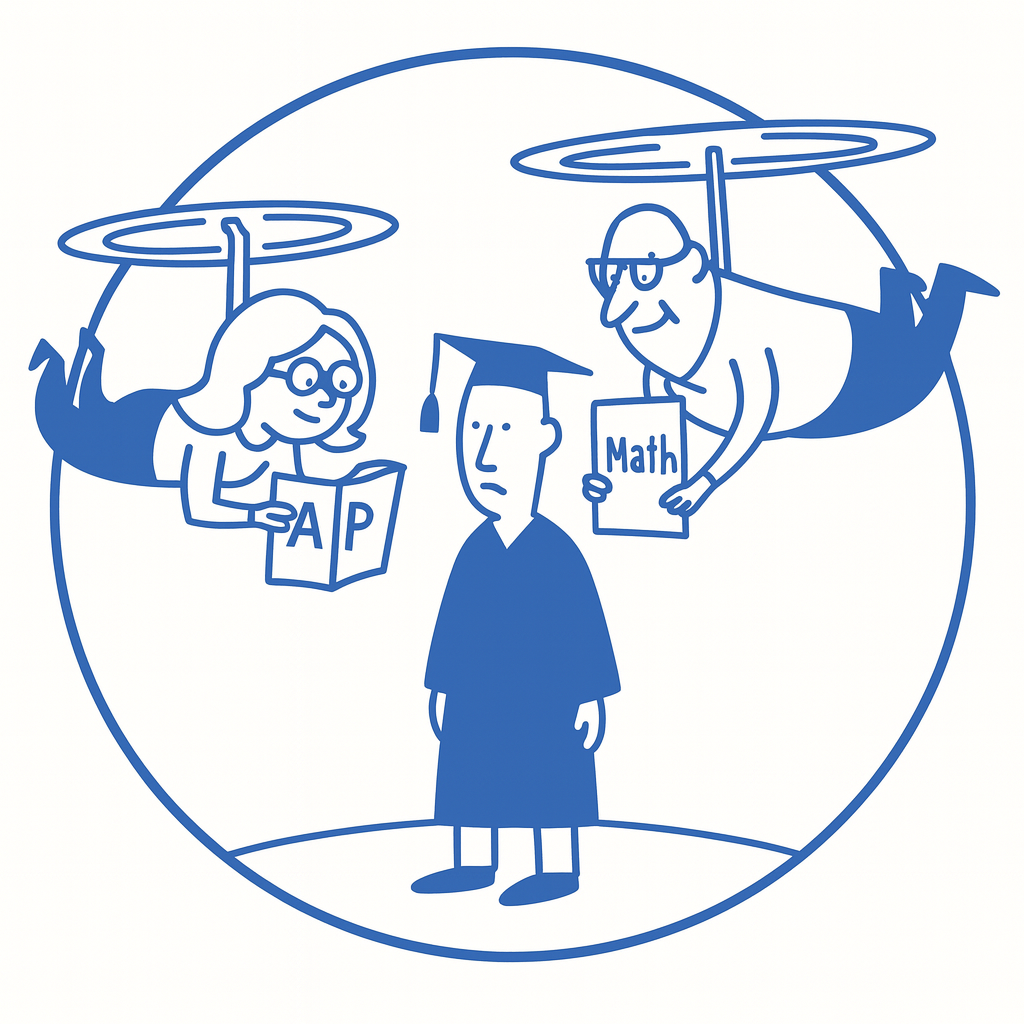
- Is This the Same as AP Calculus?
- Are These Computer-Based Courses?
- Are These Online Courses?
- Financial Aid?